Esoteric Ebb review

I have heard Esoteric Ebb described as Discworld Elysium, which is useful to give you an initial sketch. It's a tale of political intrigue amongst rival factions in a city about to boil over, as you, a hapless detective, find yourself in the middle of an investigation that could change everything. But, crucially, it's all fantasy themed and it's really funny. It's not as funny as Pratchett, mind you. But I'm monstrously protective of the man and his work, and am tempted to dock points from anything where people draw a comparison, out of spite. So maybe it is as funny as him; it's certainly much funnier than most games that try to be funny at all.
You're gallivanting around Norvik, a place with a map larger than you'd think, art more beautiful than you asked for, and a soundtrack better than you, you lowly sinner, deserve. Norvik is a human city days away from its first ever election. An already fraught situation was enfraughtened further when a local tea shop exploded. It was a) the meeting point for local radicals and b) on land that belongs to the city's goblins. Because, oh yes, Norvik was founded on goblin land, and of course the humans did a bit of genociding. We deigned to give the remaining goblins a bit of Norvik, albeit mostly underground.
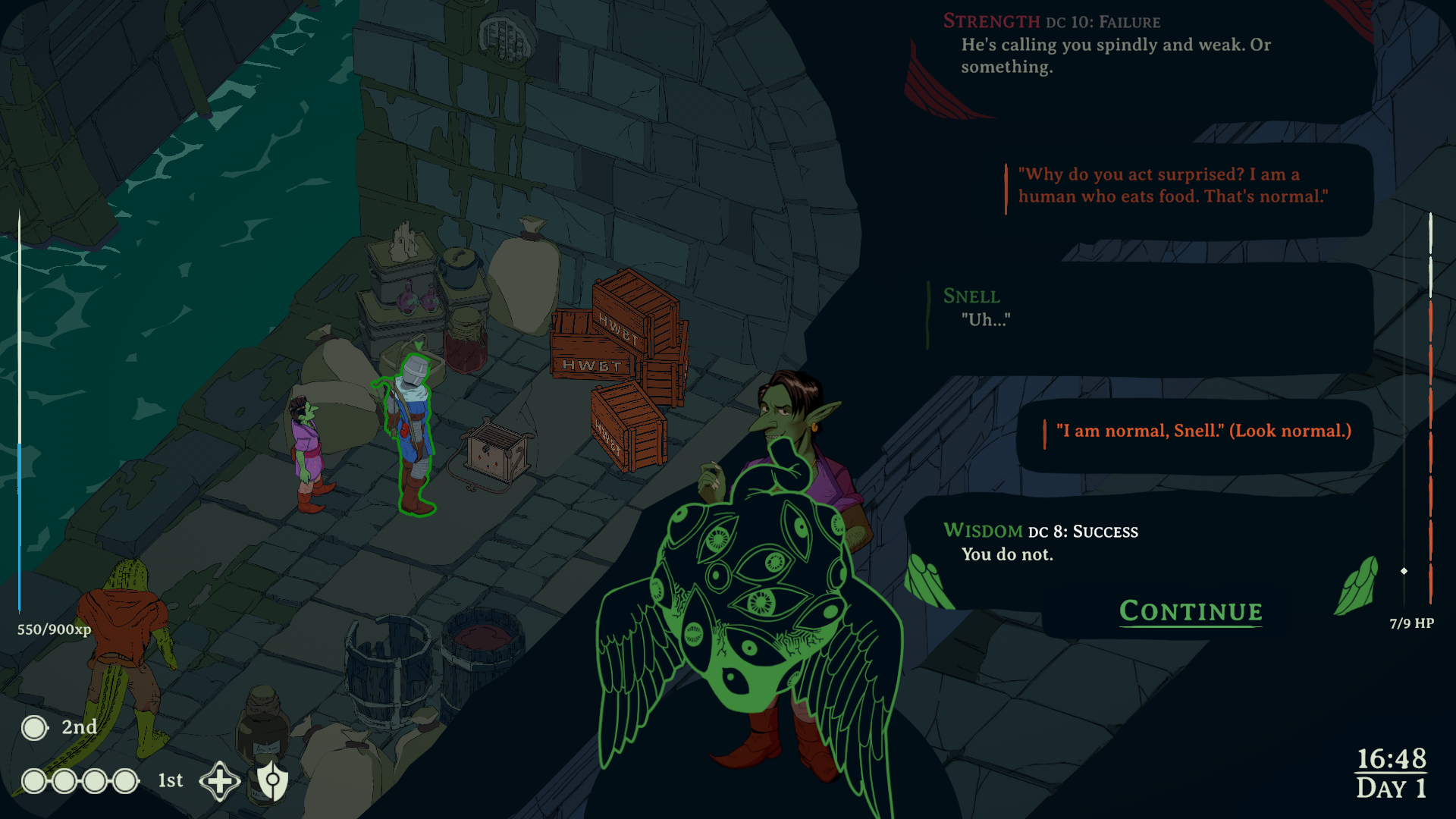
Anyway, the goblin leader has demanded a full investigation of the exploded tea shop. Enter onto the scene: you, the worst Cleric the city has to offer, whose only saving grace is that he is inexplicably really good at learning spells. Someone pushed you in the river as soon as you arrived, and you wake, resurrected, at the local mortuary. You have five days to solve the tea shop thing, and are accompanied in this task by Snell, a goblin hunk keeping an eye on you. He's a rogue; you can will your class into existence by saying it out loud often enough.
You will find Esoteric Ebb much more funny if you've played any D&D in your life
My interactions with Snell were the greatest source of humour. You, as the player character, are conforming to standard behaviour in a video game; you stuff your face full of apples to gain +1 HP each time, and rummage through bins to find useful items (possibly more apples). Snell will look at this behaviour and go: that's pretty weird, man. You know how The Last Of Us Part 2 made you kill a dog and then was like, 'Wow, you're kind of a dick?' Esoteric Ebb does that a lot, but to create fun. At one point Snell said he'd assumed I wasn't really a foodie because he'd only ever seen me eat apples, and I laughed for a full minute. Much of the supporting cast is also playing the straight man to your flailing idiot. It is very funny to see a sphynx indulge you as you talk about your obsession with quests, or stare at them for 5 minutes while listening to your internal voices.
Because, yeah, the largest influence is Disco Elysium, in the dialogue taking up the rightmost third of the screen, the prevailing theme being literal politics, and your stats talking to you. These stats, though, are cribbed from Dungeons & Dragons. This puts me in something of a bind, because you will find Esoteric Ebb much more funny if you've played any D&D in your life, but as a decade-plus veteran of the world's most famous TRPG I cannot recommend that anyone play it. Still, a passing familiarity at least is essential to getting the in-jokier in-jokes, if not for understanding the combat.
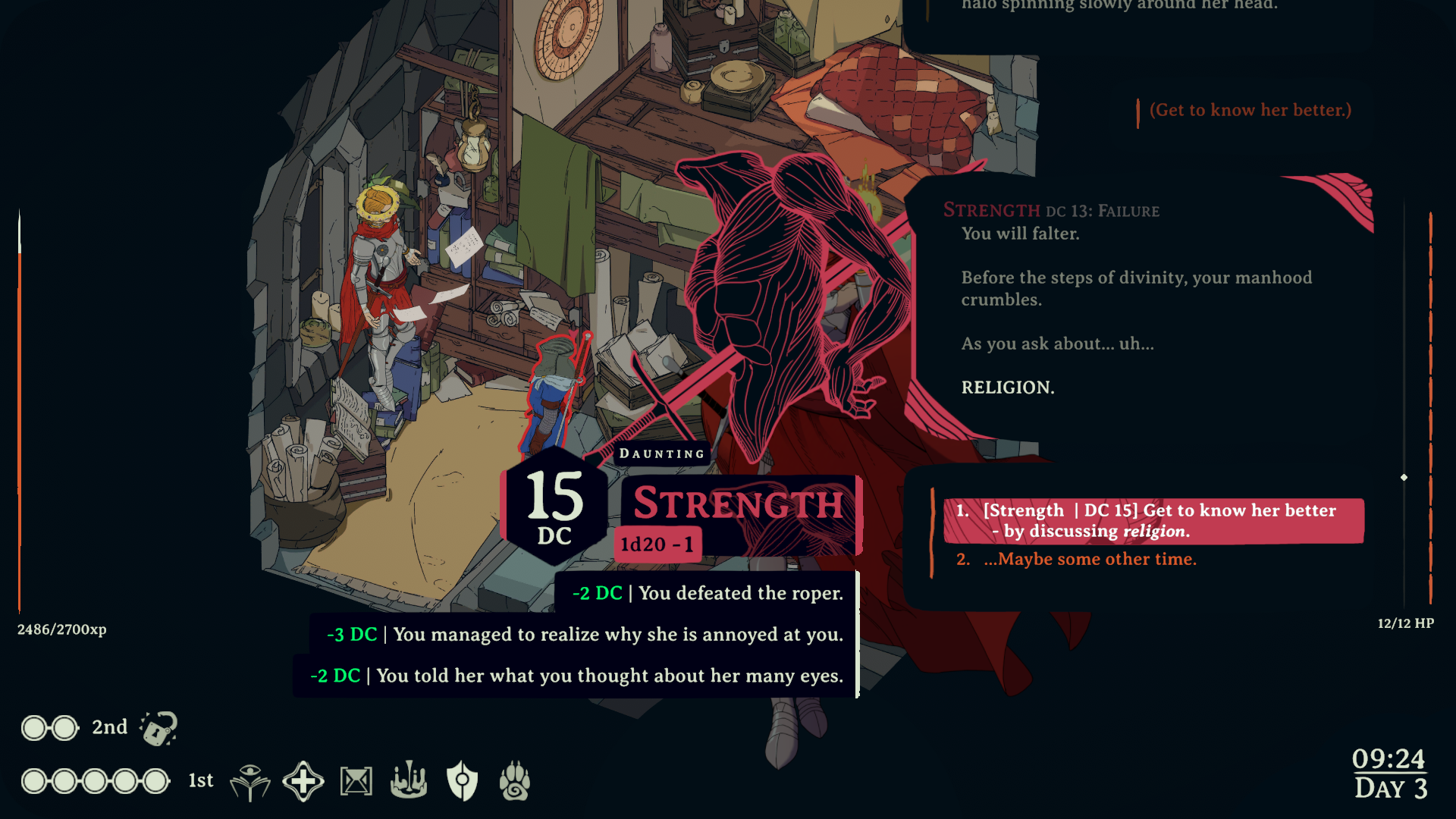
You get to put skill points in Strength, Constitution, Dexterity, Wisdom, Intelligence and Charisma. The higher your points, the greater a modifier you get when you roll a D20 against one of them. So, you might be prompted to roll dexterity to avoid a trap, with a difficulty of 14. You roll a 13, but luckily you have a 15 in your dex., giving you a modifier of +2 to your rolls. So you pass! Alternatively, if you specced to be a bruiser you might have a negative modifier of -3, so you lose, but even more! You can add to these modifiers with gear, as well, and completing quests will give you the choice of a thematic Feat to take. These are passive abilities that might enhance all your gear, or heal some HP every time you ask someone how they're going to vote in the election. They can stack in a very satisfying way, so by the end you feel a lot stronger in combat than you did at the start.
Wisdom is socialist, Strength is fascist, Dexterity is a free market capitalist
But combat isn't a series of turns where you attack with your sword and then the skeleton attacks with its sword and then Snell uses his sling. Instead, you'll be grabbed by an eldritch monster and are presented with options. Do you squirm away with Dexterity, bust out with pure Strength, or will Intelligence identify a big glowing weak spot on this bastard? It neatly avoids the most annoying part of D&D, which is the combat, but it does mean that sometimes there are no great options, especially early on. I spammed F5 constantly not because I was save scumming, but because any encounter could end in an ignoble death and reload.
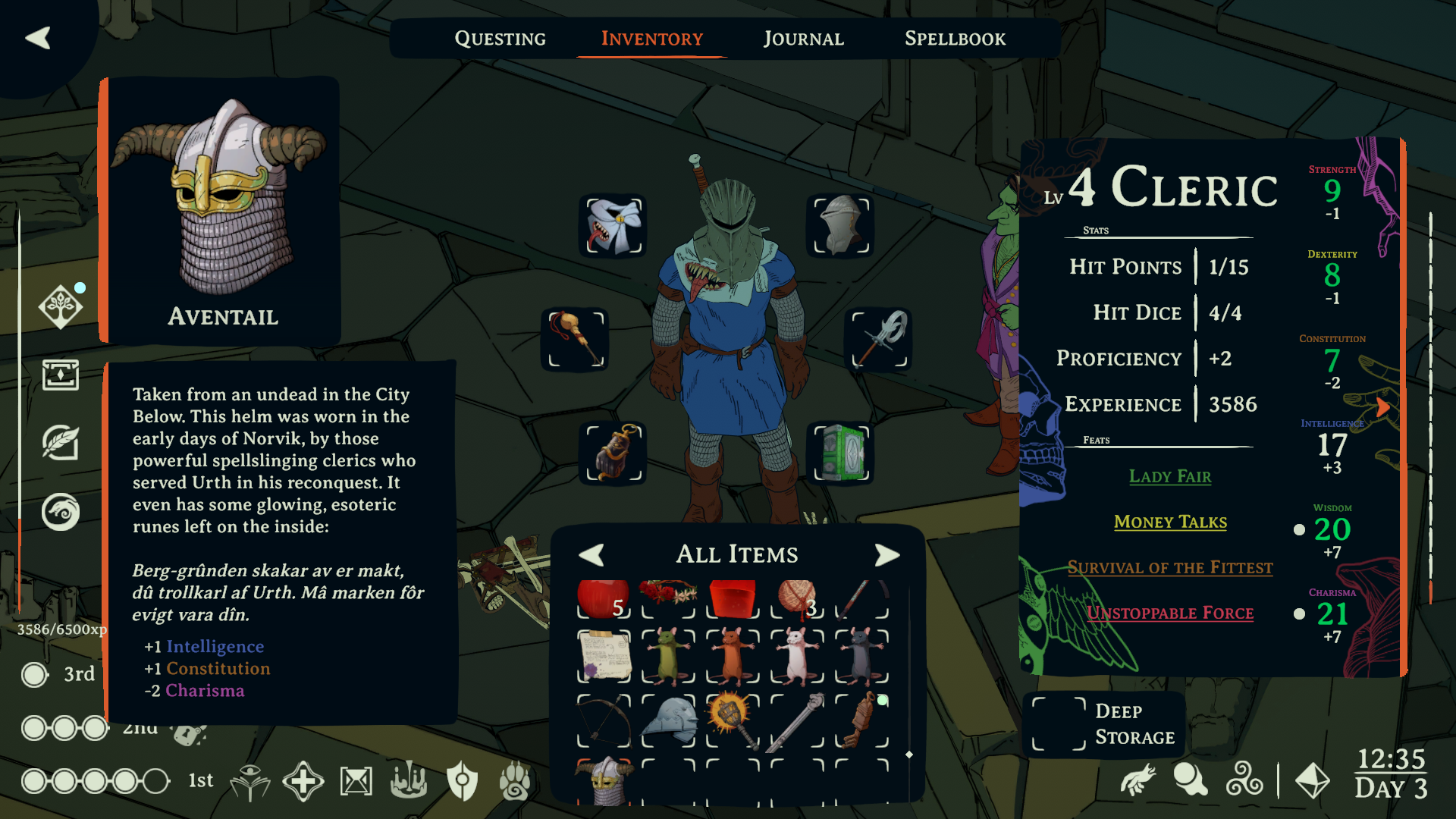
But even outside combat encounters your stats will chime in with more, or more useful, things to say if they're higher specced. They can give you a steer, and have a few jokes as well, though I didn't find them half as fun as the supporting cast of ghouls and giant seagulls. Largely they provide context on the world, as well as having political leanings themselves. Wisdom is socialist, Strength is fascist, Dexterity is a free market capitalist (I suppose because you use Dex to steal), and so on. Each will push you toward voting a different way in the election, which features political parties roughly analogous to ones you'll recognise in real life.
A bunch of dwarfs who went through a bloody revolution and rally for better rights for the working classes, you say? Some Norvik supremacists who hate immigrants and attract unemployed young men? Outwardly libertarian free-trade enthusiasts who turn out to be financed by literal golden elites? Who am I to trust? Well, nobody, obviously. Except, actually, some of them. The game is at great pains to show nobody is infallible, up to and including your literal god, while also clearly having its own opinions (ah, there's that Disco Elysium again).
As with Disco Elysium I found the parts where an NPC delivers a party political broadcast to be the least engaging bits of the game, although here at least you know it's in service to something fun happening again in a minute, rather than more abject misery and/or self-loathing. Not that there isn't self-loathing and misery here, but there's a lot more jollity going on around the new world struggling to be born. One of the first characters you meet is a telepathic ant who requests that you carry him back to his hive mind, deeper in the caverns. There's a lich in disguise and a mimic with anxiety. Dance well enough for the Goblin leader and you get a flower crown. If you bother your arse to nearly die climbing a windmill, you will in fact be rewarded in a pivotal way later on.
Esoteric Ebb is unashamed about being both silly and sincere
Because the other thing, the secret real thing about Esoteric Ebb, is that it isn't an RPG, it's a puzzle game. For all that you can decide you're a Rogue by telling people 'I'm a cool sexy Rogue' a lot, your main USP is being able to instantly memorise spells. The spells are solutions to the game's puzzles, big and small - one pivotal one is being able to speak to a corpse - and finding the spell scrolls in the first place is also a puzzle.
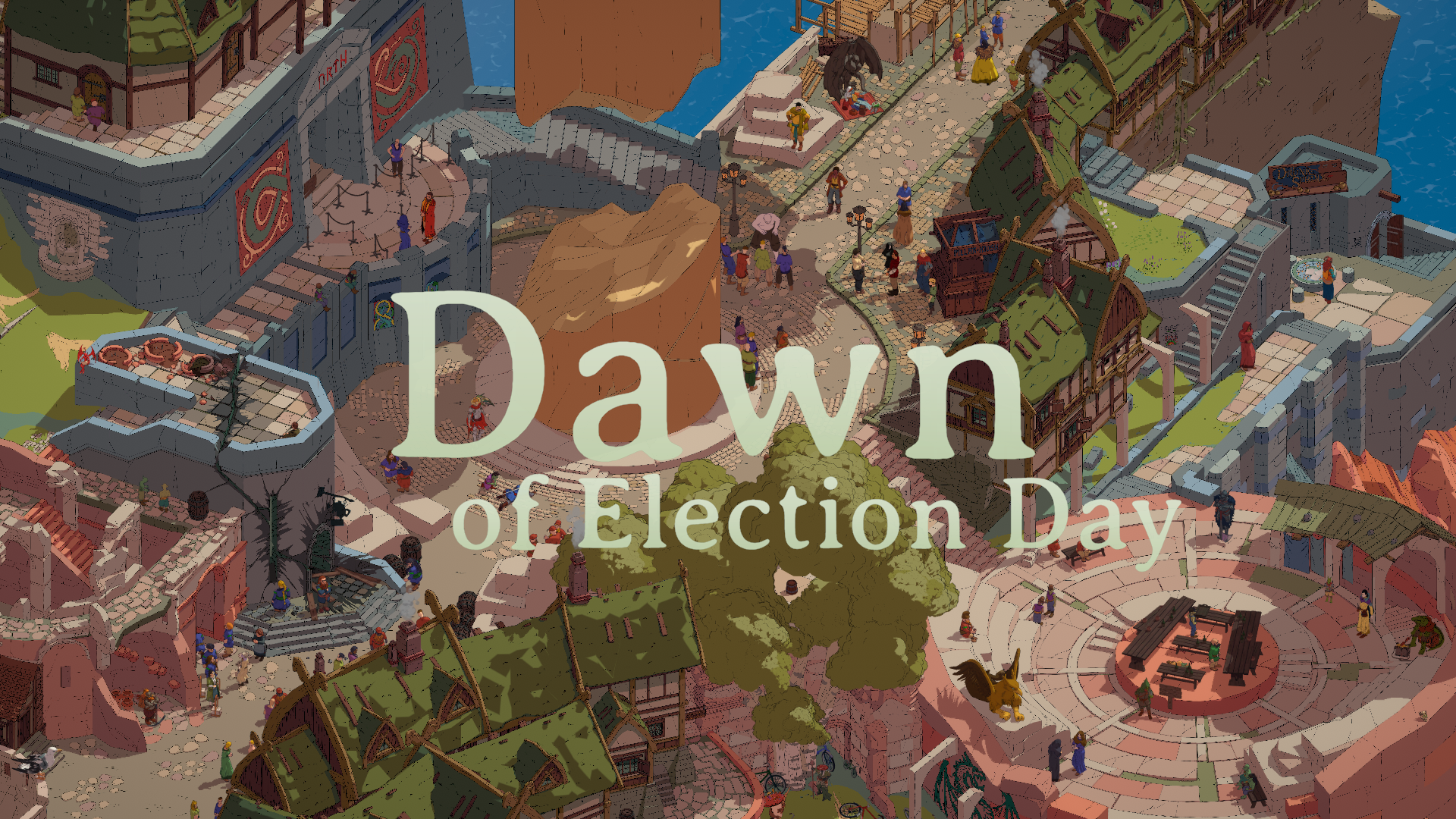
Sometimes the reward is something silly, like being able to say hello to a crab and it tells you that it's having a great time being a crab. And sometimes the reward is being able to defeat a troll more easily. I went rummaging around and found a spell to conjure an oilslick, which I did in a very important battle just because I thought it would make the enemy fall over. I had not done it in the expectation that he would set himself on fire because he had a burning weapon. But he did! And the game design is very clever in its scope because you can only cast your spells, which are in any case governed by the D&D spell slot system, when the game thinks there is a point to it.
I loved that about Esoteric Ebb. It's very freeing to have some guardrails you can trust. I haven't even had time to mention how it sort of un-metas the very concept of seeing probabilities and dice numbers on screen. I loved how smart it is. And I loved, too, that Esoteric Ebb is unashamed about being both silly and sincere. The cleric you play as comes with a set backstory and you get a few little glimpses of it, and by a feat of good writing it makes sense whether you play as a bleeding heart or a prick or somewhere in between. The game ends exactly how you expect it to, which isn't a bad thing. And I cried.


Comments ()