Screamer review: we don't give scores but this is one of those sevens
The original Screamer was the first racing game I ever played on PC. It was heavily inspired by Ridge Racer, but I didn't know that at the time. I just knew that me and my two older brothers were all competing in the same game, a rare occurrence given the age gap between us. Even in permanent third place on the time trial leaderboards, I was thrilled.
It didn't last. By the time Screamer 2 and Screamer Rally released in '96 and '97, my brothers had mostly moved on, and I played them alone. I remember being disappointed, unable to recapture the spark of excitement that I'd felt competing in the original. It would be foolish to blame the games for this, although maybe it did make a difference that I'd played actual Ridge Racer by that point. I think I'd instead be wiser to accept that the original Screamer wasn't a great game either, but that sometimes, games don't need to be great; they just need to arrive at the right time, for the right person. Enter Screamer (2026).
If Screamer lacked its own identity in the '90s, this unlikely reboot is an attempt to finally claim one. Instead of taking its cues from Sega's AM2 racers as the original did, the aesthetic here is urban, cyberpunk and anime, with a prominent story told through cutscenes and visual novel dialogue seemingly inspired by death games, Redline, and many anime shows. It sometimes feels like Dispatch with arcade racing in place of any other minigame.
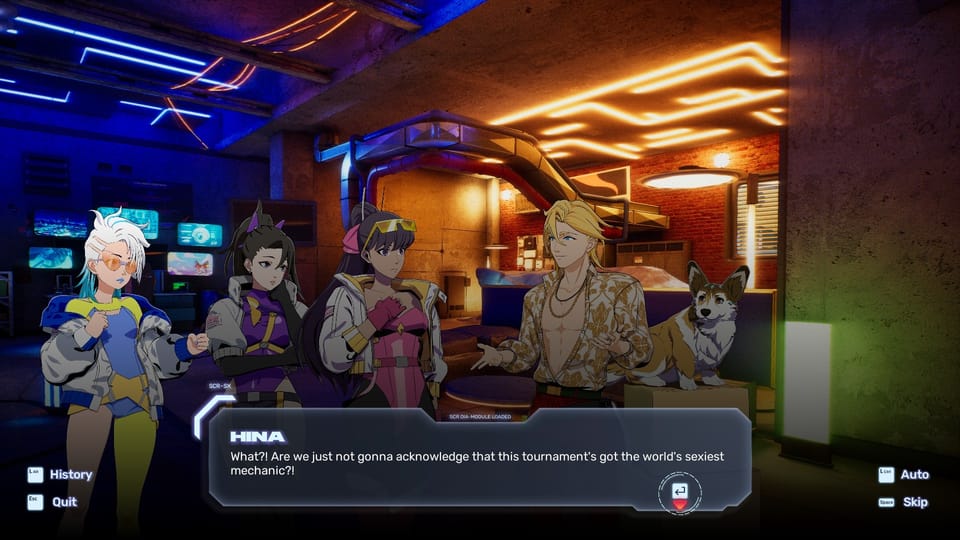
Screamer deftly introduces a vast cast of characters, who race in teams but who each have individual motivations for entering the Screamer tournament beside the 100 billion dollar cash prize. Hiroshi, Roisin and Frederic have entered because they want to murder German suit Gabriel as revenge for the killing of their boss and mentor, Quinn. Gabriel has entered the tournament because he's the scion to a corporate behemoth and his mother is threatening to disinherit him if he doesn't prove himself. Aisha wants to investigate the death of her boyfriend James during a mission to space - and popstar Ritsuko is entering for the same reason, though none of James' friends seem to acknowledge she exists. The entire tournament is orchestrated by a mysterious masked Mr. A, whose motivations are even more science fictional than you're already imagining.
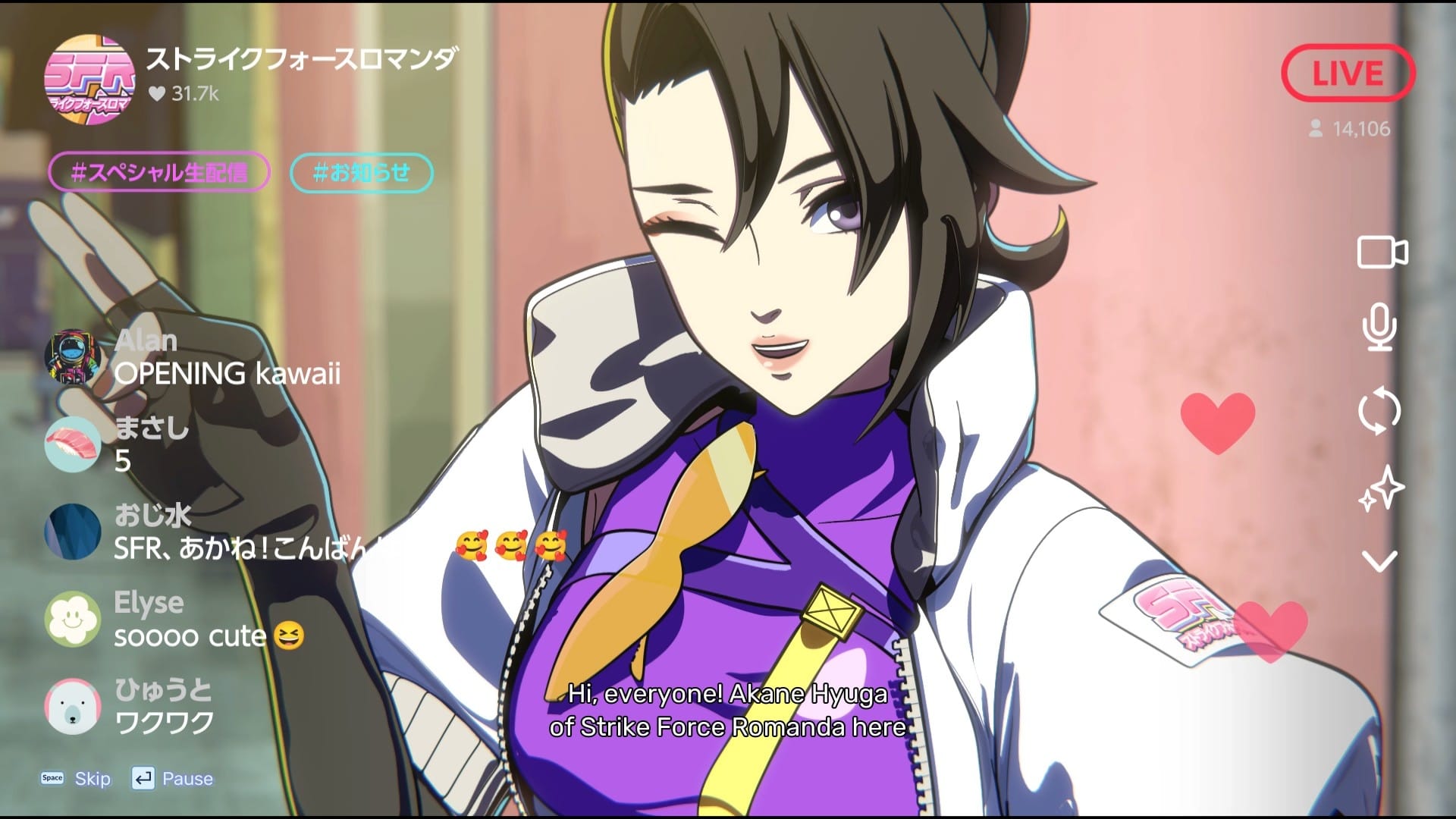
This all works as well as it does in part because there's no single player character, with each race dropping you into a different cockpit - although Hiroshi is the clear audience insert, somehow simultaneously an anime ingenue boy and the newly elected leader of a private military company. The perspective-switching means you get to witness the humanity of the full cast, even the obvious villains, and no one of those characters needs to be oriented towards the player as quest giver, exposition deliverer or emotional proxy. They all have their own wants, a basic tenet of good fiction writing that most games nevertheless fail at, and the personal conflicts this generates between characters meant I was instantly, unexpectedly hooked.
If it seems odd to focus so much on story in a review of a racing game, that's only an indication of how substantial the story is to playing Screamer. The story-driven (is that a pun?) tournament mode is also where you should start because it is extremely gradual in introducing the peculiarities of Screamer's driving - and it is peculiar.
This is a twin-stick driving game, for a start, in which left stick steers and right-stick flicks your bum out. This means you don't need to brake into corners to trigger a drift, although it'll take some getting used to if you've never played games like (the similarly anime-inspired) Inertial Drift.
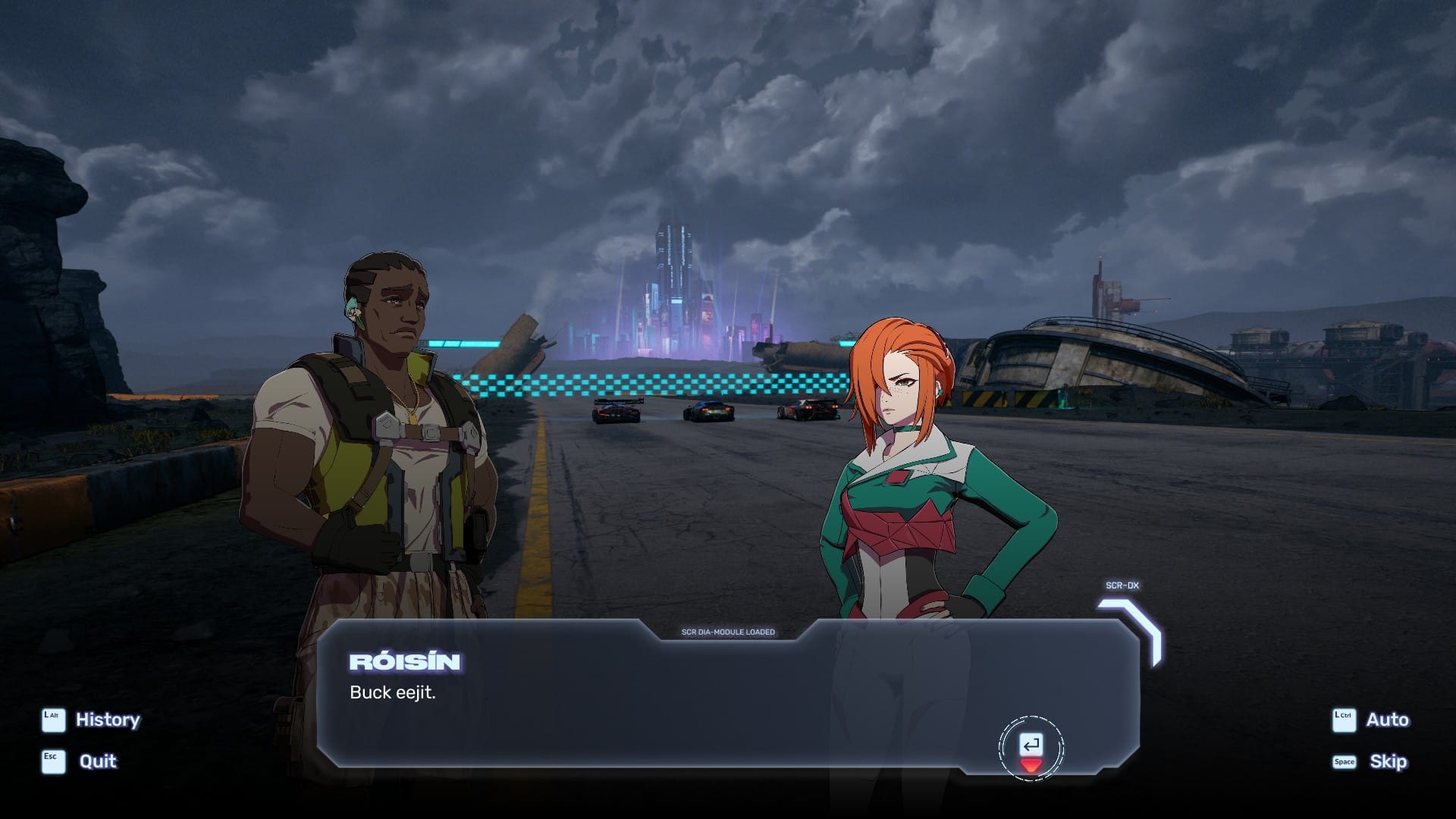
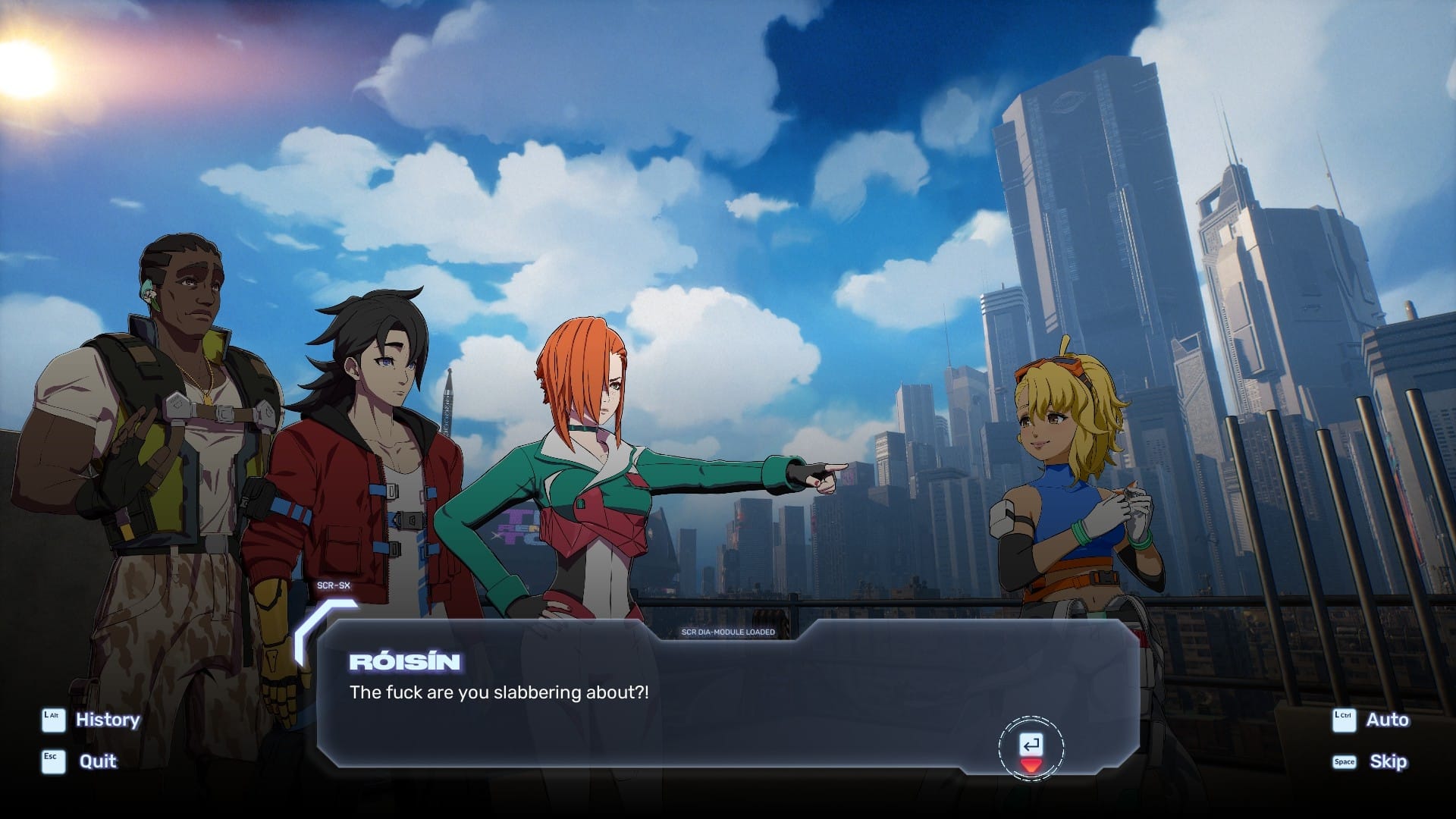
Róisín is Irish and I can confirm this is exactly what it's like being in Jank meetings with Brendy.
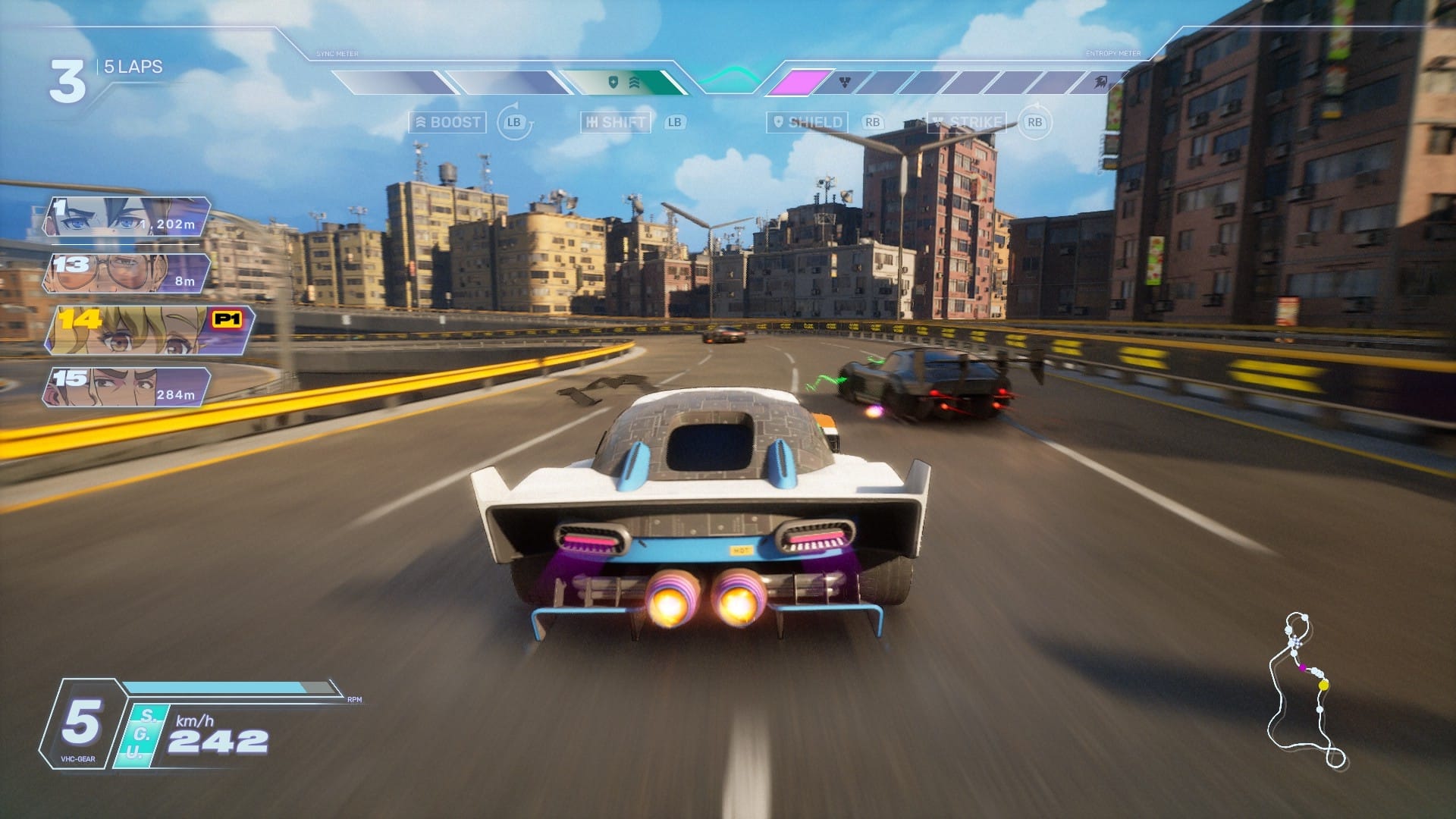
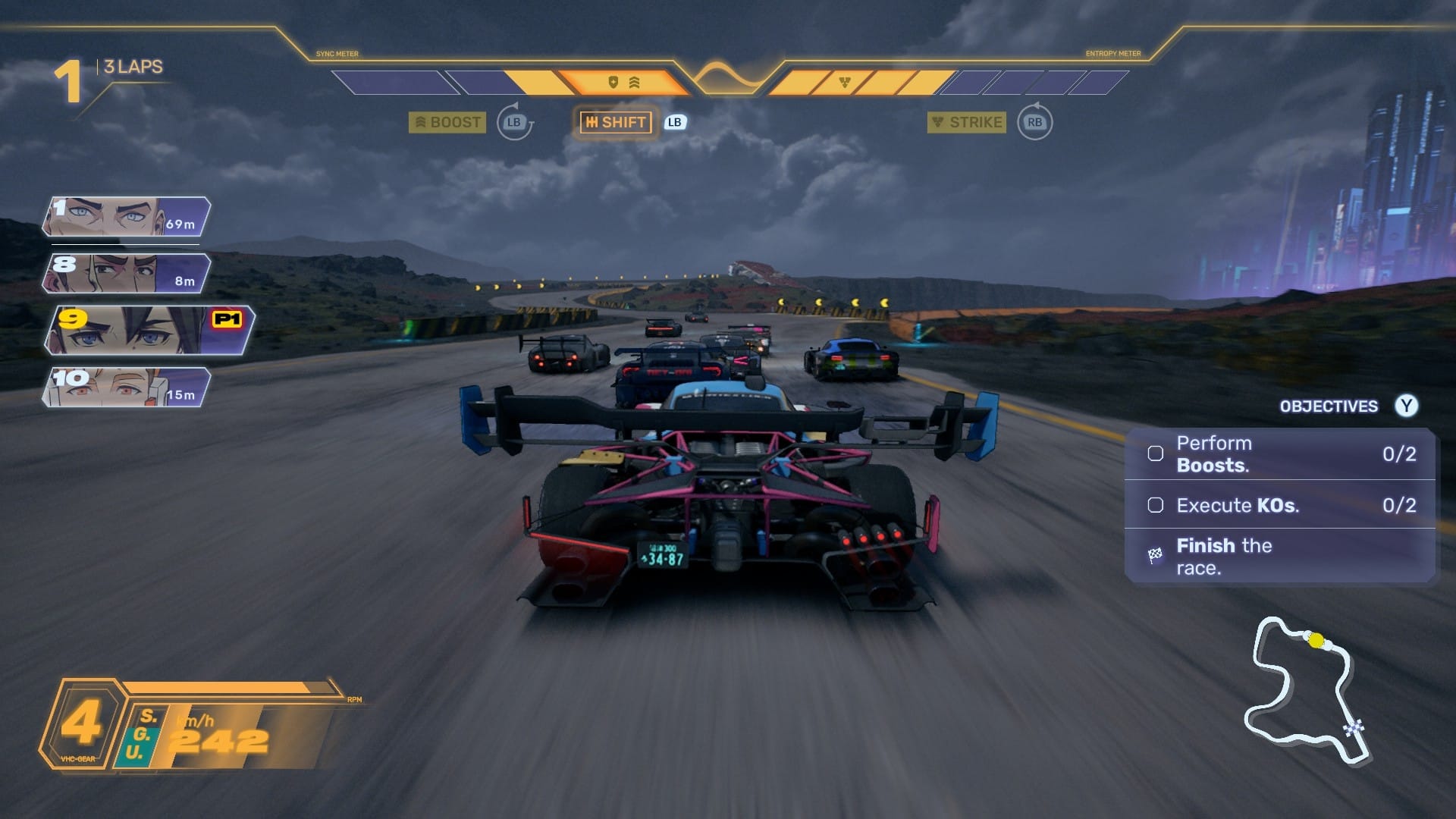
This is just the start. Your car will shift gears automatically, but you can press LB at the right moment to do it manually and gain a boost of speed. This also builds your boost meter, which can be triggered via a Gears Of War-style active reload for a potential "perfect boost". You'll also, eventually, be able to perform a Strike move which allows you to ram and explode your opponents, and an Overdrive, which turns your vehicle into a rocket that, while quick, will explode after the slightest collision. Finally, there's a shield move, which if triggered with perfect timing, can deflect anyone who is trying to use Strike on your own rear.
If that sounds like a lot, that's because it is. It takes the story over five hours to introduce all of these abilities, and thank goodness, because when it does you'll be using all four triggers and both sticks, sometimes tapping, sometimes holding, while scanning the UI for timing prompts as you simultaneously hare around a race track, trying to both win the race and complete objectives like colliding with specific opponents.
At its worst, it feels like trying to resolve QTEs every few seconds while still, ultimately, playing Ridge Racer, but it's not without purpose. In plot and actual systems, it feels like the designers asked themselves, "What kind of racing game would be called 'Screamer'?" and then worked backwards. The result is a game that wants you to drive aggressively, to slam into walls and other drivers and simply boost through it, and it makes the connection between your car's abilities and your racer's emotions increasingly explicit as the story and systems pile up.
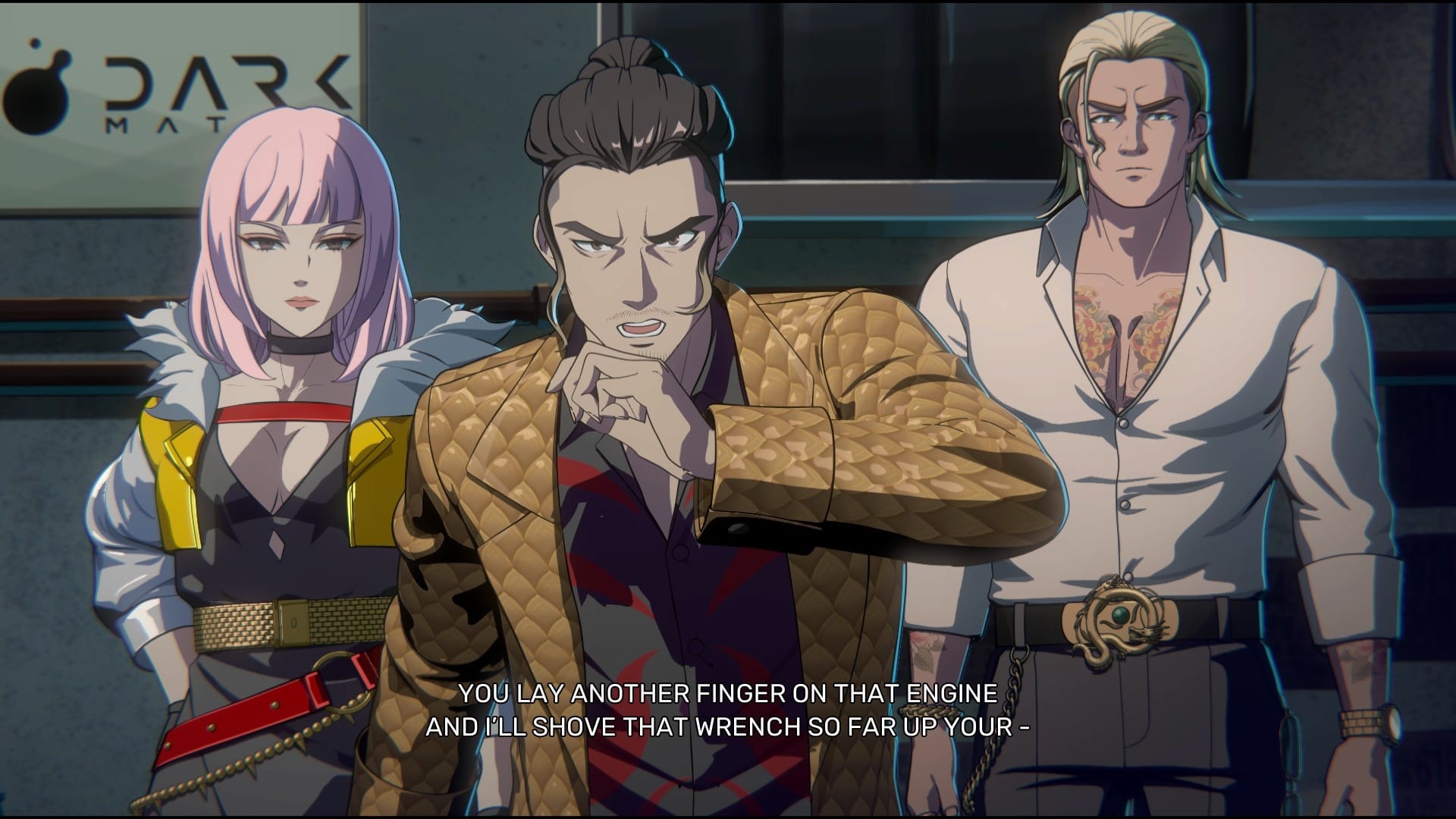
I won't spoil anything, but early on you learn that each of the vehicles in the tournament is equipped with an "Echo", a device that allows the cars to explode and then instantly reset without the driver inside being killed. This is the invention of Gage, a mechanic who can talk to his dog, because he hacked his universal translator, something every character has in their brain. That device otherwise allows the entire cast to be voiced in their native tongue, meaning cutscenes are often a mixture of English, German, Italian, Japanese and more, with subtitles for those of us without universal translators of our own. This presumably saves the production team from needing to hire a full voice cast in each language, but it also enhances the flavour of the entire story while still making dialogue scenes feel natural. I wish more games did this.
I feel out of breath trying to describe all of this, but I think it's important because Screamer could easily be dismissed as "an arcade racer with a story", when I think it's taking bigger swings than that suggests. The story is strange and surprising, and so is the racing. I want people to give Screamer its due for what it attempts, and I particularly want people who have never been interested in a racing game before, but who love narrative games or anime, to consider it.
Yet this isn't isn't a full-throated recommendation, either. For one, there are other, better arcade racing games to play. All of Screamer's innovations are fine, but I'm not sure any of them are an actual improvement when compared to more traditional control methods or systems of boosting and combat racing. I also wish it was less difficult on both its balanced and its easier, story-focused difficulty modes, so I could truly put it in front of people who don't play racing games. Likewise, the story, while it starts strong and surprised me with its characters, struggles to maintain momentum or to follow through on all the personal stakes it establishes, and the ending feels rushed.
Screamer (2026) isn't a great game, then, but it is an interesting one, and I didn't regret playing it. At the right time, for the right person, I think you could love it.


Comments ()