
Peak

Three game devs climbed a mountain - epilogue

We've Peaked

So all of my interview subjects died. Big deal. We learned some things along the way, didn't we? Back in Peak's lobby (a cartoonish airport you can play around in) the developers and I have a debrief. Is there anything they've learned while playing Peak - apart from the fact that having friends is fun?

"Don't work on a game for five years," says Bennett, referencing the fact that Peak was reportedly made in just a few months, yet has sold a huge number of copies.

"Yeah," says Holly, "that's a big one, honestly... it shows how you don't need to spend a huge amount of time if you just go in with a really simple premise and kind of extrapolate your idea from there."

"Yeah, do a little less," laughs Bennett.

For a full list of articles in this series - click here

What do they think of the game itself? What's interested them most about it?

"I think it's really interesting, especially in multiplayer, if I look at the 40 minutes we've played, we've obviously climbed, but also I've been fed,

Three game devs climb a mountain - part 7

Ain't no mountain tall enough (except this one)

I wait around at the bottom of a tree for Bennett Foddy to scramble up the bark, desperately looking over my shoulder for undead threats. I would like the game designer and noted moral philosopher to climb quickly and offer me a hand from the platform above. But he has circled back to a question I asked some time ago about resource management.

"For Baby Steps," he says, climbing painfully slow, "at some point we must have decided we didn't want resource use, but I don't know why. I think partly it's because we got so allergic to implementing UI... and that makes it really hard to have resources."

Bennett climbs a tree as Holly's ghost watches on.
Okay, no, yes, of course, but also: climb faster please.

Bennett runs out of stamina and falls from the tree. He is lightly hurt. I hear zombie noises nearby. I put down the heavy, unconscious body of Emeric Thoa for a moment (I'm sure he'll be okay) and try to climb the tree myself.

Beneath me Foddy continues to talk about user interfaces and how they can get in the

Three game devs climb a mountain - part 6

Cannon Foddy

"This is a thing that roguelikes and climbing games have together," says Bennett Foddy, completely unfazed by how close to death we are. "Which is that you carry the things that go badly for you. You carry them forward into your run, right?

"There's that thing that roguelike designers talk about. About how a roguelike can be 'flexible' or 'inflexible'. If it's flexible, it means that you can always turn it around to your favor and do your preferred strategy. And if it's inflexible, you have to roll with whatever happens in the randomness. And this one feels like we have to go with whatever happens, right? But I think that's maybe typical of climbing games."

What has happened is that we are all exhausted, poisoned, starving, and injured. I don't know how "flexible" or "inflexible" the others feel, but I do not feel particularly well-treated by the game's dice rolls. Holly stops us on the next ridge.

"I have an item," she says. "I don't quite know what it does. It's called Pandora's lunchbox."

There is a ripple of sound

Three game devs climb a mountain - part 5

Getting to the root of the problem

Bennett Foddy thinks his friends might be dead. We call down to the forest floor from atop a mossy boulder and wait to see if either of our co-op climbing buddies respond.

"Yeah, sorry guys," we hear Emeric Thoa speak up. "I was being rescued by Holly because I died or fell or passed out. I don't know... I was witnessing the whole thing from my dead body."

Missed some of this series? Click here

Emeric is not dead, thankfully. But he is badly ill. Spore blasts and falls have taken their toll on his big-headed orange body, reducing his stamina meter a lot. This is where Peak's many items and gizmos may come in handy. Bandages will heal wounds, for example, while others might help with ascending unscaleable walls, such as the small circus cannon Holly Jencka has quietly stashed in her backpack. It's a familiar concept to these bleeding, aching game designers: resource management.

Holly and Bennett wander around on the mossy rocks, with Emeric out of sight.
If you take a moment to look at my health/stamina bar you will notice maybe things are not going so well.

"There is a little bit of that in Cairn," says Emeric,

Three game devs climb a mountain - part 4

"I don't know if coming up here was the right call, gang."

We finally reach the summit of the first mountain. Holly Jencka, Emeric Thoa and I gather by the fire as Bennett Foddy talks about random generation and orthodox versus unorthodox game design. You can tell this man is a professor. I feel like I am getting a university class for less than the thousands of pounds of debt it would otherwise cost. I forcefeed him a roast marshmallow but he keeps talking. 

Meanwhile, Holly charges towards the Roots. This is Peak's newest biome, a dense forest of spiders, poisonous mushrooms, exploding spore pods, and other fungal threats. I follow dutifully, asking more questions as random gusts of wind whip through the canopy.

New to this series? Click here

The geometry and layout of every island in Peak is procedurally generated, which means some might be wildly more tough than others. Again, this devotion to randomness is something the three developers haven't necessarily pursued.

The three Peak players look toward a giant toadstool and a green vine that will get them across to it.
Just a simple vine rope to the next mushroom. Simple.

"When we started [with White Knuckle]," says Holly, "we considered: do we want to do fully procedural level generation? But it is really quite difficult. People think

Three game devs climb a mountain - part 3

They still haven't eaten each other, at least

Holly Jencka stuffs girl scout cookies into Bennett Foddy's mouth. She turns and marches on, looking at a rickety-looking rope bridge ahead of us.

"Okay," she says. "We should only do this bridge one at a time... because they have a tendency of collapsing."

We make it over one by one. If we'd tried crossing all at once the bridge would possibly give way under the combined weight of our cartoonishly large heads. It's good to have Holly here, someone who has played Peak more than the rest of us. But this kind of high-stakes multiplayer camaraderie, sometimes lovingly referred to as "friendslop", isn't actually a factor in the games created by these developers. They all make single player stuff. That means their own games feel quite different.

Missed previous entries? Click here

"That sense of isolation adds a lot to the somber mood I think a lot of climbing games have," says Holly. "This game, you don't really feel it, because you're goofing off with three other people but... I think any of the games all of us have made you get this melancholy at points, as you look out over everything

Three game devs climb a mountain - part 2

"I would never do climbing for real"

In Peak, you reach out your hands to grab onto surfaces. Holding left click against a wall or a tree sees you climb, but your stamina bar will drain quickly. Thankfully, players can offer an arm to hoist up a fellow climber in a difficult spot. You'll need to boost and help each other out a lot to reach the summit. It's a good thing the three game developers I have roped into this horrendous jaunt seem to be good at working together.

"I think when you talk about climbing, you're talking about a very strenuous sort of activity," says Holly, plucking fruit from a shrub growing on the side of a cliff and pocketing it for a future snack. "You're talking about this very physical thing. And giving your player character a physical body that obeys some rules of reality helps the feeling of climbing become more real in a sense, right?"

Missed any of this series? Click here

Over the course of a climb in Peak, your stamina bar will become afflicted with all sorts of clutter that reduces how much energy you have - injuries, burns, sleepiness - all reducing how much

Three game devs climb a mountain

It's your turn to get over it, Foddy

"So, I assume the task is to climb that giant peak up there."

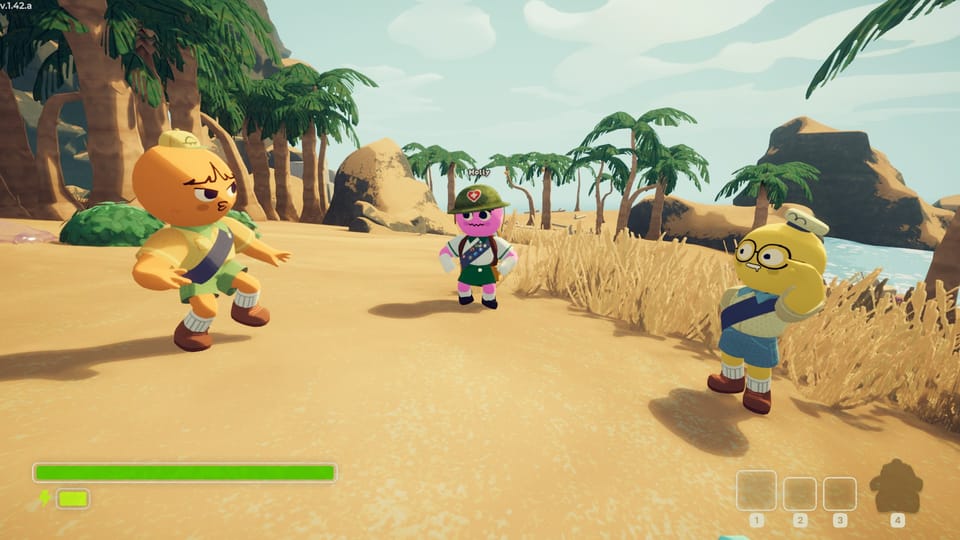
I look at the mountain and tell Bennett Foddy he is correct. The creator of Getting Over It and co-developer of Baby Steps has agreed to my unusual journalistic request. He must conquer a mountain in co-op climbing game Peak and answer my questions while doing it. And he won't be ascending alone. With us on the beach at the foot of this mountain are two other hardened developers of climbing games. Holly Jencka, lead developer of urban clambering sim White Knuckle. And Emeric Thoa, creative director of sci-fi alpine sim Cairn. They are currently rummaging through suitcases and collecting coconuts. I don't say it out loud but I have a strong feeling none of them will survive.

After messing about on the beach for a few minutes, I tell the trio they're "on their own". I'll be following, but mostly hanging back and asking questions. I want to see how three developers of climbing games will manage when faced with a mountain not of their own making. Maybe we'll uncover gems of game design wisdom along the way. Maybe we'll just plummet to our doom.
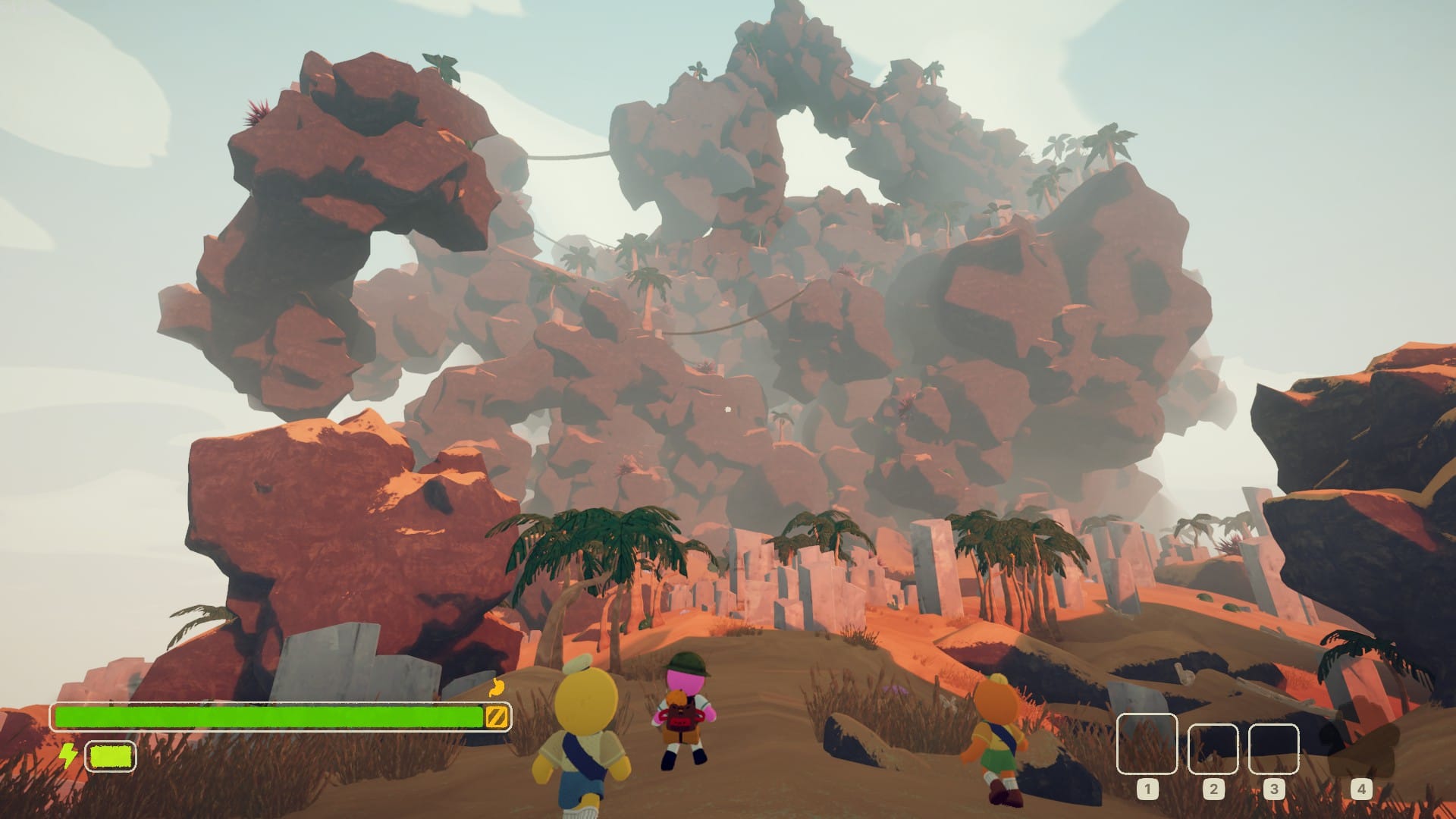
Three players stroll towards a twisting and rugged looking mountain.
Peak