
The Jankword No. 1
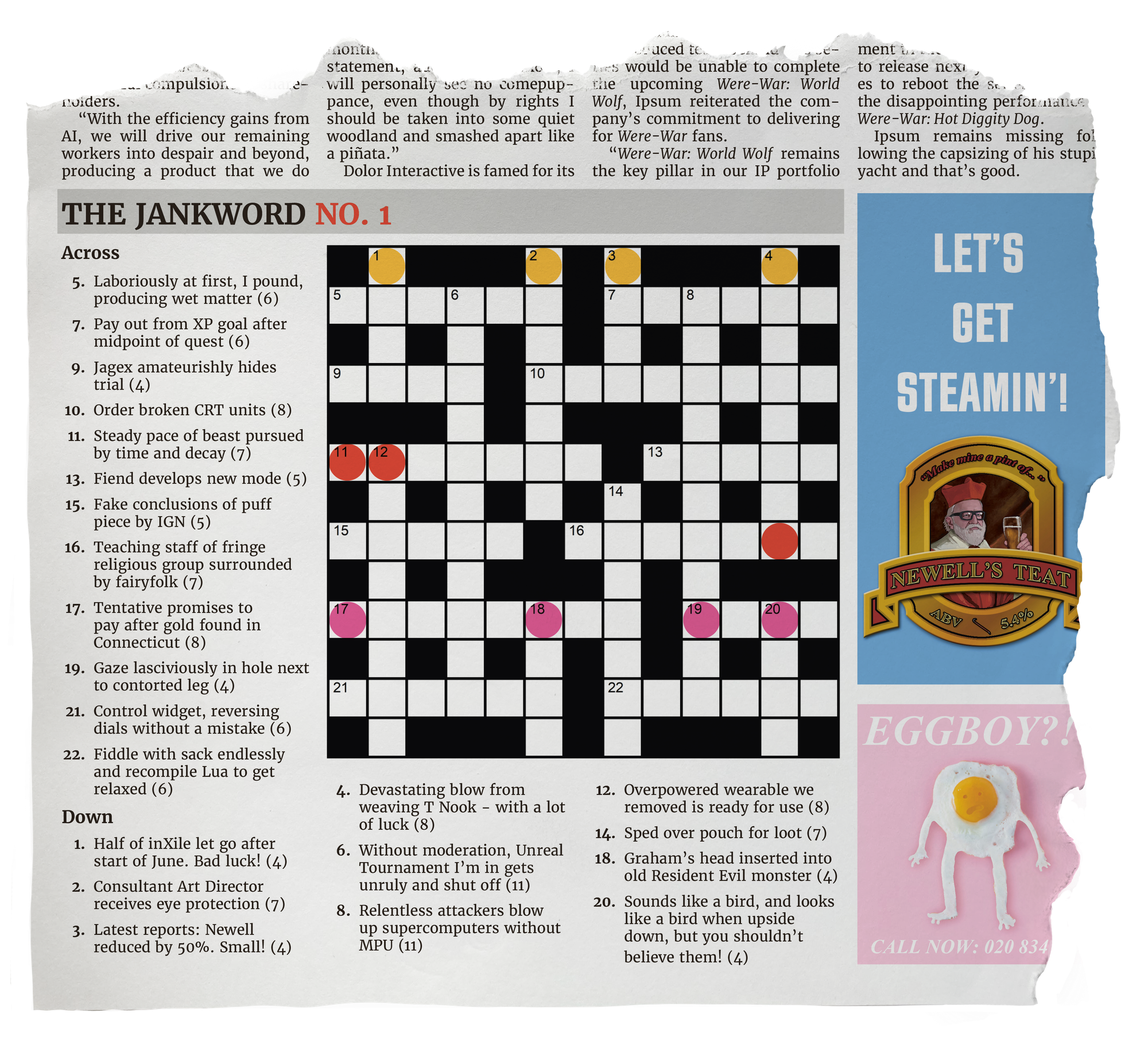
Cryptic crosswords are one of my favourite things in this entire world. They are also, I accept, total bullshit. Each clue is not merely a riddle, but (usually) a series of coded instructions on how to assemble the answer from fragments of words within the clue itself, synonyms, anagrams or abbreviations—much of which cannot be intuited, but only known, often drawing on conventions established in previous centuries, by vicars or retired sergeant majors, sometimes about things that no longer exist. Cricketing abbreviations feature very heavily. Allusions to political figures who died in 1967. Military and ecumenical shorthand. To the uninitiated, this is extraordinarily annoying. You are right to be annoyed.
However! Imbibe enough of these awful things, and you begin to speak the language, reading multiple layers of meaning into the clues and holding alternative interpretations in a superposition until some combination of them unlocks the entirety, and an answer emerges. The pleasure is immense.
Are they PC games? Sure, if you're reading this on your PC. To whit, here is the first Jank cryptic crossword, or Jankword, that I am optimistically calling "No. 1". Advice on how to solve such a thing follows below.
How to solve a cryptic
Cryptic clues come in a few different formats, but nearly all include a definition of the answer either at the end or beginning of the sentence. The rest of the clue is the wordplay from which you construct the answer, often syllable by syllable, as you might in a game of Charades.
Picking out which parts of the clue are the letters to be manipulated, and which are the instructions on how to manipulate them, is the whole trick—and part of the joy, for me, is seeing the grammar of the clue do double duty, secretly telling the solver how to assemble these fragments while masquerading, ideally, as an otherwise grammatically valid knob joke.
Here are a few common components of cryptic clues:
Synonyms and Abbreviations
Most clues use synonyms to substitute for a syllable of the answer, or abbreviations for letter groups. For example:
Church has sparkling wine—thank you, celibacy! (8)
[CH] [plus the following] [ASTI] [TY] [definition: celibacy]
CHASTITY
Abbreviations are maybe the hardest convention of cryptics to internalise. There are too many to list, but Wikipedia has compiled some of the common ones. In general, I try to not to use obscure abbreviations, or even ones that are common within niche domains, like cricket.
Anagrams
Some clues will instruct you to reorder letters to get either the whole answer or some fragment of it. This instruction takes various forms: a phrase like "makes a mess of..." or a word like "broken". Sometimes the anagram is a simple reversal of the letters, indicated by a phrase like "backwards", "flipped" or "on its head". For example:
Warm tea mixed with heroin (4)
[definition: warm] [the letters TEA] [formed into an anagram with] [H]
HEAT
OK, I lied a little about obscure abbreviations: it's possible no self-respecting drug addict is even taking heroin these days, much less using the street slang, H, to refer to it. But we are all mired in our own idiom, and these are the stagnant waters in which the cryptic aficionado must swim. Welcome to the muck.
Hidden Words
This one's self-explanatory: some instructions direct you to find words within others. Easy peasy!
Partial Words
Sometimes the clue wants you to use just the first or last letter from a word, using instructions like "initially" or "at last". Sometimes it'll suggest you remove a letter, with a word like "decapitated" or a phrase like "using most of". Occasionally, clues might want you to take every other letter from a word (perhaps by saying "oddly" or "evenly") or take the first and last letter of the word by referring the word's "case" or by disposing of its inner parts, as in this example:
Han Solo emptied butt around jacuzzi (3,3)
[middle letters removed, leaving HO] [the letters BUTT] [reorganised] [definition: jacuzzi]
HOT TUB
Positional Hints
Where the various clues fragments go is not necessarily in the order they are delivered. You'll often get words indicating that the last bit of the clue in fact goes after the next (e.g. "following" or "behind") or vice versa. If this is a Down clue, the position indicated might be vertical: "above" or "under". For example:
Reports beginnings of fart smell after cheese (6)
[definition: reports] [starting letters of fart and smell: FS][placed after [BRIE]
BRIEFS
What Else?
If it's not obvious by now, you can ignore all the punctuation in the clue. That only exists to support the clue's superficial meaning, and not the cryptic instructions. Extraneous words should support both the superficial sentence structure AND how the other words are combined, even if they aren't wholly necessary. E.g. in the "Church has sparkling wine" example above, "has" isn't really used but nonetheless implies that one word fragment is adjoined to another, and so its presence is grammatically permissible. Similarly the words "is" or "results in" might separate the wordplay from the definition—valid in both cryptic and superficial senses of the sentence. Other crossword setters aren't so rigorous about this and litter their clues with irrelevancies and red herrings. Such people are morally deficient.
Expect to use these tools in combination. You might spot the instruction for an anagram but have to apply it to a synonym, rather the letters in the clue. And so on!
Finally, "out loud" or "on the radio" might be instructions for you to listen out for a homophone. I don't like these that much having been burned so often by the New York Times' ridiculous assertions of what words sound alike.
Anyway, in honour of this website's first, and possibly last, cryptic crossword, let me offer you one last clue:
Wank blasted off tip after initial jerk, resulting in dysfunction which, somehow, we enjoy (4)


Comments ()