
Peter Molyneux is a pop star
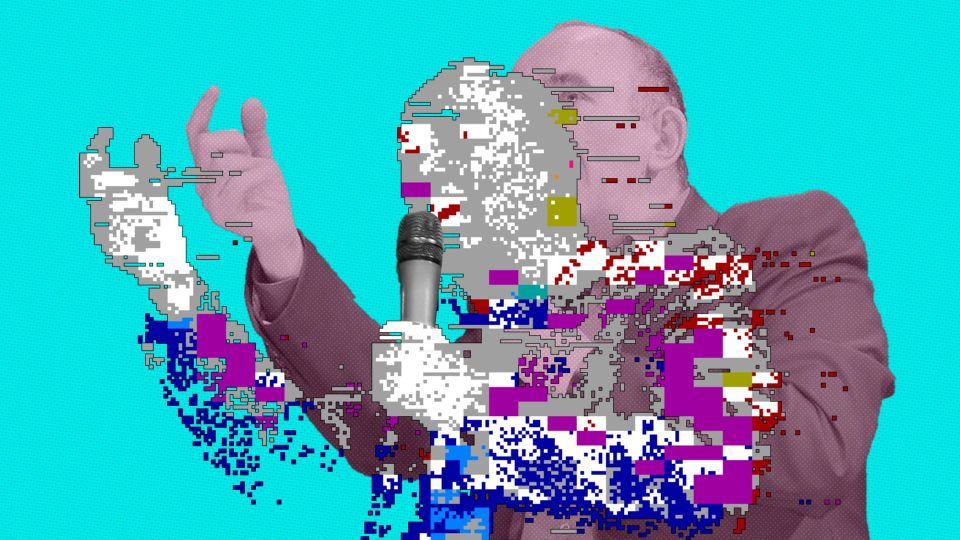
Back in 2023, Peter Molyneux began talking to press for the first time about his new game, Masters Of Albion, which released into Early Access last week. "The only thing I can say", he told GameReactor, "is that, firstly, this game is the first game really that I've coded, been a coder on since since Black & White." In 2017, Molyneux was talking to press about his previous game, Legacy. "I was in the hotel this morning, I was having breakfast, I was coding Legacy, and I had an idea. Within an hour, I was actually playing with the thing," he told Glixel. The year before, Molyneux was discussing the newly released Godus Wars with Eurogamer, and the fallout of an infamous interview he had done with Rock Paper Shotgun. "After a couple of days I came up with this simple strategy: I would just be a coder and a designer." He lists a few of the things in Godus Wars he personally coded. "I did some coding on The Trail as well," he says at the end of the interview.
So Masters Of Albion is the first game that Molyneux has coded, or been a coder on, since Black & White. Except for Legacy, The Trail, and Godus Wars. Now, this is harmless, and I don't think anyone actually cares on which games Peter Molyneux is or is not coding. Still, these contradictory quotes - and many others like them - all cause me to ask the question: is Peter Molyneux a... pop star? He's been called worse.
I've read, watched or listened to nearly every interview Peter Molyneux has given over the past decade, and this is the best, or at least most generous, interpretation I can come up with. We expect myth-making from pop stars. They construct a public persona at least as diligently as they make their music, such that the persona is the performance. These constructed identities don't need to be true, only to feel authentic. Perhaps we shouldn't expect any different from game developers.
"I work long and late and if the game's rubbish, then what's that sacrifice for?"
To talk about Masters Of Albion, I think I first need to talk about Molyneux and 22cans' previous game, the one Molyneux was coding in his hotel. Its name was no accident. Legacy saw Molyneux return to the business simulator concept with which he began his career in The Entrepreneur, the management genre that delivered some of his biggest successes, and to PC gaming after a critically disastrous (and commercially fruitful) detour into mobile games with Godus and The Trail. It was also, Molyneux told Red Bull Gaming in 2017, inspired by his father's workshop. Here was Molyneux on the comeback path, making something deeply personal, and at 60-years-old, concerned with producing work that could justify all he'd sacrificed to make it.
"It's what my family thinks of this game that's incredibly important to me, especially my son," he says near the end of the interview. "I work long and late and if the game's rubbish, then what's that sacrifice for?"
Then, after several years of development, Legacy adopted the blockchain. Molyneux appeared in in Las Vegas in 2021 to praise the technology. "We’ve got this unbelievable simulation, this incredible narrative we weave through the game. We’ve got moral choices in there and competing against each other, all within this totally new world, which is, of course, exactly what blockchain is all about." Before it had even launched, Legacy had sold in-game land deeds as NFTs to different buyers for a total of around £40 million. The game then launched on the Gala Games blockchain platform in 2024. 22cans almost immediately stopped updating it, the value of those NFTs cratered, and Legacy has since been removed from the platform, rendering it unplayable. 22cans' own website does not mention it. Legacy now exists solely as a secondary market of those same land deeds, on which a single item that once cost $2000 is now being offered for $11.
Molyneux says the money Legacy made was less than reported, but like all web3 transactions, the land deed NFT sales were stored on a public ledger and therefore the figures were visible for anyone to see. Molyneux does say that those sales funded the creation of Masters Of Albion, and so finally we arrive in the present day. Here, presumably, is what all that sacrifice was for.
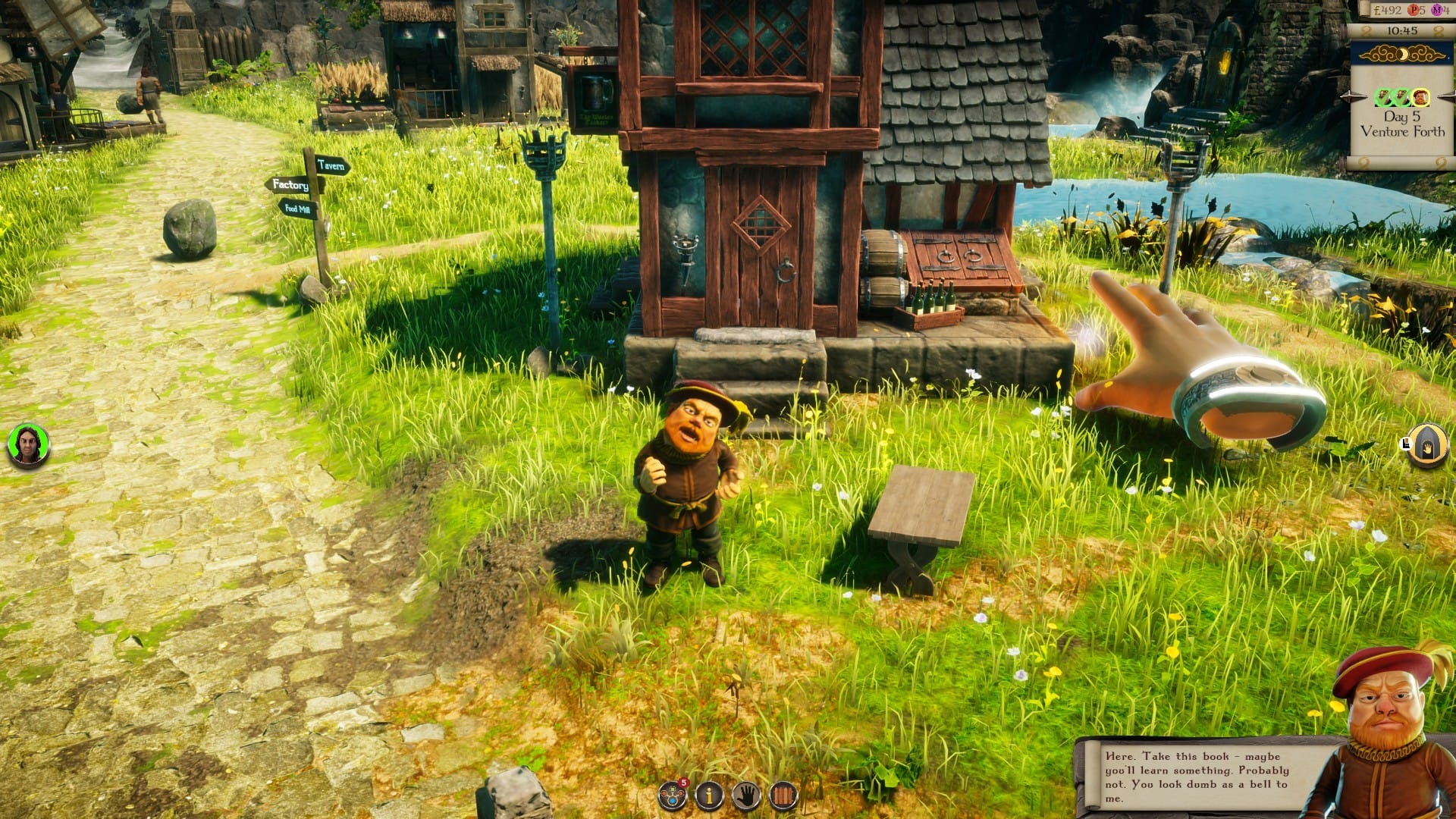
If Legacy was inspired by Molyneux's first game, Masters Of Albion is inspired by almost all the others: it's set in Albion, a new take on the same fantasy Britain that provided the setting for Fable; you are a disembodied god hand who must perform errands for west country folk, a la Black & White; and you will be periodically invaded by enemies which you must repel, in part, using your ability to possess and directly control any creature in your world, as per Dungeon Keeper.
[Molyneux] saw the number of people playing Facebook and mobile games, and it blew his mind.
In the early game, you are confined to a small, pastoral village. An air balloon brings orders to your town, asking for things like six sandwiches or twelve pies, and there is a tavern for hiring workers, a farm for harvesting wheat, a mill for making flour, and a factory for turning that flour into whatever the order requires. It's a simple supply chain, only slightly complicated when you unlock items like swords and armour. The only substantial wrinkle is that every order must be hand-designed by the player.
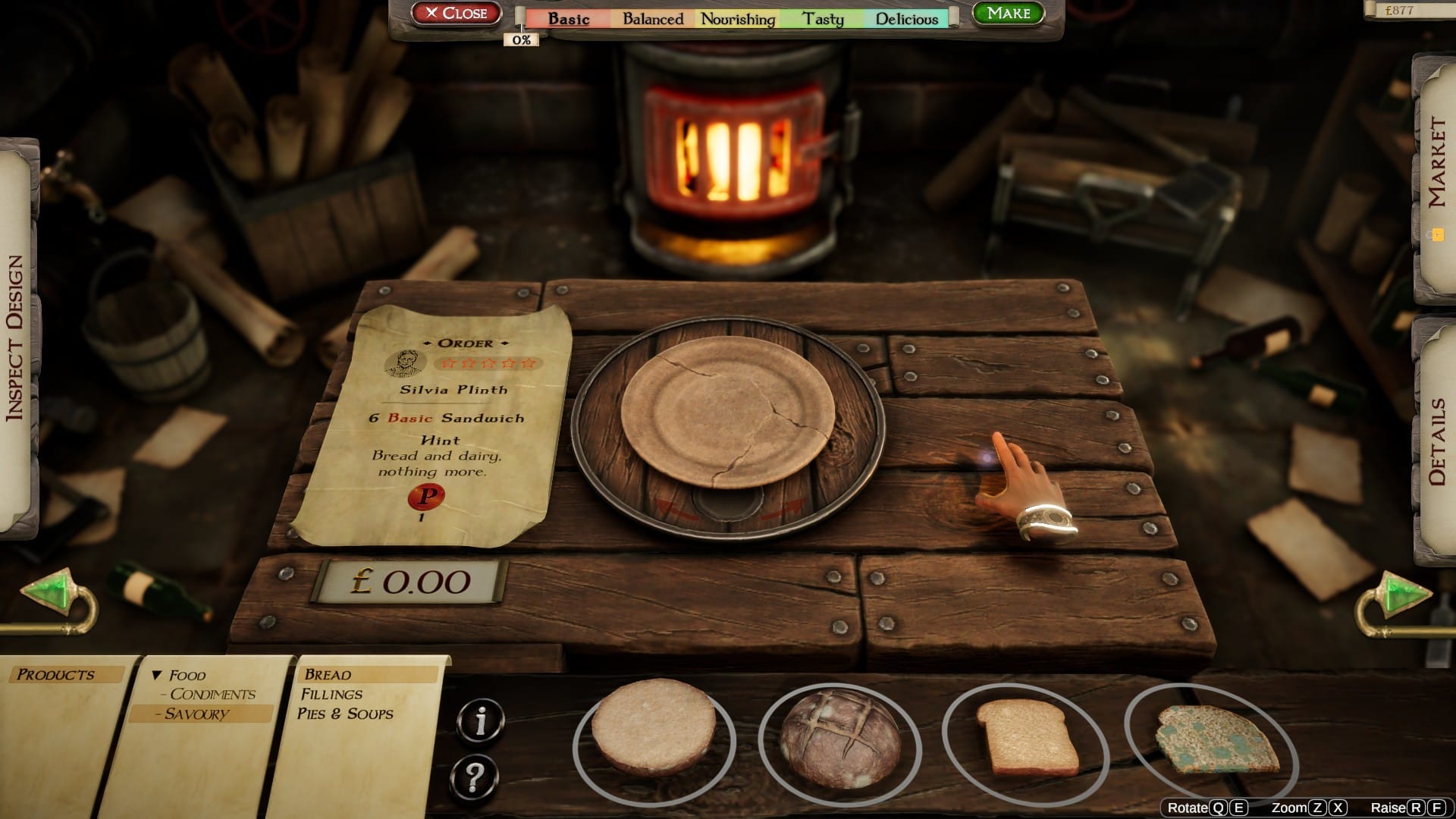
This is the part that most looks like Legacy, which had players free-wheeling inventions by clicking disparate pieces together to make products to sell. In the early hours of Masters Of Albion, the orders ask for sandwiches, with a brief hint about what kind and quality of sandwich is required. So you slap down a side of bread, then some cheese, then some lettuce, then another piece of bread, and then send it to be tested. If it meets requirements, your client is happy, and you send it into production. This is monotonous and doesn't at all feel creative given the limited ingredients and narrow specifications of each order, but there is at least some satisfaction in simply doing what you're told, like completing a jigsaw, and watching numbers tick up.
I think this simplicity is the result of Molyneux's biggest problem as a modern game designer. Around fifteen years ago, he saw the number of people playing Facebook and mobile games, and it blew his mind. "What we’ve got written on the wall [at 22cans] is that someone – hopefully it’s going to be us – will make a game that will touch a hundred million people in a single day," he told The Next Web in 2012. "Now just imagine that. Imagine being part of a team that’s going to make something that a hundred million people interact with."
Godus was his first real attempt to reinvent his work for a broader audience, pitched to Kickstarter backers as a spiritual successor to Populous but in reality simplified into a tap-tap-tap Farmville-style resource-harvester for mobile devices. Molyneux, whose ambition for fame and success had once driven design innovation - new genres, 3D worlds, rich simulations, innovative AI - instead spent the past decade driving towards systems of player engagement and extraction. I say this as someone who loves plenty of mobile games, but in Godus and The Trail and, one suspects, Legacy, there was no there, there. They were a thin veneer stretched across a hollow core. Switching to making console games with Fable might already have been his 'Dylan goes electric' moment; pivoting to mobile was more like 'Cab Calloway goes disco'.
This is a design ethos fundamentally incompatible with what Molyneux's existing audience wanted from him - and what he'd sold them in the Godus Kickstarter campaign. (The more serious issue, often elided by press and by Molyneux himself, was that he offered features as stretch goals which were impossible with the middleware 22cans were using and beyond his ability to add. Molyneux says that he's "like a kid" when doing interviews and talking about design, and fair enough. I think you'd have to be extremely credulous to accept he's also like a kid when writing Kickstarter pitches. Molyneux memorably described his own mindset during the Godus Kickstarter as, "Christ, we've only got 10 days to go and we've got to make £100,000, for fuck's sake, lets just say anything." It was these failures, rather than any wide-eyed, pie-in-the-sky dreaming, that set the stage for the backlash to Godus and Rock Paper Shotgun's interview with Molyneux three years later in 2015.)
Molyneux says that god games are about giving the player power and freedom, but I felt neither
Molyneux has lamented his time in mobile games ("What the hell was I doing?"), another part of his personal narrative in pitching Masters Of Albion as his return to PC (so was Legacy), but it retains much of the click-and-wait flow of his mobile game work. He can't seem to shake his desire to reach the largest possible audience, or his belief that doing so requires a straightforwardness that borders on pandering. Everything you can do in the current Early Access build consequently feels shallow.
After designing your sandwich, your workers and supply chain buzz into action. Your disembodied hand can help, either by moving supplies between buildings one at a time or by holding down left-click to give a speed boost to a building. There's no strategy or decision-making here. Your option is either tediously hold down a button to make it go faster, or sit back and watch the orders be fulfilled at their natural, achingly slow pace. Either way, it's busywork.
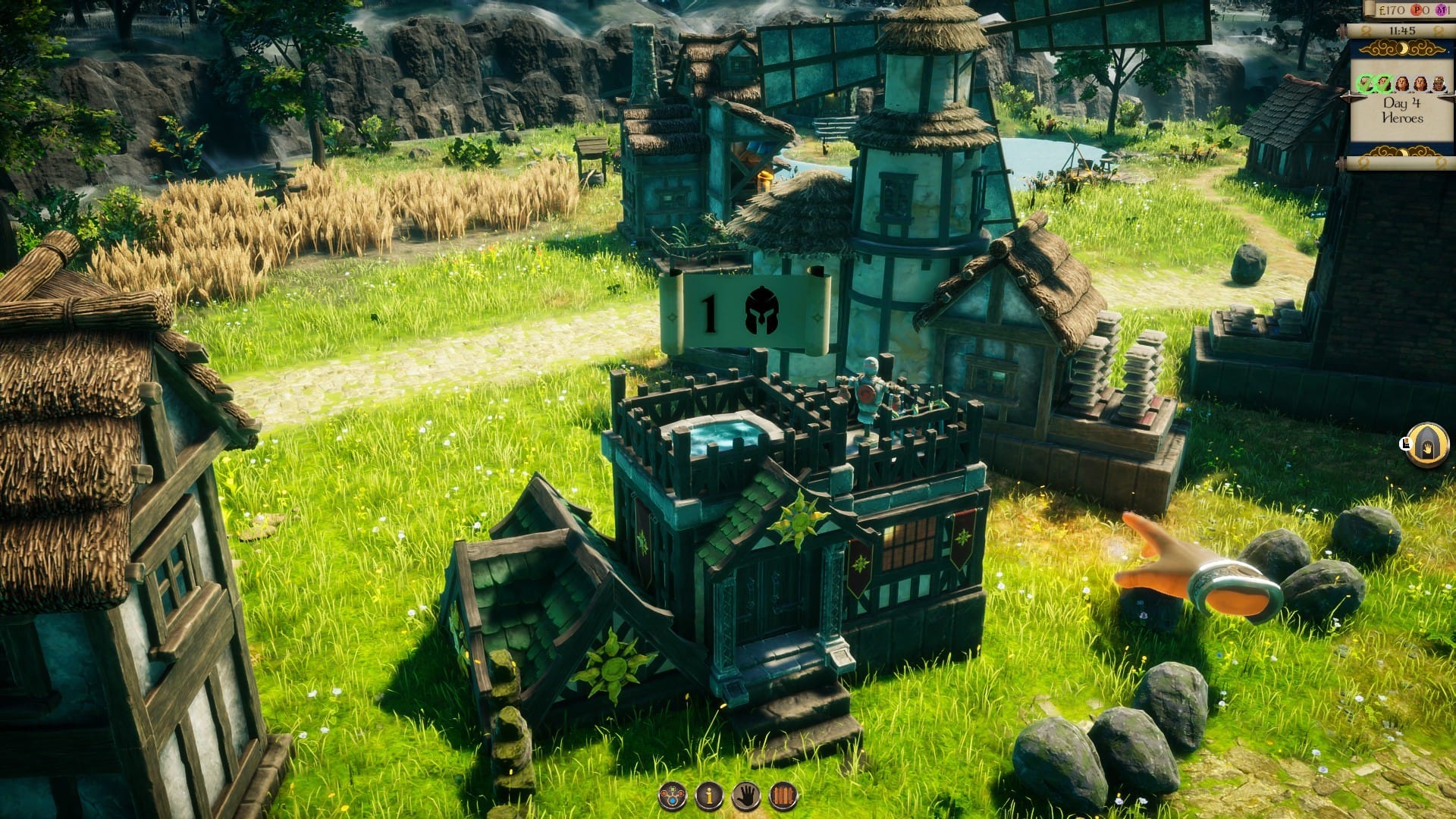
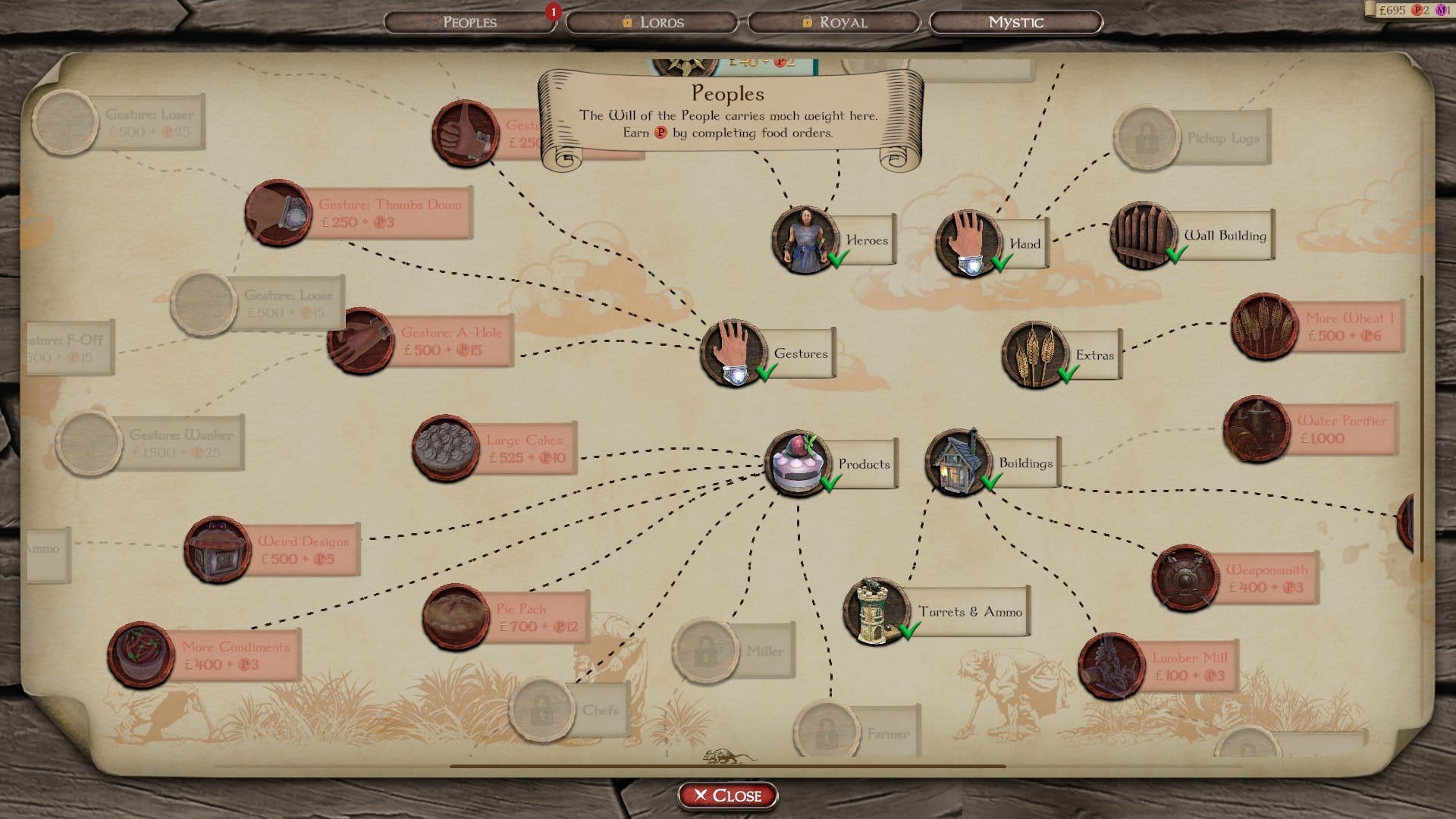
The money earned from your sandwiches can be spent on upgrades, unlocking new powers for your hand (such as force lightning), new types of worker (such as fighters who patrol and biff skeletons at night), and new buildings (such as turrets, which shoot at skeletons at night), among others. The onboarding will tell you what to unlock and when, until it opens up - although even when it opens up, there still feels like little space for player freedom. I decided to go off-piste and unlock an armoury, to equip my fighter (who I renamed "Jon Hicks") such that he might stop being knocked out at night, only to discover I lacked the required resource, had no way to get it yet, and couldn't craft any armour of significant quality even if I did. I glumly sold the armoury again and resumed making pies. Molyneux says that god games are about giving the player power and freedom, but I felt neither while playing Masters Of Albion.
If 22cans continue to update this one, it might one day be fine.
This remains true at the end of each day, when night falls over Albion and you must survive several waves of skeletons, or defeat a certain number of them within a time limit. If the skeletons reach your shrine and destroy it, or you fail the challenge, you're sent back to the day before to alter your plans and try again. You can construct walls to slow them down (but only in pre-defined areas), and help fight them yourself with lightning strikes and thrown stones, but it's fiddly.
There's a fiddliness to everything, which you can dismiss as a consequence of Early Access only depending on how much trust you feel like extending to 22cans. Dropped items magnetise strongly to sockets in the environment, making connections easy but disconnections frustrating. One puzzle requires you to arrange standing stones in a fixed order so as to play a tune for a hippy, Black & White-style, and the magnetism makes it a chore. Your hand's lightning can be fired into the foggy, undiscovered surrounds, but only if the hand itself is currently floating outside that fog of war, and that boundary is fuzzy in the detailed environments, particularly at night. The auto-targeting that helps you when throwing a stone at some enemies often hurts your chances when trying to lightning strike a particular enemy in a skirmish. The construction menus are a nest of easily-lost ingredients, and building placement and construction feels clumsy because of its flexibility, rather than creative or empowering. I quickly learned not to tinker with anything because the controls would almost always lead to me making a mess.
All of which sounds pretty damning, but considering how low the floor goes, it's worth noting Masters Of Albion is no grand disaster. This isn't Godus, with its broken and missing features, and it isn't an NFT rugpull, either. It's an oversimplified management game without any big new ideas that tries to do too much to the detriment of doing any one thing particularly well. It is jack of all trades, Masters Of Albion. It does look pretty, at least. I like that you can zoom from ground level all the way out until you can see the entire world, and that it turns into a scale model in the process. If 22cans continue to update this one, it might one day be fine.
It's tempting, given Godus' mis-sold features (and eventual removal from sale on PC) and Legacy's NFT pivot (and eventual removal from sale on PC), to categorise Molyneux as a grifter. I don't think the term fits because I think his motivations are genuine. It might not be healthy to want to produce a new "hobby", as Molyneux often talks about, one interacted with by 100 million people each day, just like it might not be healthy to want to fill a stadium with adoring fans who scream your lyrics back at you, but it is, I think, an earnest desire that's about more than separating people from their money.
"We wanted to make a game that was about building things," the late art director Paul McLaughlin says in the Red Bull interview, speaking about Legacy. "I think there's two reasons for that. I love building things, I think Peter loves the idea of other people building things. I think he wants to enable the audience to experience some of this stuff that maybe he doesn't really quite get himself."
Is my interpretation of Molyneux, gleaned from quotes by and about him, just projection on my part? Well, sure, because that's what you do with pop stars. I am poring over Molyneux's liner notes and overthinking his lyrics.
Still, I'm reminded of a peer who recently remarked that they didn't know what the scornful audience wanted from Molyneux at this point. His reputation has already taken an appropriate beating. Do those still angry about Godus want him to simply stop making games entirely?
I can't find it in myself to have strong feelings about a bad, 13-year-old videogame, and I want Molyneux to keep making games, but more importantly I want him to lean in to his persona rather than trying to fight against it. I want him to stop self-flagellating in interviews, a habit that gets worse any time he's confronted with criticism. Much of his press tour before Masters Of Albion's release has been about how it's his last game, not because he's particularly old, but because of how hard he works, and how poorly he looks after himself, so surely he'll be dead soon. It's self-pitying, as if he's trying to convince you of the inherent agony of being him. I much prefer his previously mentioned 2017 Red Bull interview where, even post-disaster, he delivers an earnest sermon on the power of his new game from the very first sentence.
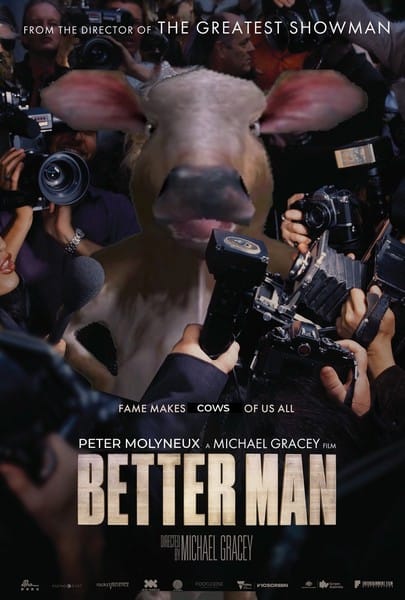
You can't convince people to like you, but you can embrace your role within culture fully - and there's nothing wrong, in pop music, with playing the villain, the cad, the preacher. Think of Robbie Williams, who has turned being annoying into a cornerstone of his identity. (And what better a game developer to be played by a monkey in a movie biopic than Molyneux? Or perhaps a cow.)
I'd suggest Molyneux change his name to Molydeux by deed poll, but the pop stars who endure transmute the narratives that whirl around them back into their work, and there are glimpses that suggest Molyneux might at least be able to do this.
The best game 22cans have made in the 14 years they have existed was their very first, "Curiosity: What's Inside The Cube?". A social experiment and a toy, Curiosity became a brief phenomenon, with over four million players tapping to destroy blocks and discover what was inside a single enormous cube. Molyneux had promised "something amazing, something life-changing." Ultimately, the only thing that was inside was, of course, Molyneux himself.
Masters Of Albion's disembodied god hand doesn't appear from nowhere. The game begins with the player in control of a single human who, after discovering an abandoned town, you walk towards a temple. Once inside, you sit him upon a throne above which floats a glowing helmet. Chains grab at his arms and legs, binding him in place, and the helmet descends. Your last glimpse of this unnamed man shows him screaming in agony as his hand is magically severed; sacrificed, along with his freedom, so that he can help rebuild the world by aiding the creative works of its citizens.
So here's Masters Of Albion, constructed under the pretence of letting players experience the joys of creativity, but in reality little more than an apologetic shrine to Molyneux's older, better work - and at its core yet again: Molyneux himself.


Comments ()