Living In Sim

Intense, cryptic, horny - Ablahshikar is for the ASCII freak in your life

Swab the ribcage me hearties

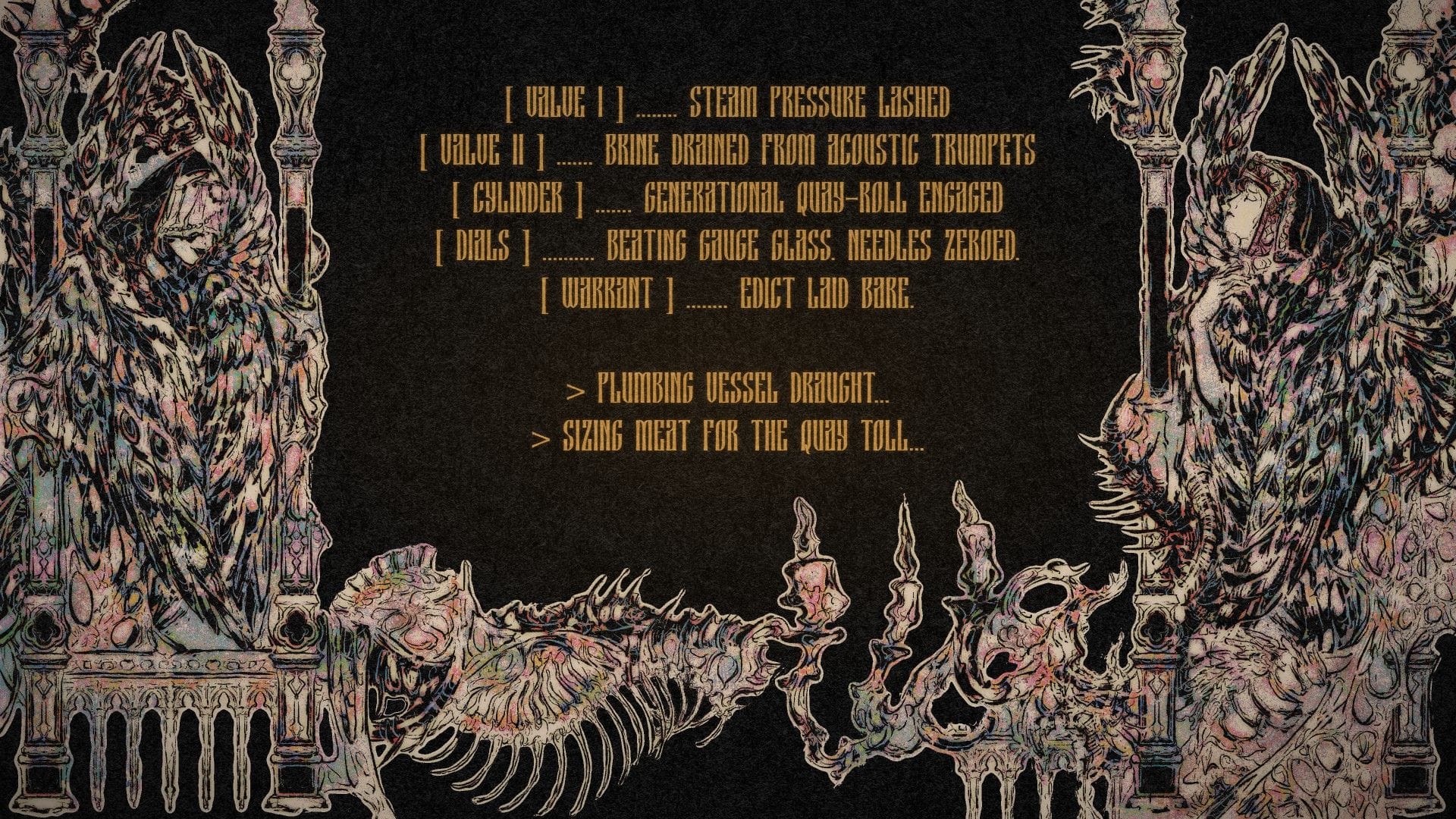
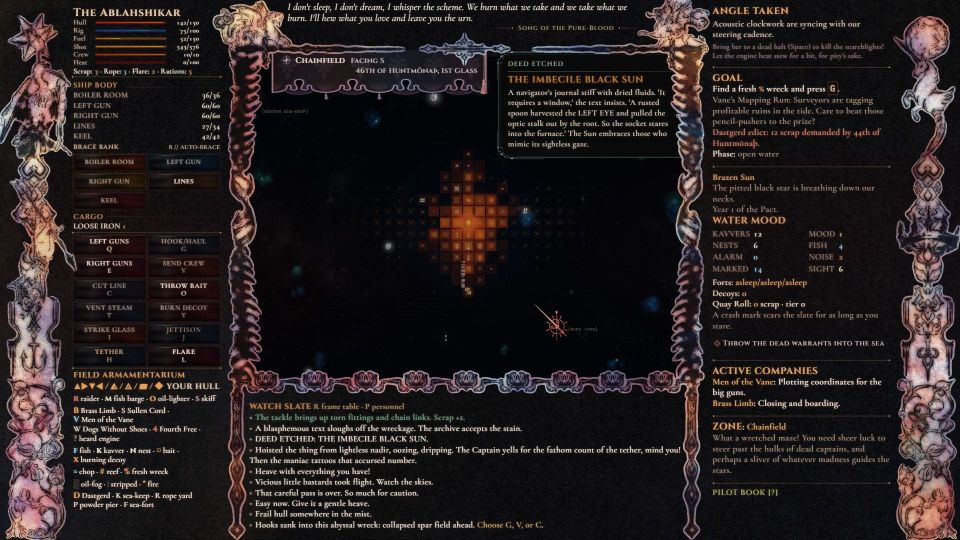
Ablahshikar is intimidating. But it's theoretically possible to grasp its essence. What we got here is an old-school ASCII roguelike about a horrible ship sailing an ocean of hateful freaks. That means moving a symbol on a black background, launching broadsides at uppercase Ws and escaping from flocks of lowercase ks, collecting the fuel and scrap you need to survive along the way. It has a heinously cluttered interface and lots of proper nouns that it refuses to describe to you or anyone, perhaps even itself. For the first hour you will feel like you are drowning, and it is possible you are. Yet read between the microscopically small lines of labyrinthine prose plastered everywhere, and there is a lot going on. You can almost smell this game.

The writing is ferocious, it clamps onto you like a badger with lockjaw. The opening screens are five minutes of prose growing purpler by the page, sprinkled with a few player choices, including one of the most amazing gender options I have ever read. The gender options are "Maiden", "Brethren", or "My most exalted host, there are sovereigns ruling the eastern companies who weave the flayed faces of their foes into mourning veils! Must we truly concern ourselves with the vulgar taxonomy of my hide!? It will do absolutely nothing."  

⚓
Living In Sim is our monthly column about simulation games, and the frequently stupid misadventures they inspire.

Here, a beautiful trailer that explains precisely nothing.

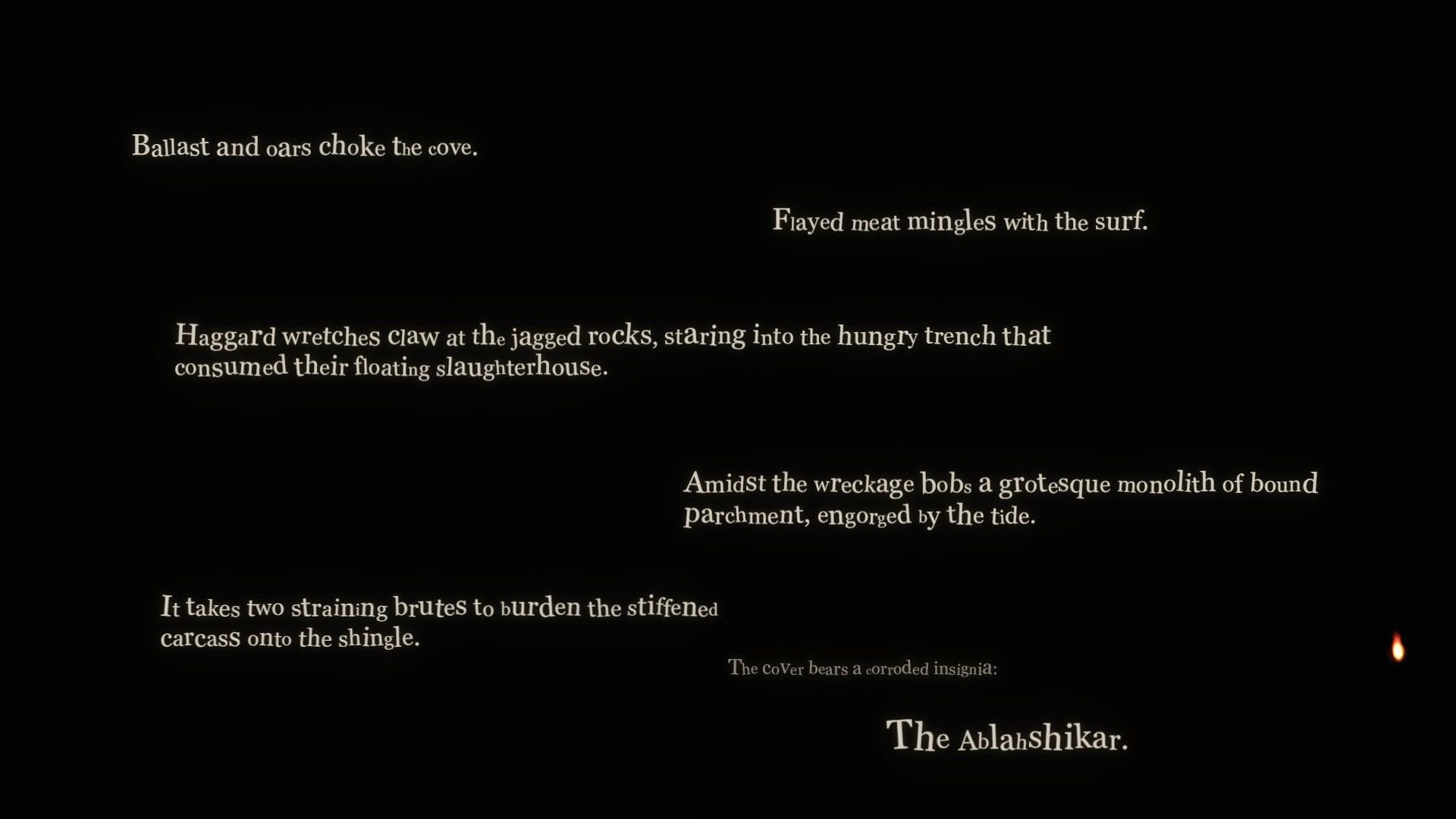
The text and notes Jackson Pollocked across the screen will likely overwhelm you, not just in volume but in their unapologetically opaque lore. This is a story about a bastardboat sailing around, looking for misadventure and spare body parts, but it's hard to know what to pay attention to at any given moment. It's hard to know what your ship looks like, or why the sea is so full of unwell people. Is this the past, or the future? Unclear. Neither.

Enigmatic nouns land on you like cannonballs. Important notifications appear in every corner of the screen, while a feed at the bottom sometimes offers semi-intelligible things like: "Hear that ticking in the smog? Vane Parasite." or "Seems like the dross of Twin Moons has infected kavver flocks." I still don't know what a Vane Parasite is. An average game might say: "You hear enemies approach". Ablahshikar says: "Acoustic trace: Sullen Cord drawing a bead on us." It is like if Sunless Sea were passed through Google translate into Kurdish then Anglo-Saxon then back into modern English again. It is deeply compelling.
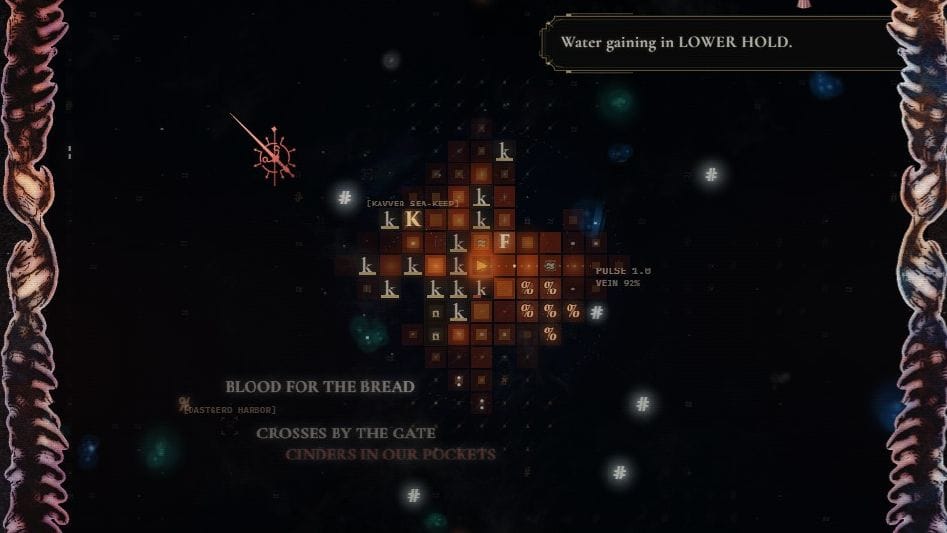
Look, it's very simple. In this screen I am being pursued by twelve swarms of horrendous shitgulls.

You have to learn the game from two angles: you must learn to read the ASCII, to know to avoid the scary V sailing your way (a ship of hostile marauders called "the Men of the Vane") or to throw down a grappling line at the nearest % (a shipwreck full of scrap and goodies). But you must also learn what a kavver is (a horrible seagull thing, as far as I can tell) or what "Munira's Curvature" might be (a semolina pudding, believe it or not). A legend in the corner helps with the common ASCII of enemies and outposts. You find clues to other confusions in myriad screens, your cargo bay doubling up as an encyclopedia. Sometimes you just have to guess at the nature of this world entirely from context. The game's closest analogue is Caves Of Qud, except it sort of hates you.

There are a bunch of actions you can perform, all done with simple keystrokes but few explained in any manner that would satisfy the average player used to clear tutorials. Fire at ships to your right or left with Q and E. Press space to wait a turn and cool your boiler. Fire a flare with L to light up the area ahead. Repair your ship's ailing parts with judicious taps of B. All sounds simple enough. It is not. I advise using this Steam guide. Alternatively, here's what it looks like when you are machinegunned with information by the in-game manual, known as the Pilot Book.
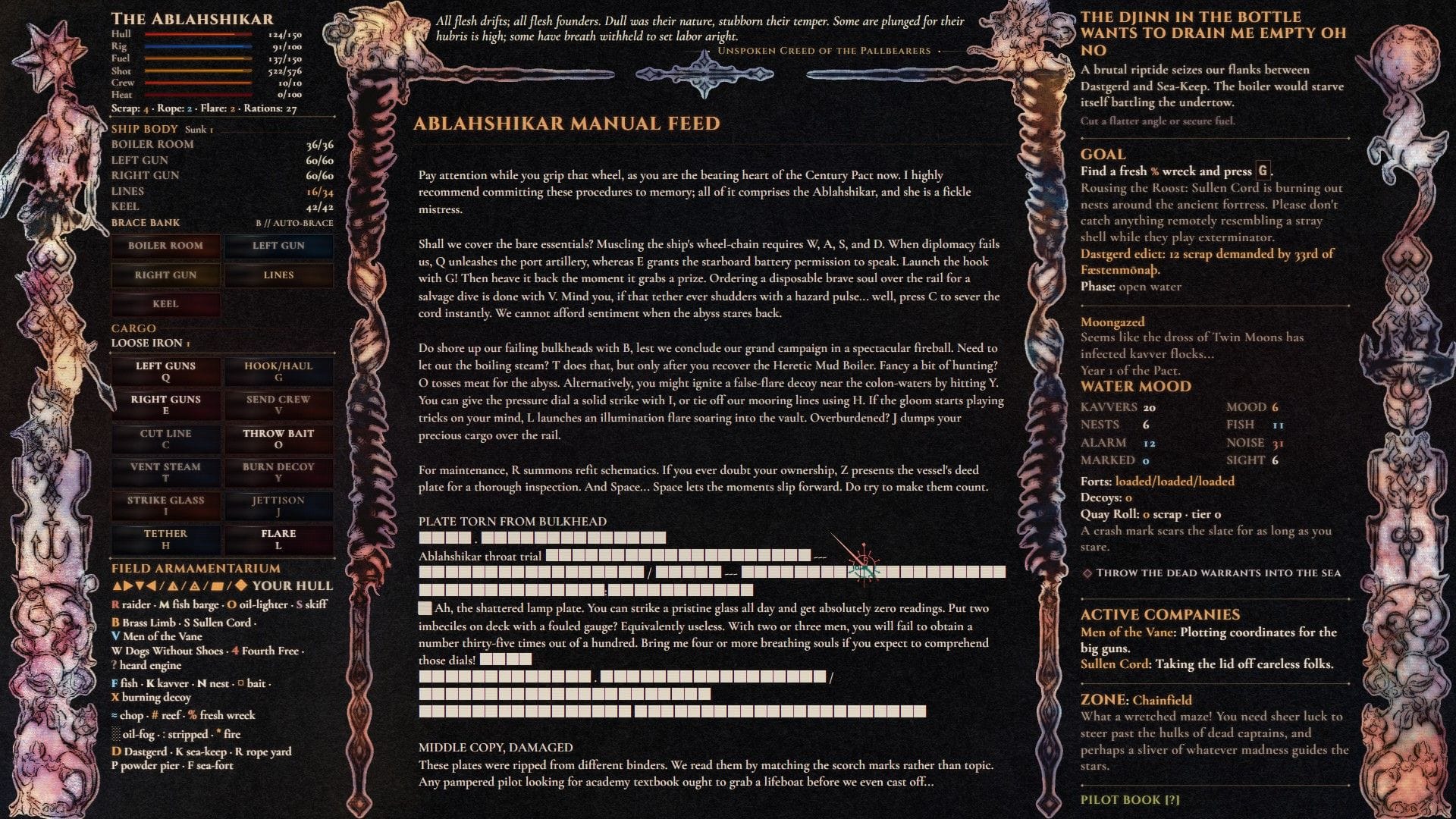
The absolute chutzpah of a game in 2026 to render a "controls" page completely as three paragraphs of in-universe prose.

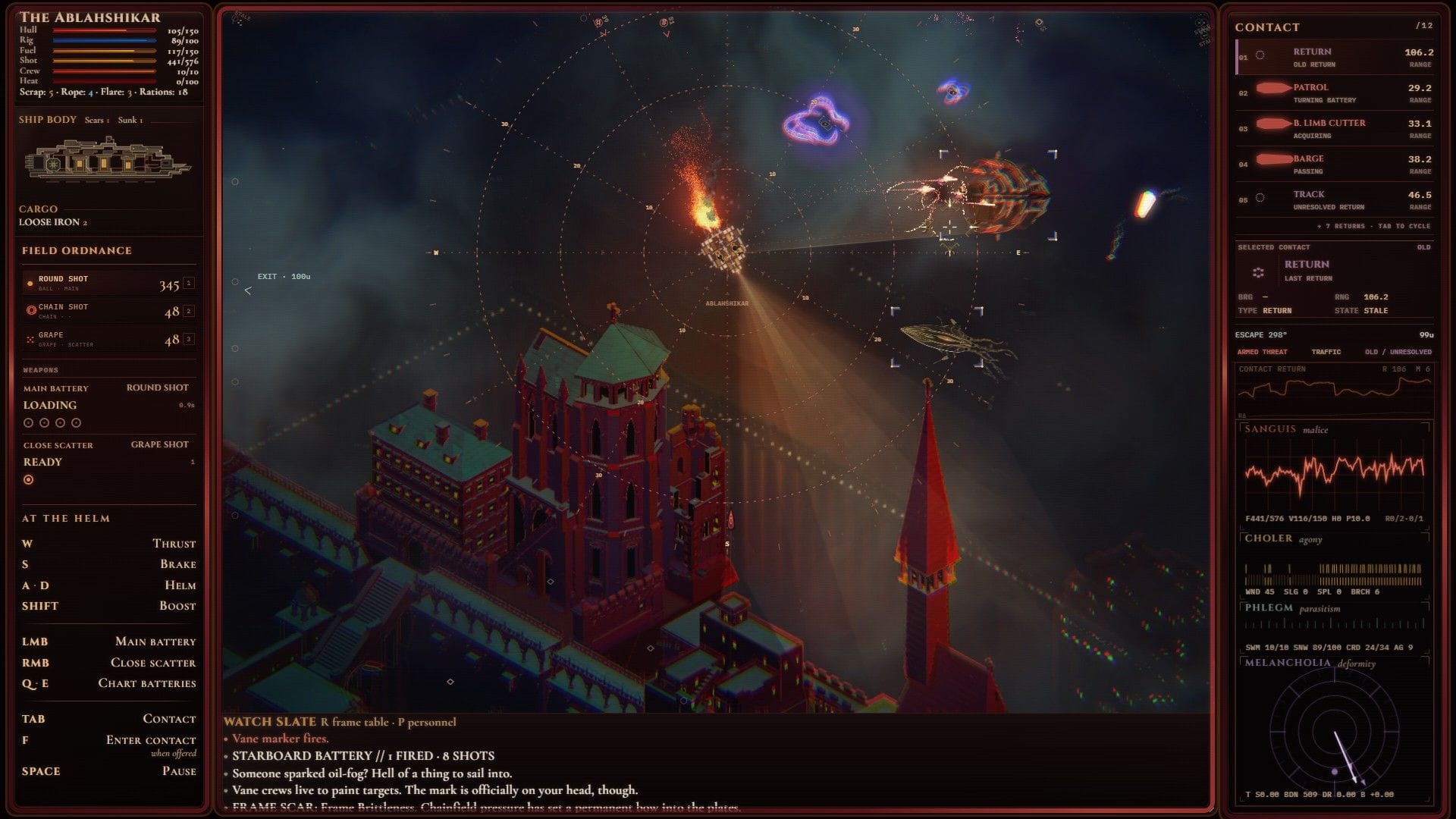
It is not all words. The genre waters are muddied when you get too close to enemy vessels, at which point the game snatches you into a sorta twin-stick shooter close-up, where you have to slowly sweep around launching cannon-missiles and grapeshot blasts at huge horseshoe crab beasts, squiddy freaks, and small ratty ships, then head for an exit zone. You can salvage the scrap from enemy wrecks after the fight, once you're back out in the ASCII overworld.  
But it takes more than one estranged captain of indeterminate gender and appearance to keep a vessel alive. Let's delve down to the management layer - my favourite screen of the entire game - and check in on the crew with a ferocious slap of the P key, for Personnel I suppose.

Ah, here's Asgar. He is described as a "street-razor" from the port city of Dastgerd. What's his disposition? Well, says here he "fantasises about feeding your thyroid to the birds." Right. What about Murtazali, that nice fellow working below deck? "Experiencing a catastrophic collapse of the ego which they are currently masking as a persistent cough and a sudden interest in knot tying." 

These men are in clear need of a help you cannot provide. Nevertheless, there are "caring" commands you can type for your sailors, as if they are all fucked-up little Tamogatchis. Typing "Water" will give them a drink. Clattering out the word "Comfort" will soothe them with a calming touch that reads as sexually charged. In fact, most of the captain-upon-sailor actions can be read as violently horny. You grasp their hair. You open their mouths wide. You wrap your hands around their throat as they protest mildly, "I'll do anything. I mean it, anything..."
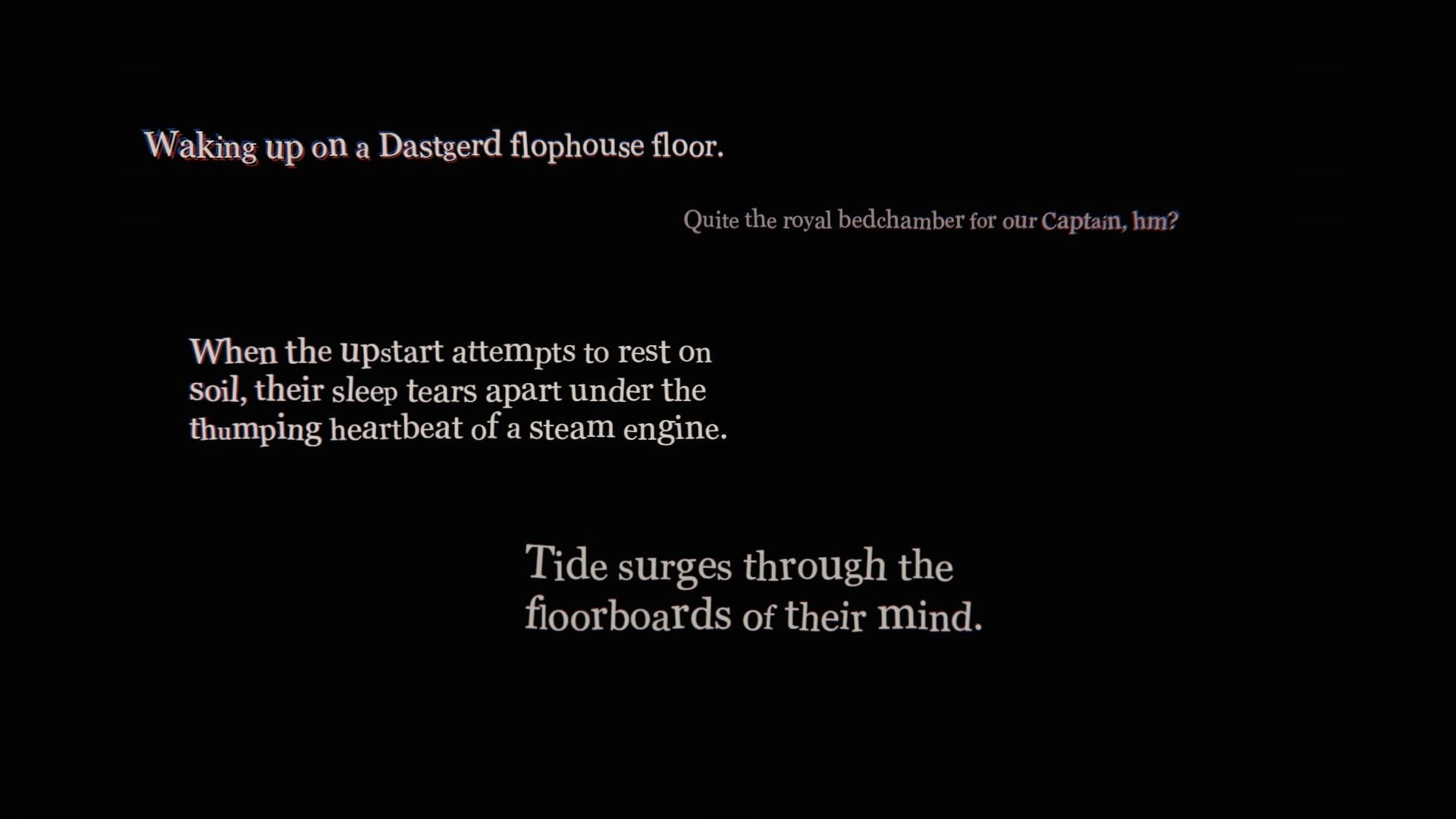

Apart from eliciting spicy S & M flavour text, these crew commands will also increase or decrease stats for each sailor. Some stats seem straightforward enough. Comforting a gunner might increase his Relief meter. Others are as vaguely worded as the rest of the game. Aversion, Lucidity. What do these do? I don't know, and the game will never tell. There is a "Headpat" command, for patting people on the head. It increases both Relief and Humiliation.
This post is for paying subscribers only

Already have an account? Sign in.

The city of Nivalis feels alive when you're unemployed

Get un-busy

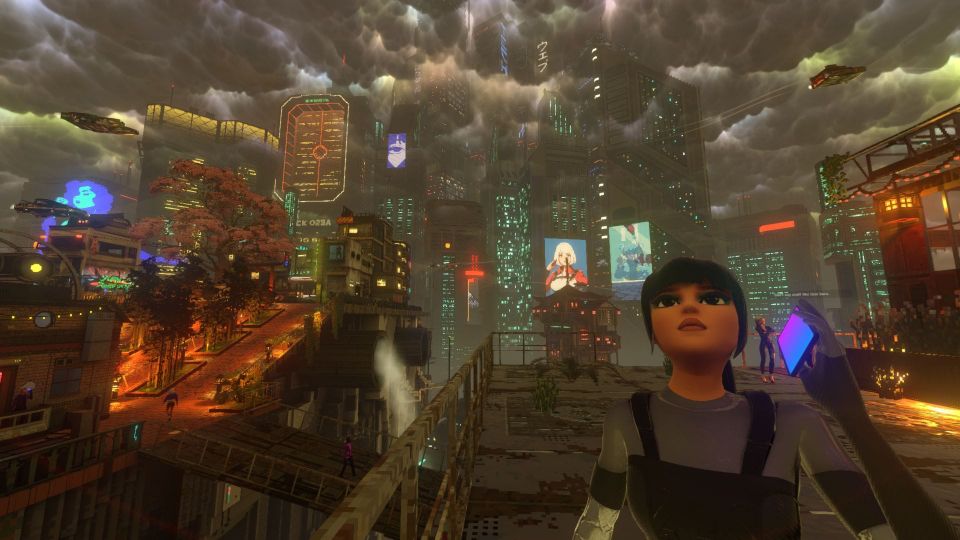
The best thing you can do in Nivalis Nights is hold down the J key and watch your list of quests vanish. The city will flood your eyes. Freaks in plastic clothes roam the plazas, bright adverts are reflected in rainkissed slabs, little delivery robots zip around at knee height, hovertaxis thrum overhead, the walls are plastered with signs and graffiti and posters and aircon units. The sky is... god, is it boiling? Why didn't you see all this before? Well, it's easy to miss when you're blinkered by small business chores. 

At any time almost a quarter of the screen in this flashy life sim is covered by a long to-do list full of objectives like "restock ingredients" or "buy a houseplant". Not only does this homework menu take up more real estate than the highrises towering over you, it also acts as a constant reminder to go go go, do do do, quest quest quest! It was only when I learned to make this journal disappear and ignored my workload that Nivalis' biggest strengths beamed through the smog. It's a wet cyberworld built for pedestrian ambling and for chatting to random strangers. In other words: quit your videogame job. Forget about your bank balance, for once in your life, and go for a walk in the neon rain. You won't regret it.

🌆
Living In Sim is our monthly column about simulation games, and the frequently stupid misadventures they inspire.

On your very first day in Nivalis some guy you barely know gifts you his rundown ramen stand, and kindly includes all the debt that goes with it. To pay that off you'll need to find ingredients, source new soup recipes, hire waiters, and get more bums on seats (seats sold separately). From here, the game spirals out into other life sim territory - supplement your noodle stand by going fishing, try your luck at wreck hunting, start an urban farm, buy an apartment, decorate the apartment, abandon the apartment for a nicer, more expensive apartment. Have you too grown immune to the paradox that home ownership is achievable in dystopian videogames but not in reality? Cool. Let's move on.

This post is for paying subscribers only

Already have an account? Sign in.

A shadowy group has captured the early 2000s military sim

And they're threatening to execute it if their demands are not met

Last week I learned that if you serve in the Territorial Army, even for a short time, you get a discount to Disney World. There is some kind of insight here for a clever person to make, something about the intersection between playfighting and realfighting. Perhaps hiding under the camo of each soldier boy, with all their manoeuvres and training and trigger discipline, we are destined to find a little kid playing pew pew.

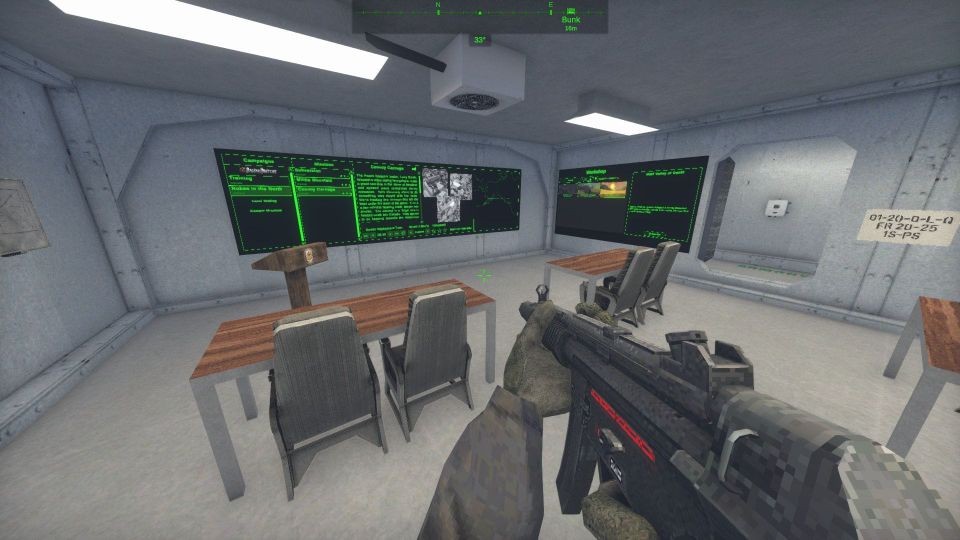
If we dip hard enough into tactical first-person military sim Dagger Directive, maybe we'll find that inner child. Its genetic material is Tomothon McClancy's Rainbow Six (1998) or maybe more accurately Rogue Spear. The aesthetic is rooted firmly in early 2000s counterterrorism shooters like Soldier Of Fortune. The cursor in the menus is a crosshair. When you quit to desktop it asks: "Do you really want to go back to being a civilian?" This game could not be more Y2K if it came on a free CD-ROM in a packet of breakfast cereal sponsored by the US Navy SEALs.

💣
Living In Sim is our monthly column about simulation games, and the frequently stupid misadventures they inspire.

Yet it's no boomer shooter, not exactly. The simulation elements go surprisingly hard. There are ricochet physics, shrapnel from frag grenades, ACOG scopes with adjustable ranges, and only lying prone will give you a truly steady aim. You will perish with a single hit, and enemies go down just as quick. You can either use nightvision goggles or your scope, never both. There's no HUD to speak of - no ammo counter, no health bars - and reloading a clip that's still half-full is a waste of bullets. Veteran milsimmers are free to turn the crosshair off completely in the settings, although I will not surrender this. A man must have his comforts.  

The tutorial mission made me worry there was a problem with the scale in the levels. It's a long empty jaunt from the obstacle course to the firing range for seemingly no reason. Only when I played the real missions did I understand this is reflective of the whole game. Maps are expansive combat zones - snowy mountain ranges, whole towns surrounded by broad prairies, stretches of rural countryside with village after village.

This post is for paying subscribers only

Already have an account? Sign in.

This free SETI simulator mops the floor with other job sims

Doing the dishes

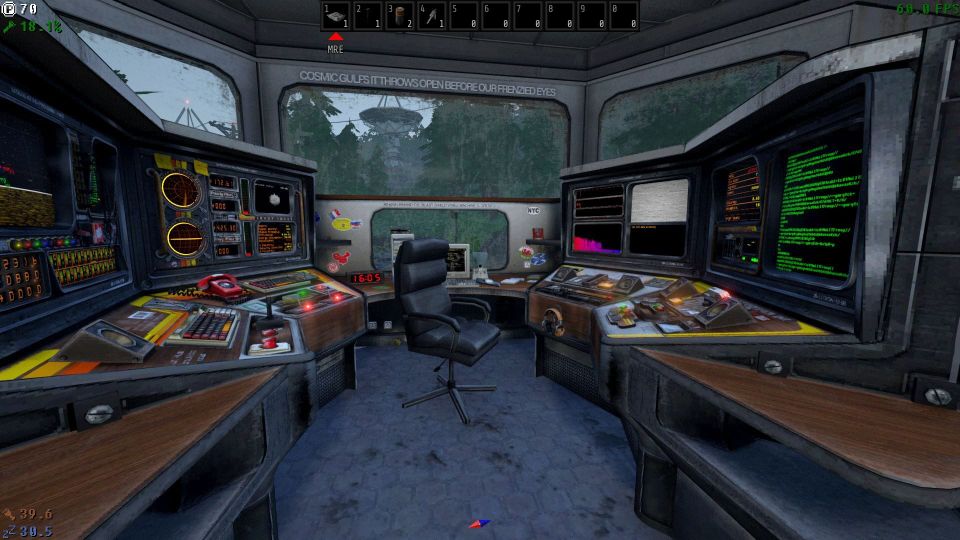
If aliens are watching, I hope they can't see the state of my bedroom. Voices Of The Void is a job sim about being a lonely engineer in a remote signals laboratory, pointing big satellites at the sky in the search for extraterrestrial life. You are like Jodie Foster in Contact, except less qualified. It is extremely my cup of hot tea. It is also about living in a disgusting dormitory full of cockroaches.

I spent the first hours in this surprisingly complex and funny sim not pressing buttons on the old analogue machinery required to do my job, but instead sweeping up years of rubbish that had piled up in the abandoned lab before I took over. Chinese takeaway cartons, bottles, fried circuit boards, busted keyboards, indeterminate pulp. If the little grey men do send a message, I might miss it. I am busy scrubbing the toilet.

👽
Living In Sim is our monthly column about simulation games, and the frequently stupid misadventures they inspire.

You arrive to the lab in the dead of night, your first task to simply go around switching on the lights in every room. You read the emails waiting for you on the computer running on the desk. Your science boss wants you to record signals from space and send the recordings to them every day on hard drives, alongside other data on a big tape reel. I ignore the emails, take a look around, find the cleaner's closet, and come back with a roll of black bin bags. I am NOT working in this absolute shit hole until I have at least cleaned up my desk.

This post is for paying subscribers only

Already have an account? Sign in.

The Data Center is where dreams go to die

Join my professional network on 192.168.0.1/24

I suppose it's time to reconcile my love for engineering marvels with the world's collective nosedive into technofeudalist hell. Okay. I can do that. Just as I find fighter jets impossibly cool, but do not actually want them used to explode people, I think data centres are impressive, but I do not like to see them sucking the world dry like a parasitic force beyond any ordinary human citizen's control. And since I am broken in the brain, the only way I know how to settle conflicting emotions like this is to play a videogame. 

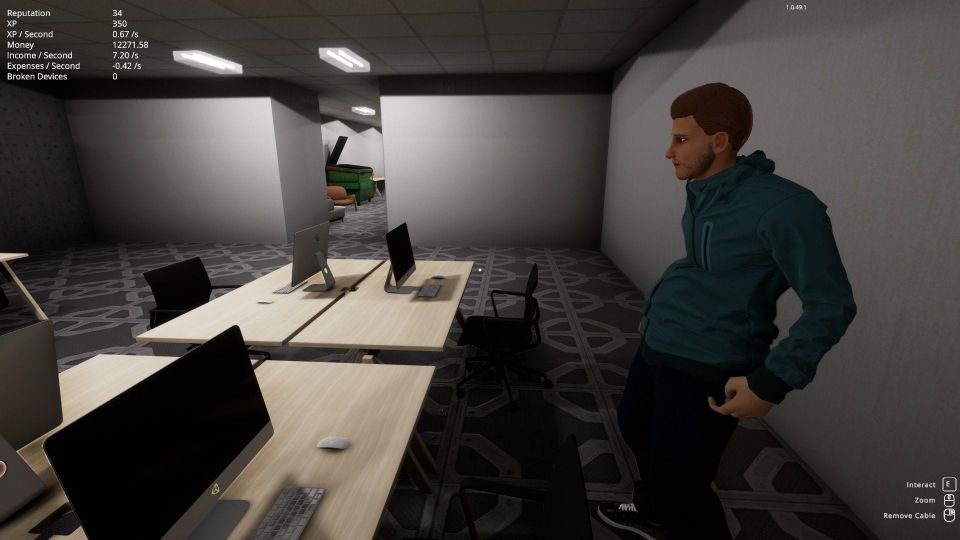
Data Center (US spelling) is about being a technician in charge of a data centre (UK spelling) and making sure all the wires go into the correct holes. On arrival to this new virtual workplace I find a radio on a nearby desk. I turn the radio on. It plays a sound I shall not classify as music. I turn the radio off. Time to get to work in a very compelling sort of hell.

Living In Sim is our monthly column about simulation games, and the frequently stupid misadventures they inspire.

This is an early access job sim all about

Truck Mechanic is the sim you abandon by the side of the road

Let me give you the breakdown

Living In Sim is our monthly column about simulation games, and the frequently stupid misadventures they inspire.

I like to test the boundaries of a world, and today I will do so by getting my truck into fifth gear and soaring off a bridge into a river. "Your truck has been destroyed," says a game over screen, bringing a sense of mild relief now that I cannot hear all the heinous gobshites on a walkie talkie who I have quickly grown to hate. I had such high hopes for my inaugural simulator in this much-hyped column, but here I am fully and apologetically sodden in the wet pits of a Latin American waterway. There are some car crashes that simply cannot be repaired. Truck Mechanic: Dangerous Paths is one of them.

It's a straightforward premise: all the simple pleasures of unscrewing wheel bolts and calipers in Car Mechanic Simulator 2021, but with the added terror of doing so on the edge of a deep ravine. Instead of working on bits of other people's cars in a garage for cash, you are now maintaining a single vehicle of your own, taking it screeching and sputtering across a

Living In Sim is our new column on "simulation", whatever that means

Try simulating some enthusiasm

Simulation is a huge genre, no two people will agree where it begins or ends. When a game nails "simulator" to the end of its name, like a big plank of wood, the case seems clear cut. Flight Simulator. Gas Station Simulator. Goat Simulator. But then you have all the high-level systemic games which simulate historical nation building or space exploration. Cities Skylines calls itself a simulation, so does Crusader Kings, Rimworld, Mount & Blade, and Dwarf Fortress. Racing sims distinguish themselves from arcade racers. And sports games can veer that way too. Session is a skateboarding sim in a way that Tony Hawk's is not. Football Manager 2026 is a sim, but Rematch? Hmmm.

As I am constantly reminding Jank readers, all taxonomy is folly. Viewed from the firmament, every game is a simulation. But there is often some extra pedantry or detail that pushes a game into being classified a sim. For the purposes of this column, I don't care where that fuzzy border falls, I only care that it exists. A sim is just any videogame that commits hard to the bit.

Why sims, of all genres? Well, we're a PC gaming site,