
The Data Center is where dreams go to die
I suppose it's time to reconcile my love for engineering marvels with the world's collective nosedive into technofeudalist hell. Okay. I can do that. Just as I find fighter jets impossibly cool, but do not actually want them used to explode people, I think data centres are impressive, but I do not like to see them sucking the world dry like a parasitic force beyond any ordinary human citizen's control. And since I am broken in the brain, the only way I know how to settle conflicting emotions like this is to play a videogame.
Data Center (US spelling) is about being a technician in charge of a data centre (UK spelling) and making sure all the wires go into the correct holes. On arrival to this new virtual workplace I find a radio on a nearby desk. I turn the radio on. It plays a sound I shall not classify as music. I turn the radio off. Time to get to work in a very compelling sort of hell.
Living In Sim is our monthly column about simulation games, and the frequently stupid misadventures they inspire.
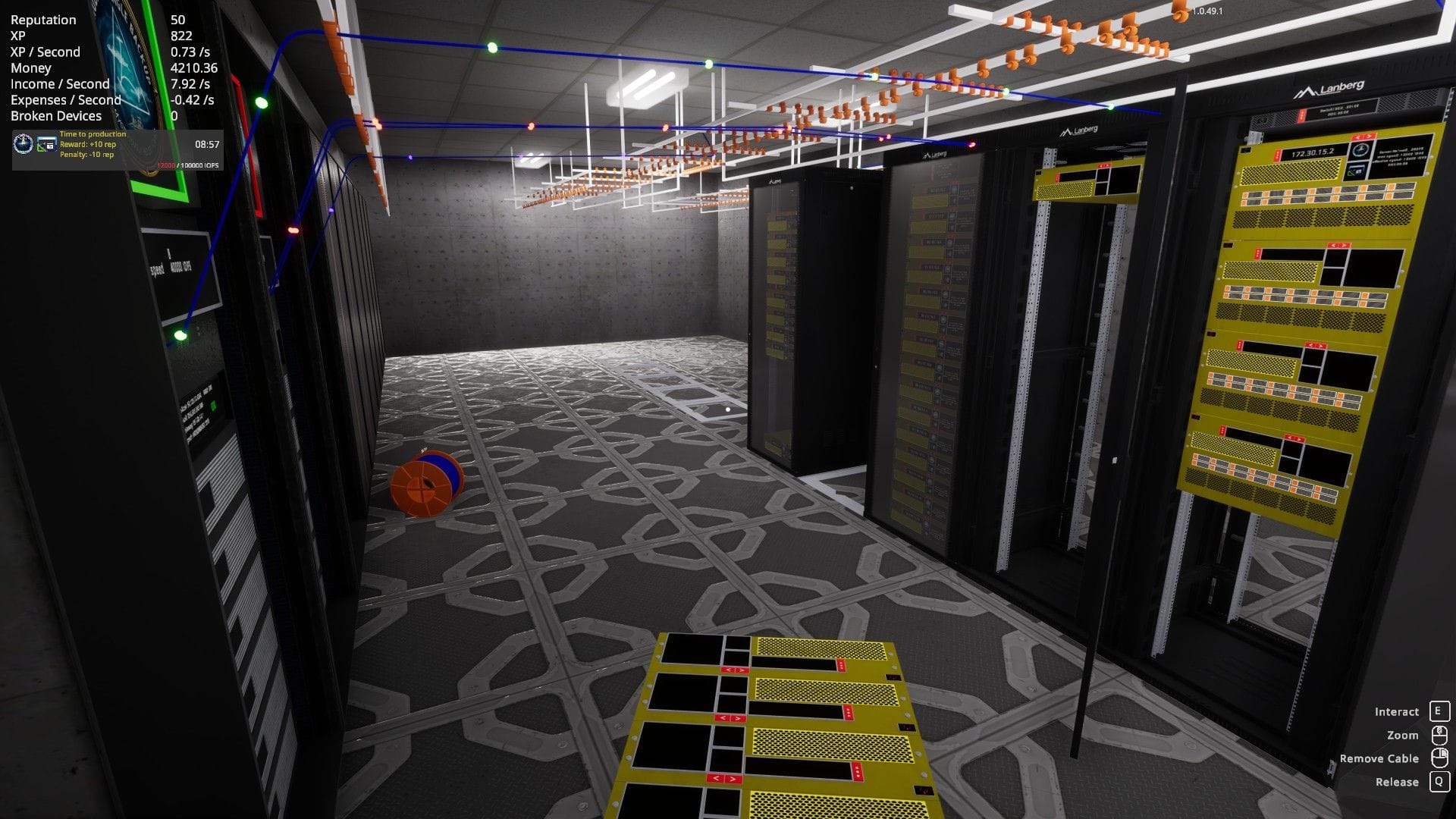
This is an early access job sim all about cable management and scratching your head over IP addresses. You plant down rack after rack, slot in servers and network switches, then string it all together with ethernet and fiber optics. One wall lines up your customer data points, and when you've got their servers up and running, you stand back and watch the little packets zip across the wires strung up overhead, like a very expensive set of fairy lights full of passwords and credit card information.
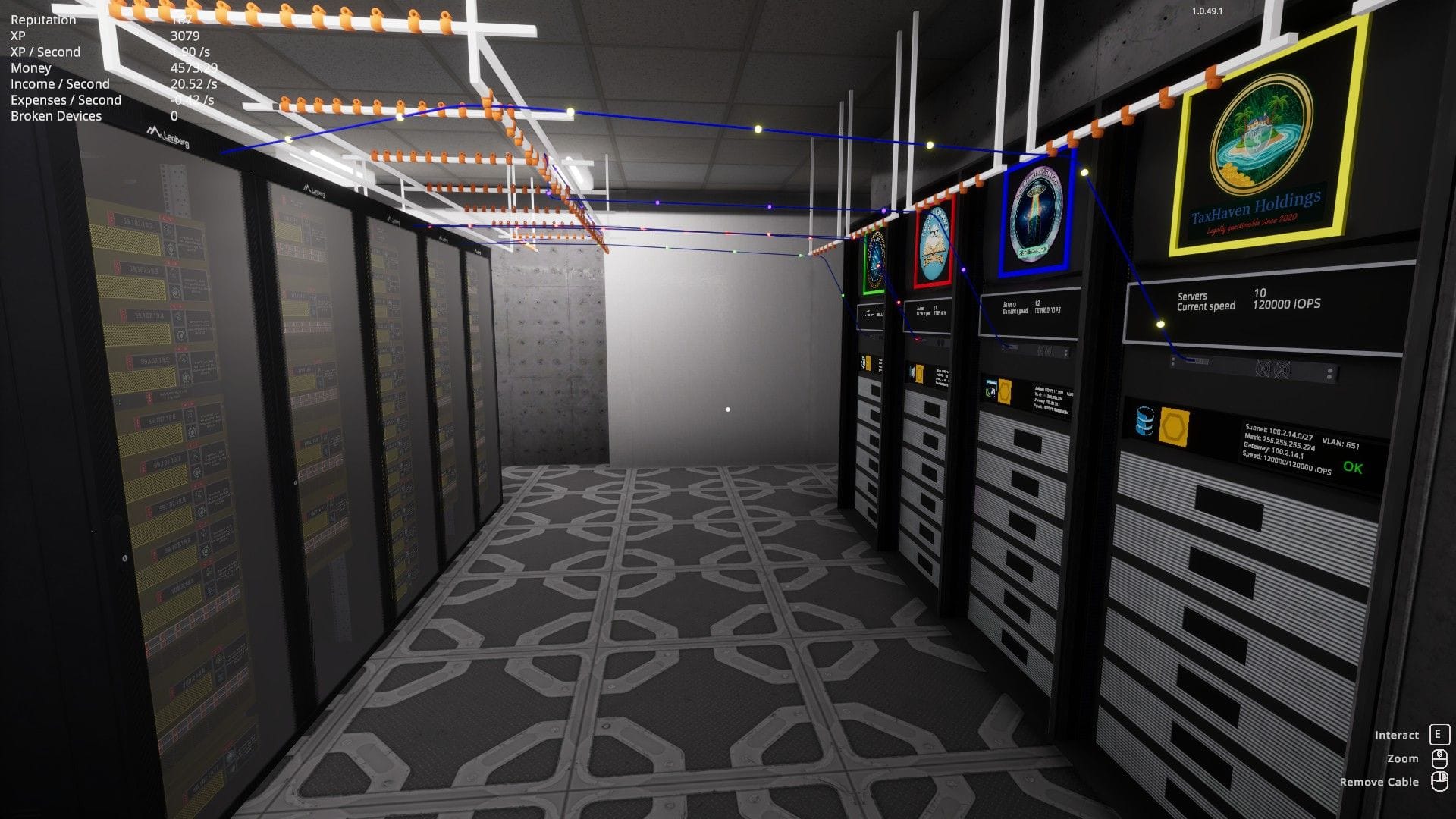
At first, I throw my wires all over the place, happy to embrace cable spaghetti. Then I realise the racks have all the useful hoops and gutters to run your cable along. Every customer you wire up generates income - money you'll use to buy new equipment to take on more demanding customers. So, like a constipated gambler looking at his Paddypower app while sitting on the toilet, I spend hours laying cable while waiting for money to happen.
But, ah, the designers have intentionally built these racks to be a problem. In one instance, I discover I can only fit 15 small servers in one rack, an annoying shortfall when I need exactly 16 servers to maintain good speeds for my customer. This means I need to untidily shove one server into an adjacent rack where it doesn't belong. I'll have to invest in beefier machines later to get everything running in one rack like I wanted.
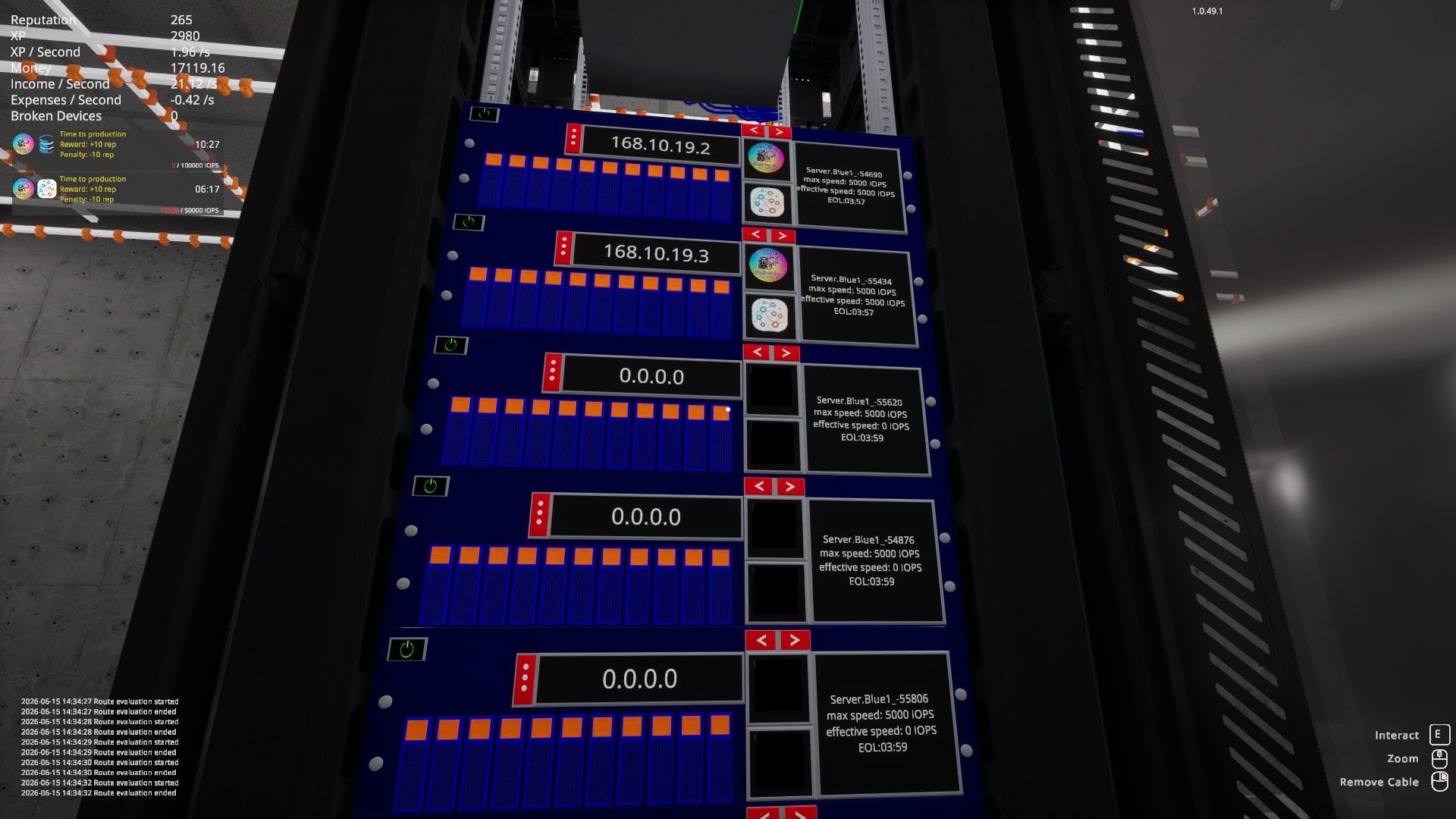
And so the game evolves like this, with you trying to cram more and more machinery into tighter and tighter spaces, every so often suffering a crunch for cabinets. The real challenge is: how do you keep this unholy mess understandable? Once you know a sensible way to organise your cables (hello patch panels) it's more an exercise in colour-coding and categorisation than in thinking through hardcore networking.
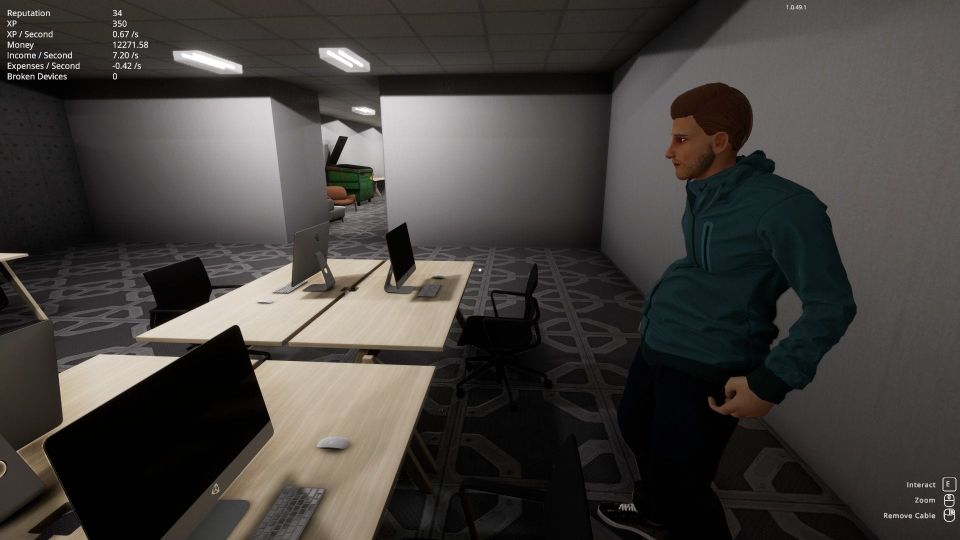
There is some depth, insofar as you have to know your subnetting limits and the benefits of link aggregation (yes, I have done a CompTIA certificate in Networking - don't ask). But it doesn't have the complex command-line hackery and broadcast storms of Tower Networking Inc, aka the job sim for freaks who like configuring their router. Not every single port and packet is simulated here. But the first-person cable finnicking at least gives it a more intuitively human feeling. At least until you outsource this cablework to one of the dead-eyed technicians you've hired. This is Greg. I pay him 1500 dollars an hour to look at a wall until something goes on fire.
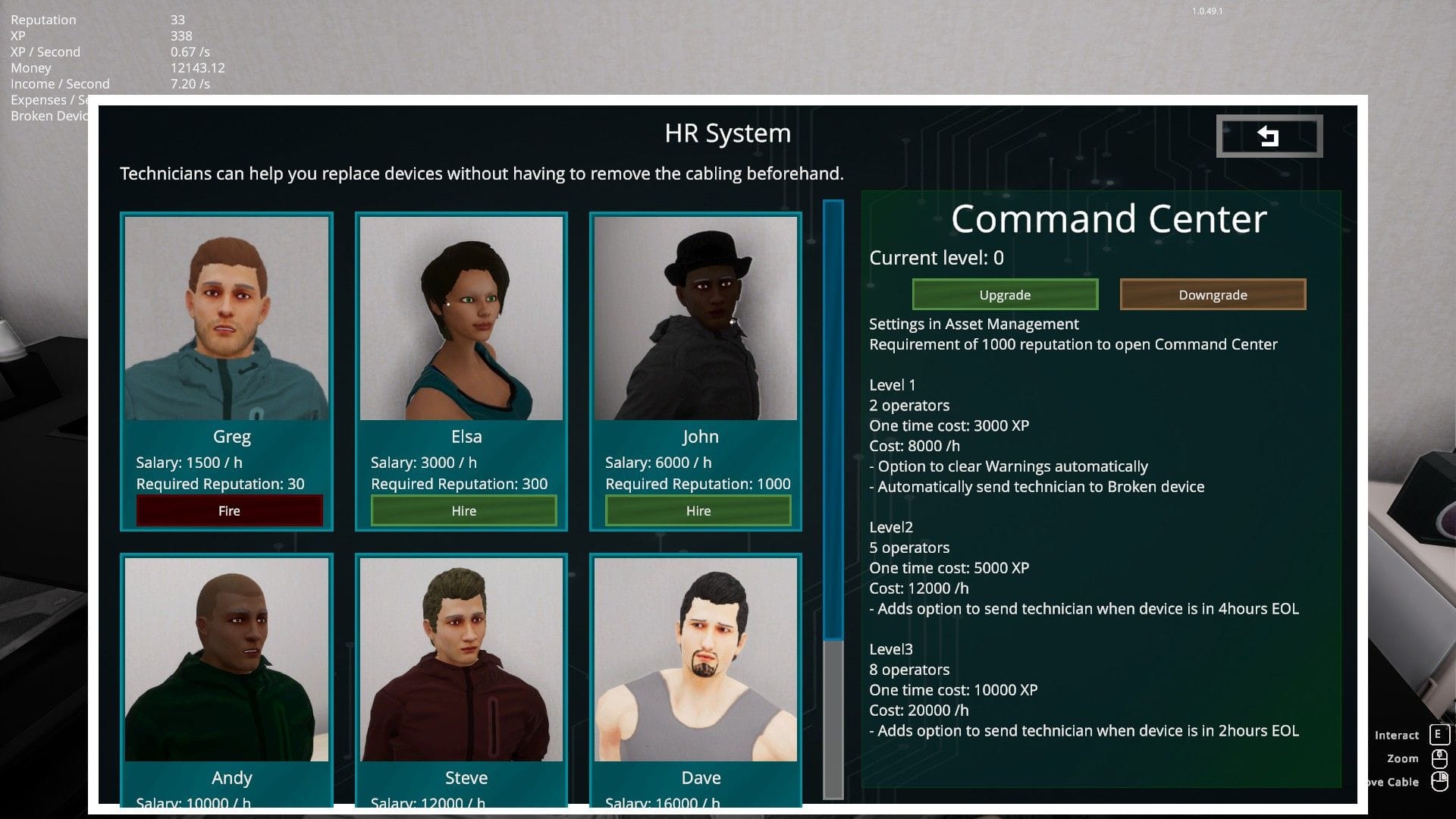
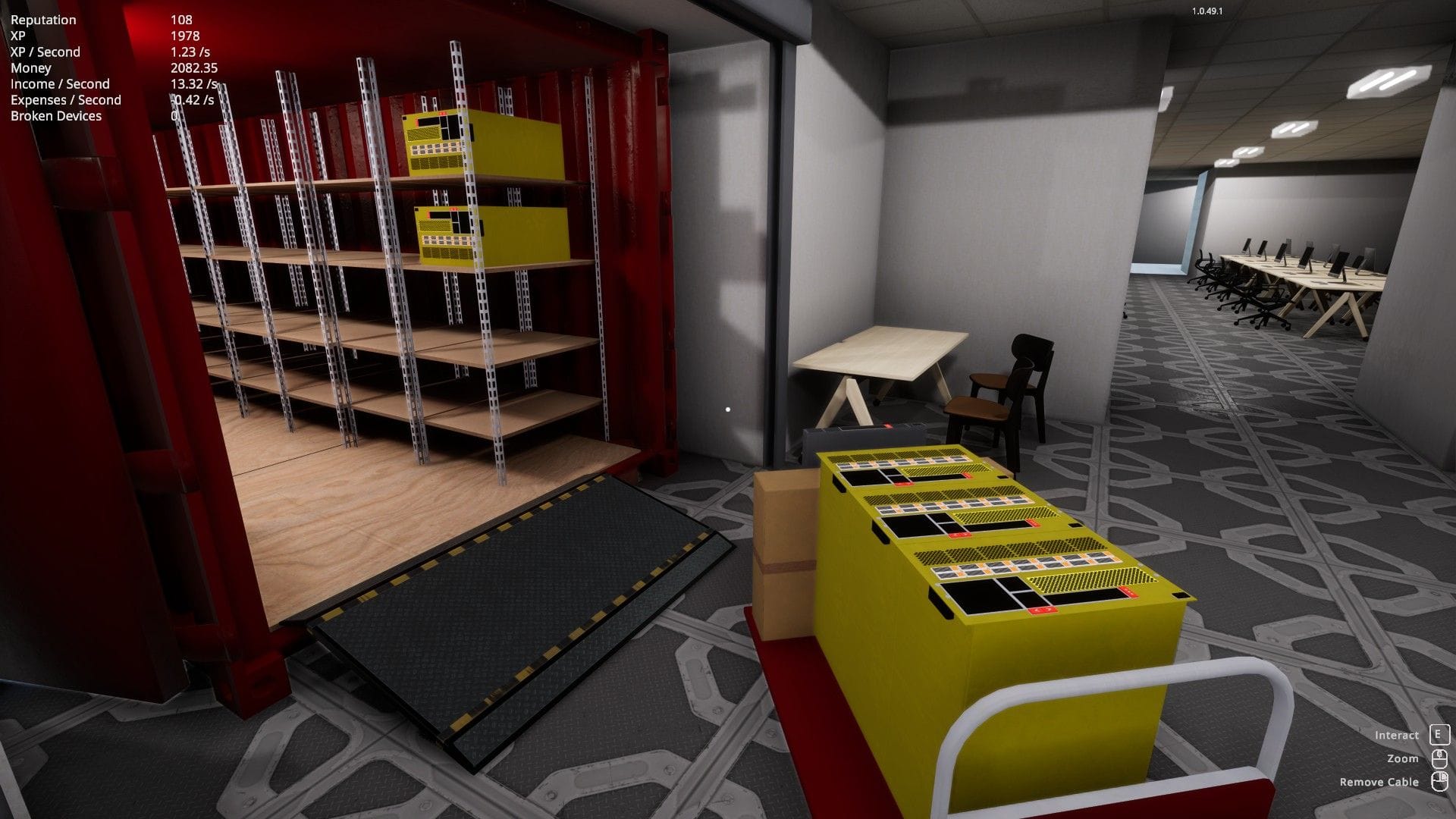
Greg and his terrible posture truly belong in this boxy limbo of early accessishness. Everything is as bare and plain as the inside wall of a pot of yoghurt. There is something very Backroomsy about the data centre. To expand your space and build more racks, you spend vidyagame dollars to blurp whole chunks of interior space into existence, giving the impression of a giant steel cave you are hollowing out somewhere deep beneath the earth. The closest connection to the outside world is the shipping container that closes when you use a nearby PC to shop for equipment. The container shutter closes. You hear the noise of a lorry. Clank. Thump. Slam. The shutter reopens and the shelves are once again full of switches, QSFP modules, cables and cardboard. The implied delivery man has gone, possibly home to his wife and child, or possibly to a greasy spoon where he can stare out the window and chew bacon with a sense of purpose and satisfaction. Meanwhile, you pick up another steel box. You will never see the sky.
At any other time this game would be a decent but unremarkable job sim played by a few folks and forgotten by everyone else. But in the calm before the AI bubble-go-bursty storm, it is a lightning rod for cultural criticism. So let us chuck a bolt. The overhanging controversy around data centre construction (or more accurately AI companies' insatiable hunger for park land and unquenchable thirst for your water) is not addressed in Data Center. At no point are you ever invited to question the moral validity of your workplace. This is not that kind of game. Wire connector go click.
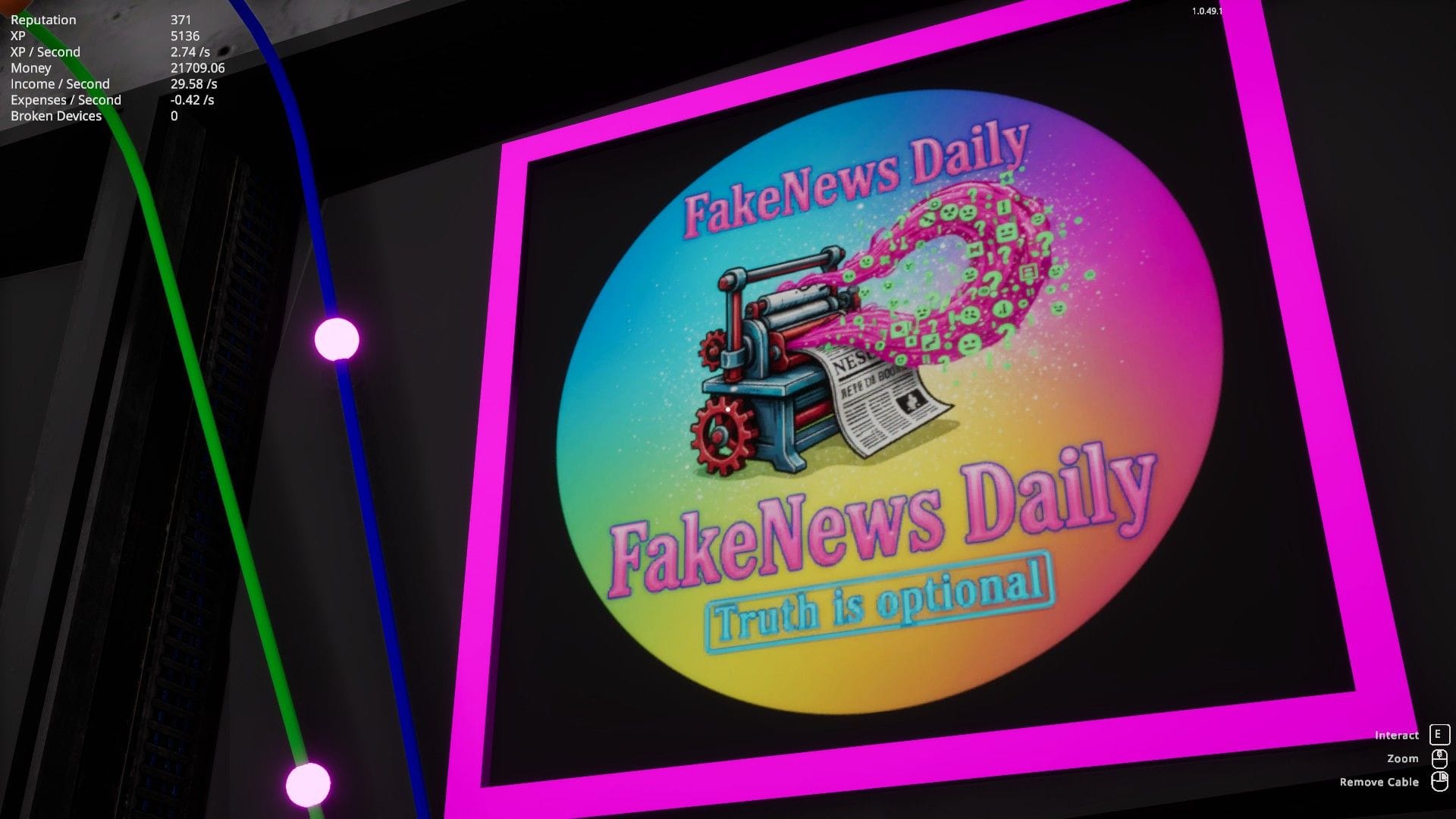
A generous interpretation of this absence is that such issues are beyond the scope of an early access sim made largely by one person. I thought about benefit-of-the-doubtfully pointing out that the fictional company names at least poke satirical fun at corporate malfeasance. Sadly, the generosity of this interpretation evaporates with the lame, low-effort names. TaxHaven Holdings, FakeNews Daily, Pollution Plus - this is worse "satire" than a GTA game. The company logos are the characteristically hideous result of generative AI. No printing press looks like this.
I recently wrote an entire piece on Librarian: Tidy Up The Arcane Library without realising AI was used in parts of that game. People got miffed, which is fair enough - I don't like AI either. I bring it up here because both games - Data Center and Librarian - share a core tension. They both appeal to the meditative task-doing impulse of humankind, yet both give you tools to shave away the time involved in doing that meditative task, whether by sufficiently advanced technology or by the book wizard's indistinguishable magic.
These are sims with twin-edged appeal. They can be about finding focus and tranquility in simple work, or they can be about chasing the dragon of efficiency. Generative AI is itself an ugly manifestation of the latter drive. Placeholder MS Paint art, like that of Slay The Spire 2's unfinished cards is better proof of a developer who values craft over crunch. It ought not to be much of a surprise that a game about data centres is utilising a tool for the artless. But it's still vaguely disappointing when the alternative - hastily sketched programmer art - would not have made Data Center worse in any measurable way. Because it already stinks so much of that often forgiveable early access roughness.
All that said, the data centre of Data Center is by definition and by design more corporate than the arcane library. You must fill the space more cost-effectively, you must employ your rack servants more frugally, you must wire more directly, you must floorplan more economically. Players have made whole spreadsheets to aid in this.
In designing the game around this principle, it ends up having more in common with an idle clicker game than a creative, open-ended simulation. You buy the next best servers to get a better speed/space ratio, you splurge on fiber optic cable instead of ethernet to up the bandwidth, and you unlock extra employees to automate the task of running new cables from broken machines. The process is complete - what was once the meditatively humdrum task at the heart of the game has been relegated to busywork you no longer wish to do. The magic is gone.
But it is not exactly realistic either. Every sim reflects judgements and values of reality, whether it wants to or not. There is no electricity bill in Data Center. There is no tax bill. You are beholden to no outside force except your customers. The only expenses are the humans you employ. And they have no humanity to speak of beyond the dopey expressions on their faces and - now that I think about it - their Roomba-like fallibility. They do not have lunch breaks and, like you, they will never go home. Hell is other automatons.
Let not this interpretation completely nullify the busybodying, cable stringing, IP typing appeal of the game. I don't want to make a moral judgement where an evaluative one will do (well, maybe I do, just a little bit). Data Center is a job sim like many others, not unique in its ability to soothe through the completion of repetitive tasks. But it has come into existence in a moment of high tension, the topic of these gargantuan buildings as charged as a giant static hand waiting to ruin a motherboard. It invites scrutiny in more than the usual ways. It comes away from that scrutiny feeling like a can of compressed air. A little bit of our messed-up world shrunk down into a tin, all used up quicker than you'd hope.


Comments ()