The Witch's Bakery demo got me out of a gaming slump
I've been feeling sort of listless lately. I want to be deeply engrossed in something and I'm currently not. My attempts to burrow inside a new game have been rebuffed several times in a row, and by the fourth or fifth time I abandon a new game within the first 30 minutes, I start to lose the will to try another. Book lovers talk a lot about being in a "reading slump", a minor malady that's often resolved by reading something short or re-reading an old favourite. When in a gaming slump, I often do the opposite, seeking out larger and more labyrinthine games as my desperation for absorption grows. This is a mistake.
The Witch's Bakery arrived at just the right moment. The demo, available in the ongoing Steam Next Fest, does not require any burrowing on the part of the player. Its delights are on the surface.
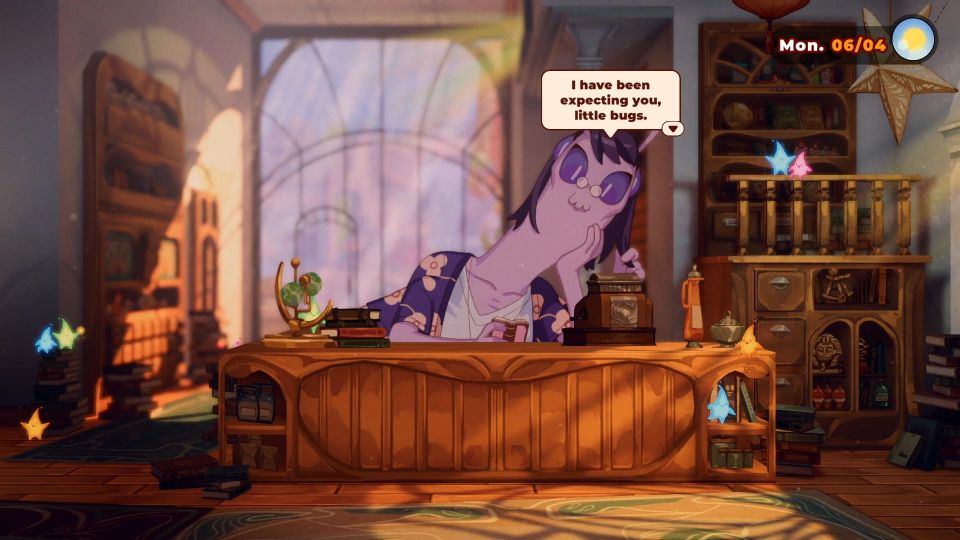
I mean, just look at it. Looking at it is most of the pleasure.
Lunne is a witch who has moved to Paris to open a bakery with her magical associate, a talking cat named Orio. You control her days and nights: serving customers their desired baked goods during the day, and then exploring Paris in the evenings to develop new dishes, decorate your shop, or make friends with the locals.
Some of those you meet are carrying a Regret, a magical entity that represents some deep pain in their past. Lunne's baked goods are magical, too, and allow her to enter into those character's hearts to resolve what ails them.
The actual mechanisms by which you do any of these things are extremely simple. At their best, you're playing a small-scale Pipemania, and at their worst you're simply dragging and dropping the cursor as directed by onscreen prompts, like one of those Elsa pregnancy browser games. Tap here, drag this, swipe there, This is friction without player choice or expression, and friction without those things is just busywork.
These moments of interaction aren't really the point of The Witch's Bakery, though, so I forgive them. Lunne's days in Paris are best enjoyed as a visual novel, and through dialogue, the 90-minutes of the demo already give a sense of intrigue to characters like your accountant (and love interest?) Estelle, magic student Mirembe, and Ghaldari, the giant spider who owns the local magic shop.
Kiki's Delivery Service and the wider works of Ghibli are an obvious inspiration, to the point where it feels almost redundant to point it out, but the art style delivers through lighting, the hand-drawn characters, and the sense of depth in the 3D backdrops. There are a couple of areas of Paris available in the demo and they're gorgeous, although the best is when Lunne and Orio return home each evening and sit on the roof of their building, with a view across towards the Eiffel Tower. Original? No. But there's an 'admire' button on the UI during this scene, and it's justified.
Clair de Lune plays during that scene above. The Witch's Bakery isn't complicated or deep. It is, if anything, pandering in its on-the-nose presentation of a friendly, inclusive, cosy world, at least within the demo. Yet it's the first game I've played in two weeks that grabbed me for longer than an hour, and I finished it ready to play more - more of The Witch's Bakery, and more of whatever else Next Fest has to offer.



Comments ()