
The World Cup is best in first-person
I am always watching football. Premier League, Champions League, La Liga, or whatever dusty field is being streamed on FIFA Plus; I do not care, I will watch it if it is football.
Naturally, I'm currently watching the World Cup. The only surprise is how often I'm watching it in first-person.
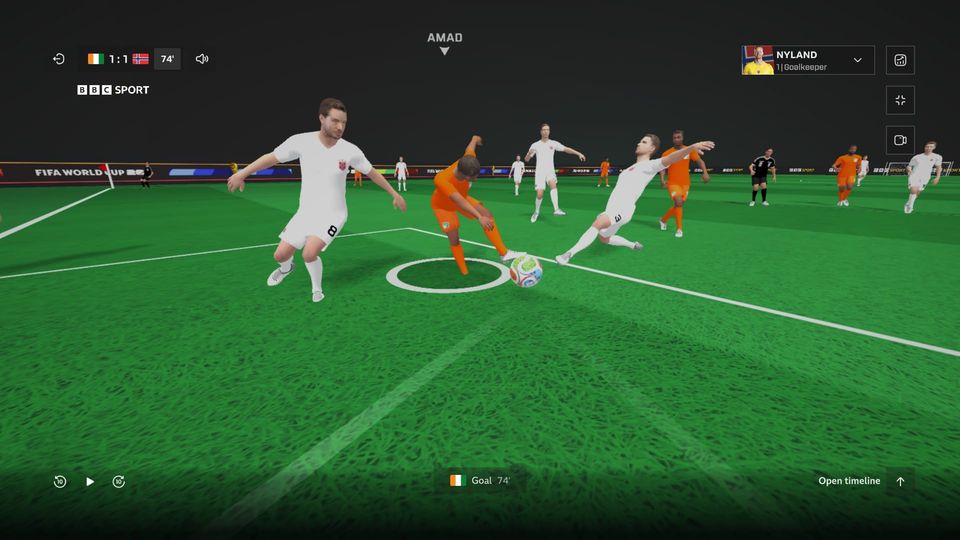
As part of the tournament, the BBC launched the FIFA World Cup 3D Experience (UK only). "3D experience" is one of those cursed phrases, conjuring expectations of a blurry Ronaldo JPG pasted on a wall in Second Life, but what they actually mean is: you can watch a replay of every single match of the World Cup in motion captured 3D. It's remarkable.
Earlier this evening, Norway beat Ivory Coast in the round of 32, and so you can now watch it in 3D in your browser. It's synced with the BBC's audio commentary, lets you overlay the pitch with shotmaps and formation stats, and best of all lets you move the camera around. That means you can watch Amad Diallo's 74th minute equaliser through Diallo's eyes as he jinks past defenders, or from the goalkeeper's perspective as the ball whizzes past him.
Messi looks at least somewhat like Messi and not like Bart Simpson
In the months before the release of FIFA 22, EA started advertising their new "Hypermotion" technology. When EA tries to sell a game on some tech they made up, it normally has the faint whiff of desperation - see Battlefield's "Levolution" - but Hypermotion was neat. After years of motion capturing a couple of people at a time in a studio, they could now capture an entire 11v11 football match at the same time, as long as everyone was wearing a mocap suit. FIFA 22 used mocap taken from just two matches staged by EA, but it made a difference.
Just two years later, the motion capture suits weren't needed anymore. EA Sports FC 24 instead used volumetric video capture taken from cameras placed in the stands during 180 real football matches in the Premier League and La Liga. Machine learning was used to process all that data and improve the animations across the game, but it also meant that Haaland could now run like the real Haaland (that is, like a terrifying locomotive coming to feed you raw milk).
That kind of data is invaluable to football itself, where teams want to track every detail of their players movements, and officials want virtual aids to help adjudicate offsides. Similar cameras are therefore now in place at every World Cup match, and allow for the creation of this strange toy.
This isn't the first such 3D broadcast in sports. Last year, the Australian Open broadcast real-time motion capture of tennis matches on the tournament's own YouTube channel, reportedly as a method of circumventing regional broadcast licenses that prohibited online streaming of actual footage. The bobble-headed avatars made it feel like you were watching Wii Sports. The year before, Disney+ broadcast an NFL match rendered in real-time in the style of The Simpsons.
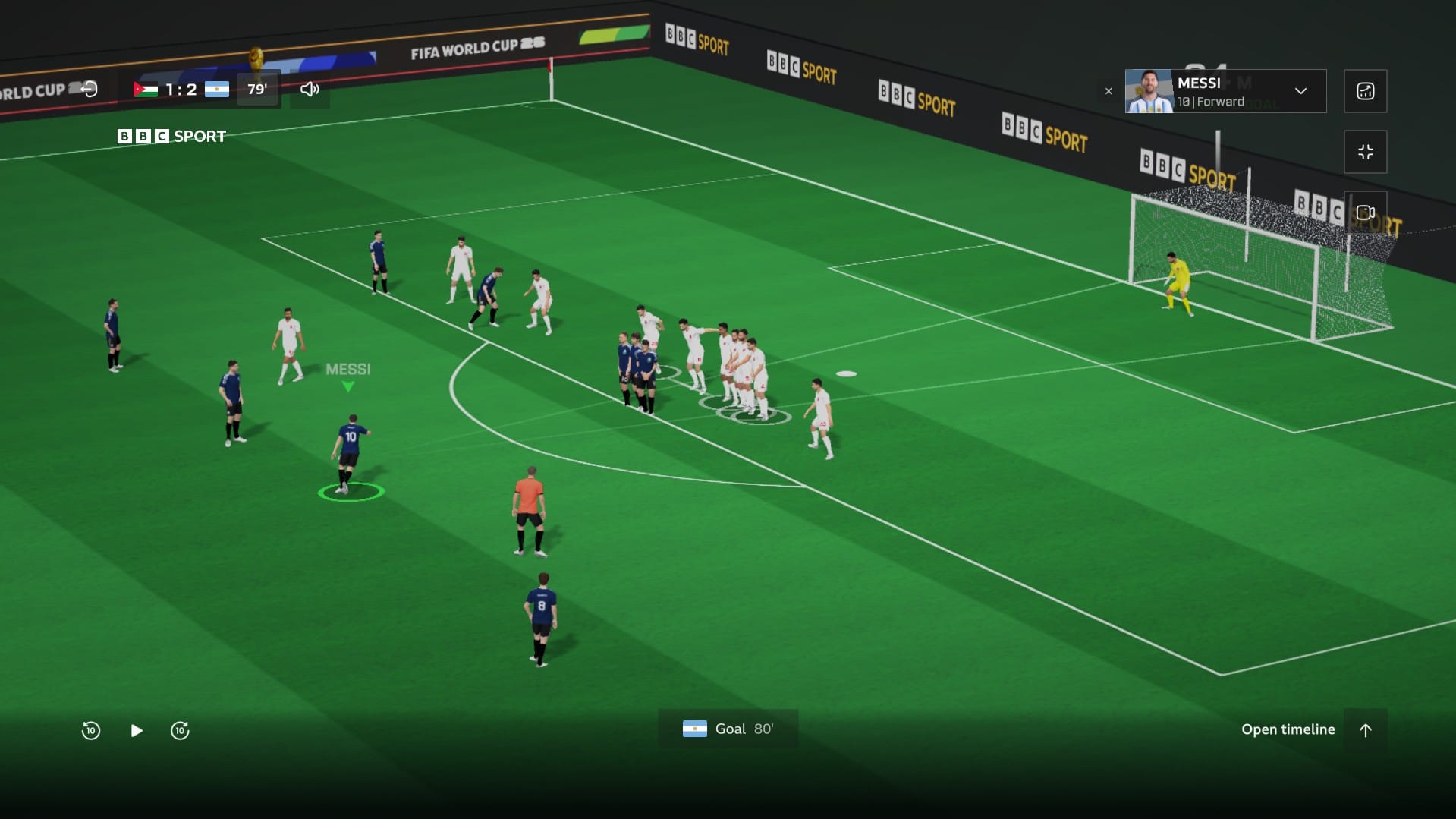
As an official broadcaster of the World Cup, the BBC's 3D experience is presumably not built to evade broadcast licensing but using data provided through it. It also feels like much less of a novelty thanks to the stats, the interactive camera, and that Messi looks at least somewhat like Messi and not like Bart Simpson.
The feel of it is less EA Sports FC, however, and more like Messi-ng around in the Grand Theft Auto 5 replay editor. I spent hours in that game, crashing a car in some spectacular fashion and then rewatching the disaster unfold from the perspective of every nearby NPC. They would turn their heads, reel backwards, and spill onto the floor like Neymar with Euphoria physics turned on. The overly nuanced juddering of the camera stapled to a Norwegian defender's head feels exactly the same way. Whenever something happens in the World Cup, I wonder: what would that look like if I was down on the pitch? And then I go find out.
I assumed doing this in GTA was fun only because it was my car that was crashing, but viewing the World Cup from different viewpoints is interesting even when it's not Scotland that's playing. It would be a stretch to say I was learning anything, but I think maybe you could if you wanted to study player positioning, anticipation, the constantly shifting geometry of a football match.
As a piece of technology, it's not perfect. The interface is a little fiddly for shifting between players. There are multiple perspectives for viewing the pitch from on high, but no fully freeform camera. And for every perfectly recreated slump of body language or swing of the leg, there are glitches in the motion capture, as when Diallo scores, wheels off in celebration to be mobbed by his teammates, and blinks out of existence.




Comments ()