Titanium Court review
You've probably already heard of Titanium Court, this season's indie game for people who very loudly say they love indie games. But hey: I love indie games! And Titanium Court is the most IGF Award-winningest game, too. This despite - or perhaps because - it defies easy explanation. Here goes.
Titanium Court is a metafictional roguelite match-3 strategy RPG. It uses 2D pixel art and has a minimalist colour palette that would be at home on the same sweet shelf as Wham bars and Refreshers. It is most obviously inspired by the Shakespeare play A Midsummer Night's Dream, but there are a lot of other influences (there's a small, very specific thing that reminds me of something from Clive Barker's short stories).
Because of all that it is very good, but also a tiny bit obnoxious at times. If Titanium Court were a person I would go to its Edinburgh Fringe show, but not invite it to my wedding.
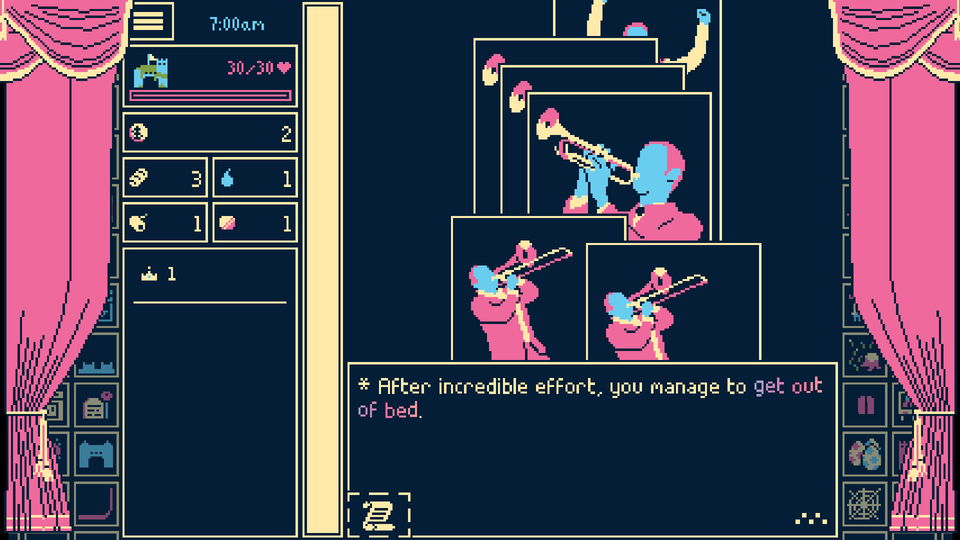
In fairness, if you're going to be meta, Shakespeare isn't a bad shout at all. His plays are often bookended by a guy coming out and saying "Here's what you're going to watch" and "here's what you just watched". Titanium Court is bordered at all times by some plush red curtains, and literally opens on a stage where a man introduces the player. Hey, that's you! You get lost in the woods and end up in a fairy castle, the court of the title, whereupon you are promptly crowned the queen.
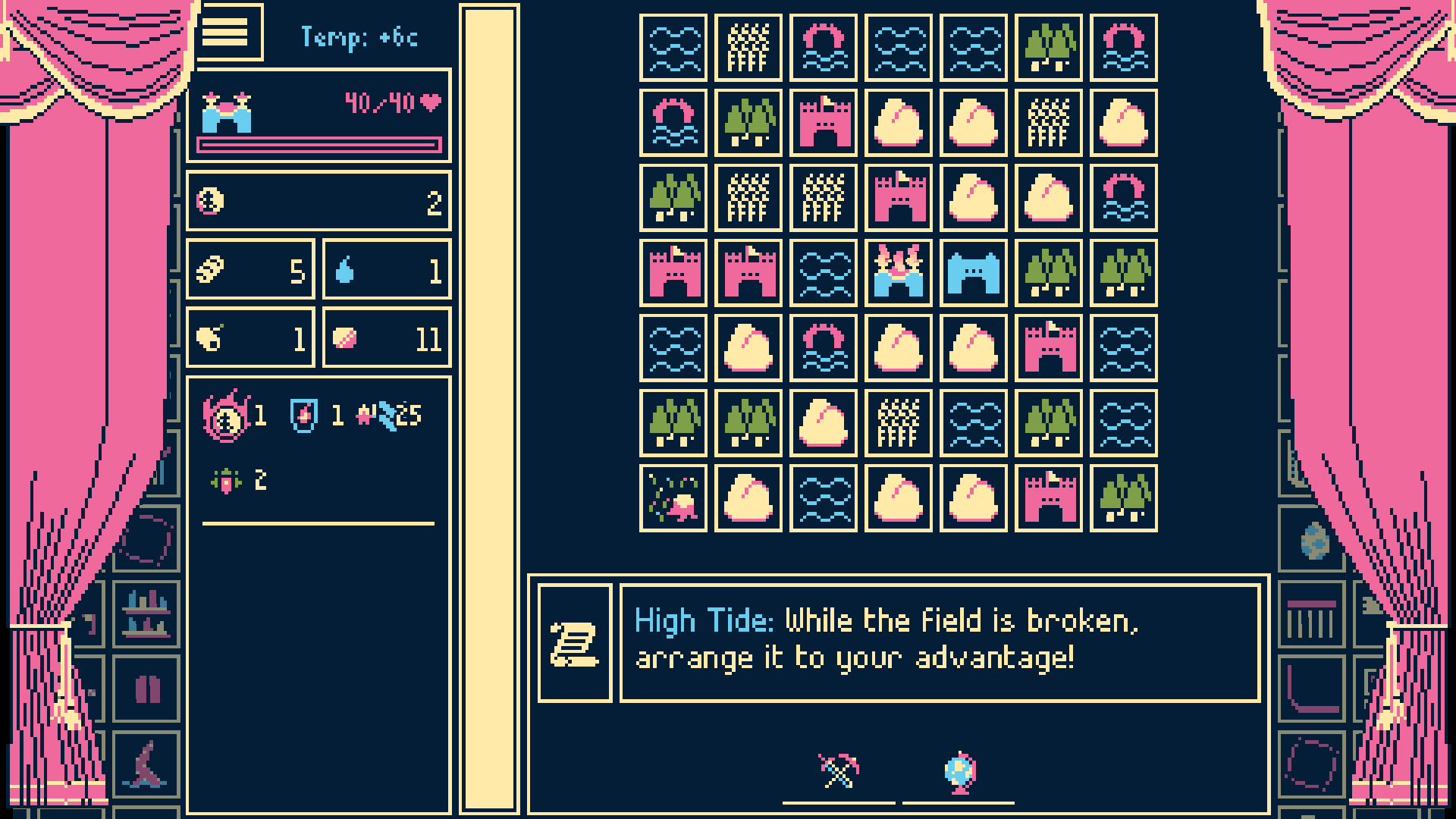
From there the game progresses along two tracks. In one, you go to battle on a match-3 field. The board is a mix of Catan-esque resource squares (water, fields, woods, etc) and enemy-generating units. During "High Tide" you can swap these around to match-3 them out of existence. In this way you can get rid of enemies, gain resources (matching three fields gives you bread, for example) or try to rearrange the board to give you a tactical advantage. Most enemies can't cross water, and hills will slow them down, that sort of thing.
Then, in "Low Tide" you can spend gathered resources on your own units and spells, be they defensive or offensive. After this you have to let the battle play out, and if your Court survives then you go to the next battle, until you face a boss (which vary from fire breathing dragon to a mirror to goats manning checkpoints). If you lose it's fine, because you get to do it over again the next day, after breakfast.
There's more to it. During Low Tide you can interact with other structures that turn up on the board. There might be a hospital to heal you, or one of three flavours of shop. I was offered a "football" that I had to get to the "end zone", which was a giant egg I had to protect until the end of the war. You can unlock other "jobs", which are basically different character builds for your Court. My favourite was the Arsonist, which is immune to fire, earns money from burning stuff down, and can cast a flame spell - except on the battlefield where I saw a sign that said "No Smoking".
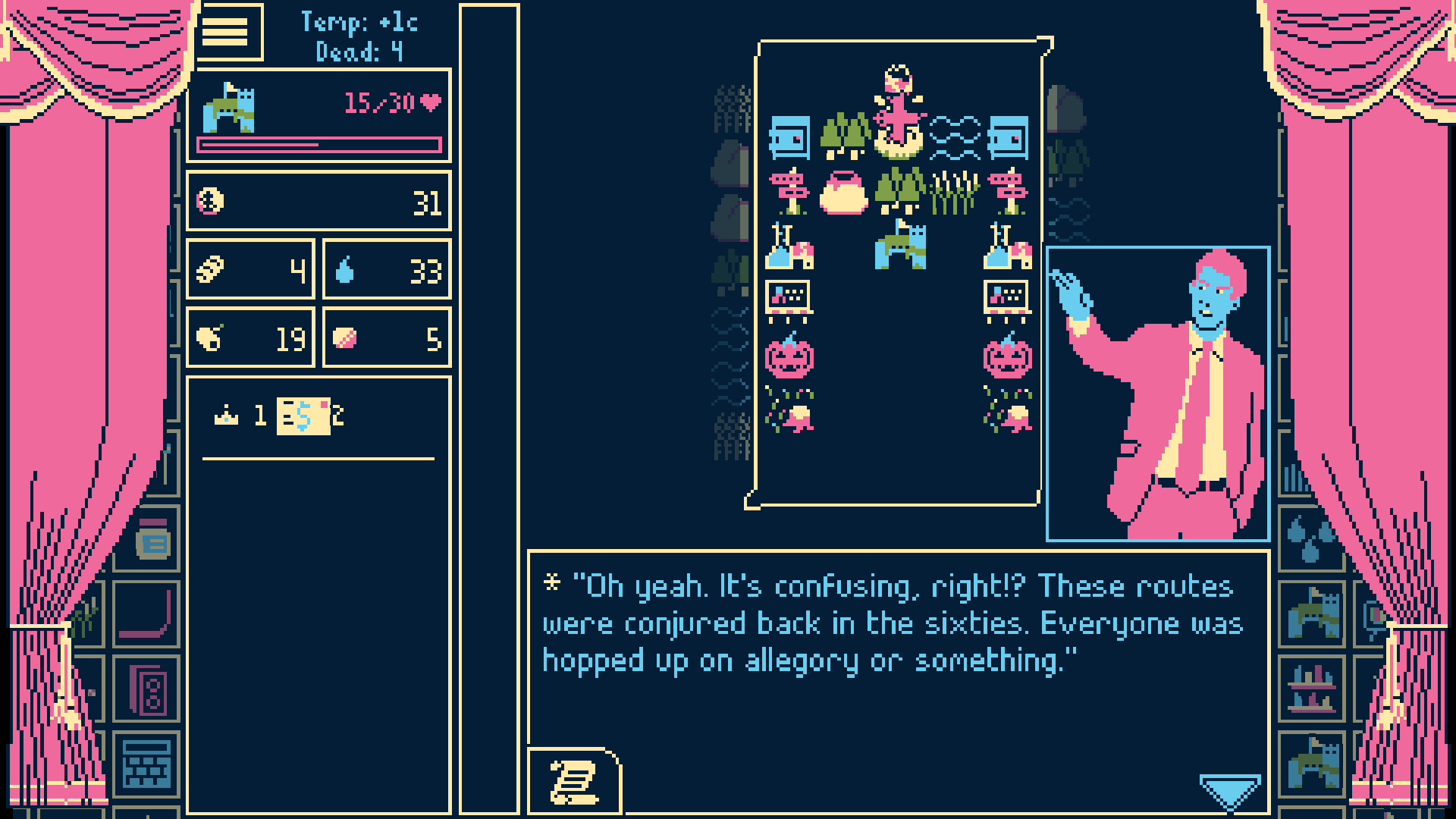
The other track is the story, which you encounter between wars, and is the weirder bit. Whether you win or lose you'll make some progress, and get to discuss the nature of magic with your courtiers, admire art, or hear petitions from the cat. But if you win you start to see through the fourth wall. Puck, notionally your chief adviser, avoids you during the day, but in some parts of the castle he "doesn't even have to stay in character", and at night you can ask him a single question, after which the whole Court disintegrates.
There's a gift shop that only opens at night, a hidden library, and the cat is in the pantry asking you to pile up resources left over from the battle. At night you have a chance to collect the keys that will open the castle gate, and set you free. Titanium Court is a game that's aware it's a game, and it will start telling you that too, in a tone that sometimes borders on tart. It's delightful. And it removes more and more of the fourth wall as you go, especially when discussing what is actually the largest threat to the Court.
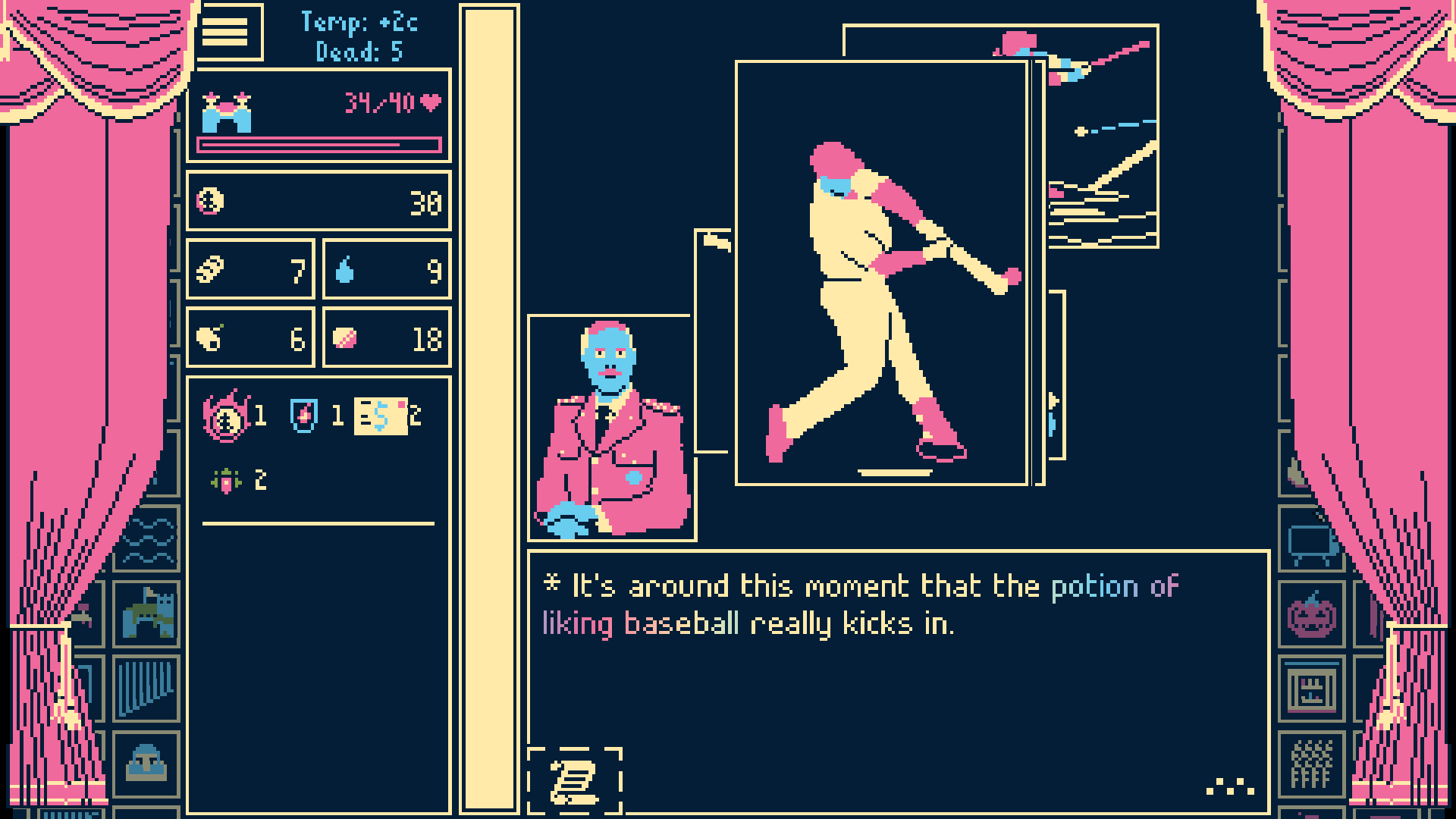
Though only Puck is aware of the extent that Titanium Court is, you know, not real, the other fairies are aware of the mortal realm as another place rather than another reality (ah, but what's the differe-). Thus they talk about cars as mythical beings, and you are able to drink a love potion that will make you like baseball (it helps with your anxiety, because in idle moments you think about baseball rather than being sad). Sometimes the anachronisms are really, really funny, and Titanium Court also uses animation in a very pleasing way. The 2D portraits are static, but they're often contained in boxes that layer on one another or zoom from one side of the screen to the other.
Titanium Court itself seems much more impressed with the story part of things, and some evidence for that is how it gives you a leg up. You can have a shower most mornings before starting the War, during which you will be given a gameplay tip, presented as your own shower thoughts. If you fight and defeat your mirror self, you can skip straight to the end of the War, and eventually you get offered a sort of automatic win on the final boss fight.
This part on its own functions as a useful yardstick. Titanium Court is layered, complex without being overwhelming, funny, and original. To skip the boss fight, you have to watch some "alternative entertainment" i.e. developer A.P. Thomson singing a full length song about... well I won't spoil it. But it genuinely goes on for like five minutes. And you will either think "ahaha, that is a funny bit of art and also I did skip the boss fight so this seems more than fair" or "alright mate, you're not getting five stars in The Scotsman for this."



Comments ()