
Half-Life

Anatomy of a wall

Some kids learn piano or dance. I learned how to keep render speeds low for Half-Life geometry

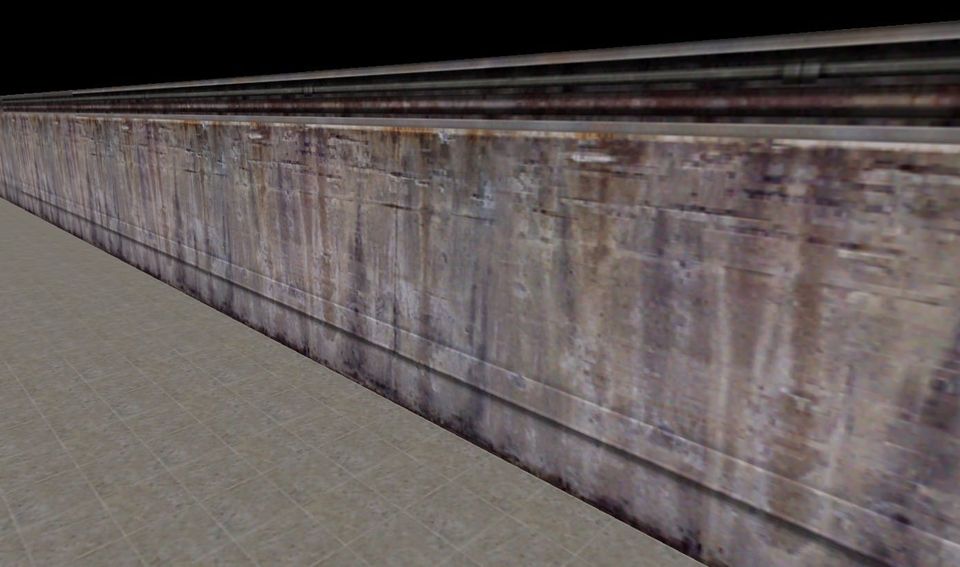
This is Wall Week, but there are no walls here. What you see in the screenshot above is not a wall, but a brush. A brush is a simple geometric shape rendered within Half-Life's Quake-derived GoldSrc engine. This particular brush is constructed within the Valve's mapmaking tool and consists of six faces, their corners defined by vertices. When run through the bsp compilation process, all faces not visible within the vacuum-sealed innerspace of your level are marked so as not to be rendered, and the remainder will rendered in-game as triangular polygons. If you look at the image and see a wall, then it is only an illusion.

Why is any of this important? It's not, really, in 2026, but I spent a thousand hours learning how to make Half-Life maps when I was a teenager and 25 years later I'm still mentally trying to keep the r_speeds down.

"R_speed" stands for "render speed", the speed at which the GoldSrc engine is able to draw whatever is currently on screen. It's a console command you can turn on in any Half-Life level to cause a waterfall of stats to trickle down the console log like you just enabled the Matrix.

📢
This article is part of Wall Week, a celebration in honour of our paywall going up.

This post is for paying subscribers only

Already have an account? Sign in.

Here's our 17 most-loved multiplayer FPS levels

These maps lead the way to our hearts

When Graham and I sat down to scrounge together a definitive list of our favourite multiplayer first-person shooter levels, we knew that many of them would originate in the late 1990s and early 2000s. We are children of the dial-up deathmatch, so it comes as no surprise that many of our most-loved maps are simple blocky arenas made of grubby textures and low-definition skyboxes.

But what has surprised me is how the best modern maps feel like classic favourites. Any fast-paced bloodsport today still benefits from the fundamentals of map design that were hashed out by the makers and modders of yesteryear, and some of the most interesting multiplayer maps of modern times come about when studios commit to a strong theme, just like 90s developers were fond of doing, repressing any consideration of long sightlines or cheesy camping spots in favour of a single funny idea. Okay, nobody at Blizzard is making a homage to Facing Worlds. But battle royale maps that dramatically evolve are all about flavour begetting function. And the Finals definitely owes a thing or two to Quake 3. Don't get what I mean? Read on, and find out.

Crossfire