
I love the command line
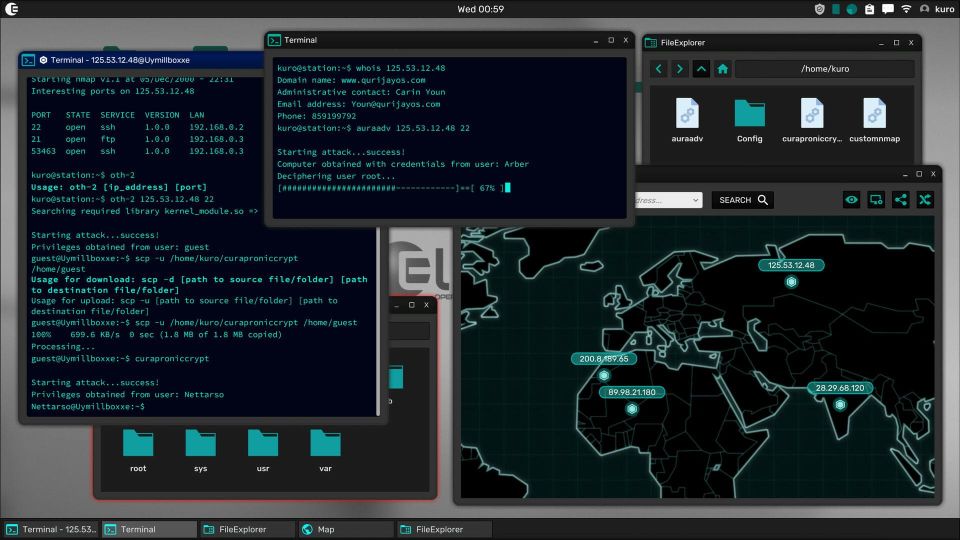
I love typing weird words in the dark. The command line interface is an archaic curiosity to some, or a desperate measure - an obsidian prompt invoked by troubleshooting articles when something on your PC has gone terribly wrong. But for me it's an invitation to an invisible realm of circuitry and verbs. I thank the cybergods that plenty of game developers have a similar fascination.
For example, Duskers 2.0 was announced during the summer games dump, a long overdue sequel where the simple typing of instructions to glitching robots is the only weapon you have against an alien bestiary of unseen threats. The command line, when done well, is enough to hang a whole sci-fi horror universe upon. It's like groping around in a dark room, with language as your only limb.
"The command line allowed us to make Duskers so much more atmospheric," says Tim Keenan, founder of Misfits Attic. "It forced the player to 'speak' to the drones in their language, reinforcing the idea that you are alone and the drones you're talking to are cold tech that require you to conform your speech and thoughts to their way of communicating.
"It also reinforced the feeling of being in a highly utilitarian environment of a spacecraft that makes things seem more real. Controlling Space Marines with a mouse & keyboard isn't realistic, but controlling drones via command line is."
I love the command line because it is essentially a blindfolded version of the same sense of discovery I like in other games. It reminds me of old text adventures, of exploring the seemingly dead computers my mum slowly accrued in our attic over the years. It also brings to mind scenes from all those movies where nerds trespassed in digital realms they really should have left alone.
The command line is particularly well-suited to stories that explore the dark underbelly of the internet. Hacknet was the best early example, a game that let you vandalise fried chicken restaurant websites and dodge government agencies by bouncing your connection from proxy to proxy. It made you feel like Dade Murphy. You could open your CD tray using an in-game command, which I realise will probably only be impressive to those who have actually owned a PC with a CD-ROM drive. Meanwhile the more recent hack 'em up Greyhack basically recreates an entire Linux machine and puts you on an MMO network with other players, all out to cut your virtual throat and steal your cryptobucks. It is the realistic modern successor to Hackmud, a sci-fi multiplayer freakshow of skulduggery that lets you write entire tracts of malware in Javascript for unsuspecting players to use.
But nothing in recent memory gets darker than s.p.l.i.t. It is a singleplayer cyberhorror from the maker of Buckshot Roulette, and it uses the command line to depict a future in which mere imprisonment for hacking offences would be a downright luxury. The more you crack your way into the enigmatic machinery of this futurehell, the more you'll regret ever having turned on your computer.
"I started properly using a command line when I bought my first VPS that ran on Ubuntu," says Mike Klubnika, the game's creator, "and it felt very cool to remotely access a piece of hardware and do stuff on it through a pretty barebones interface. Also very tricky, which made it quite rewarding and satisfying when everything was working properly."
I want to say command line games have exploded since the likes of the first Duskers, but all games have exploded since then, so it's hard to quantify. Yet they've definitely become an established subgenre of some kind. Steam recently had a whole sale dedicated to "fake OS" games, and it includes a smattering of command line driven games.
These fake GUIs excel at lighting up parts of your memory (or evoking pseudonostalgia, if you were not actually around for Windows 95). The visual and sonic character of old operating systems does a lot of the heavy lifting when it comes to building atmosphere - all those trailing dialog boxes and gray 'OK' buttons. But the command line has fewer aesthetic tricks to pull. The minimalism forces you to engage with the game itself, forces you to think and probe with an entirely different brain, whether you were there for MS-DOS or not. It's harder, I think, to pull off a good command line game than it is to pull off a good "fake OS" game with a purely graphical desktop.
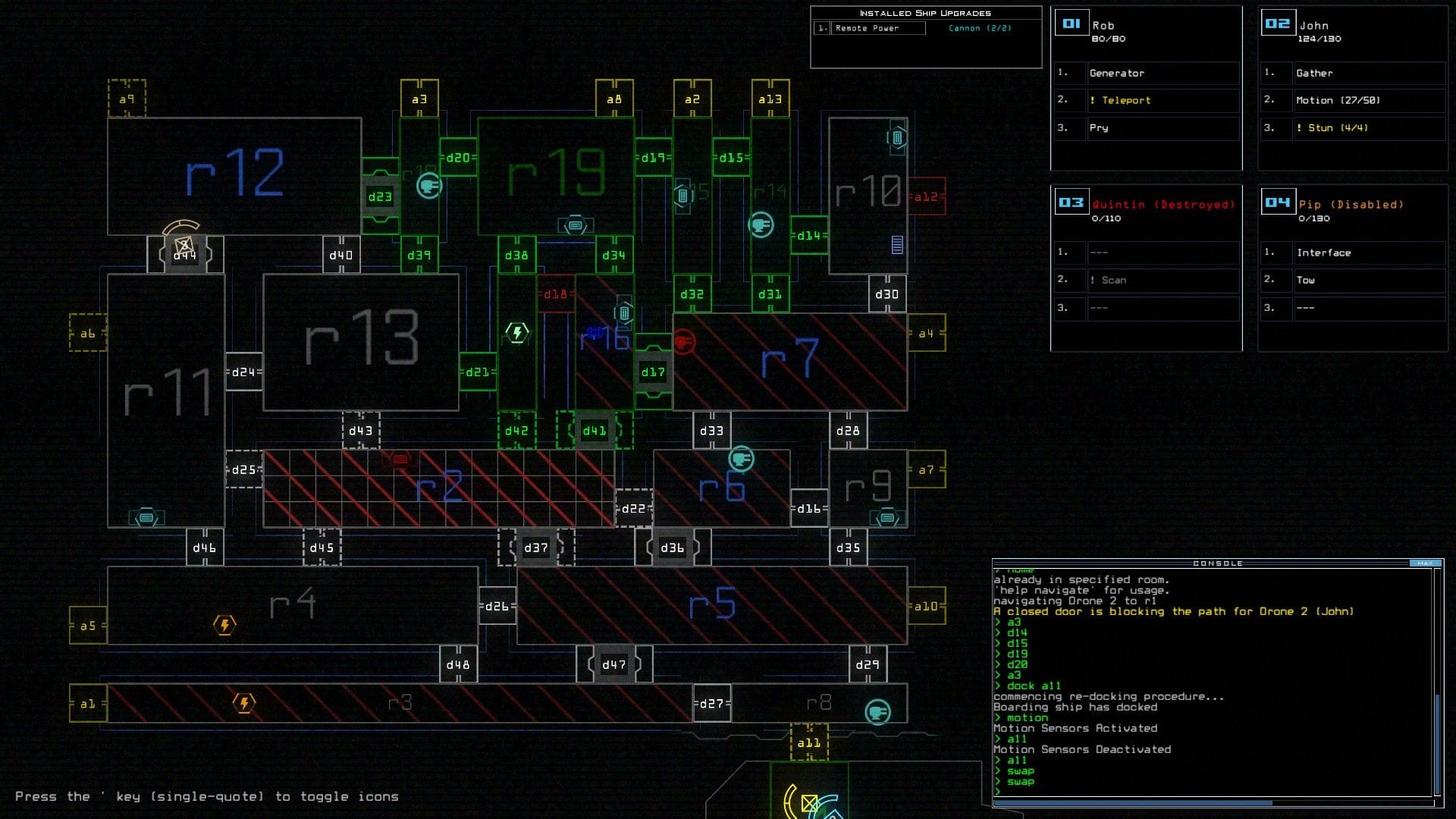
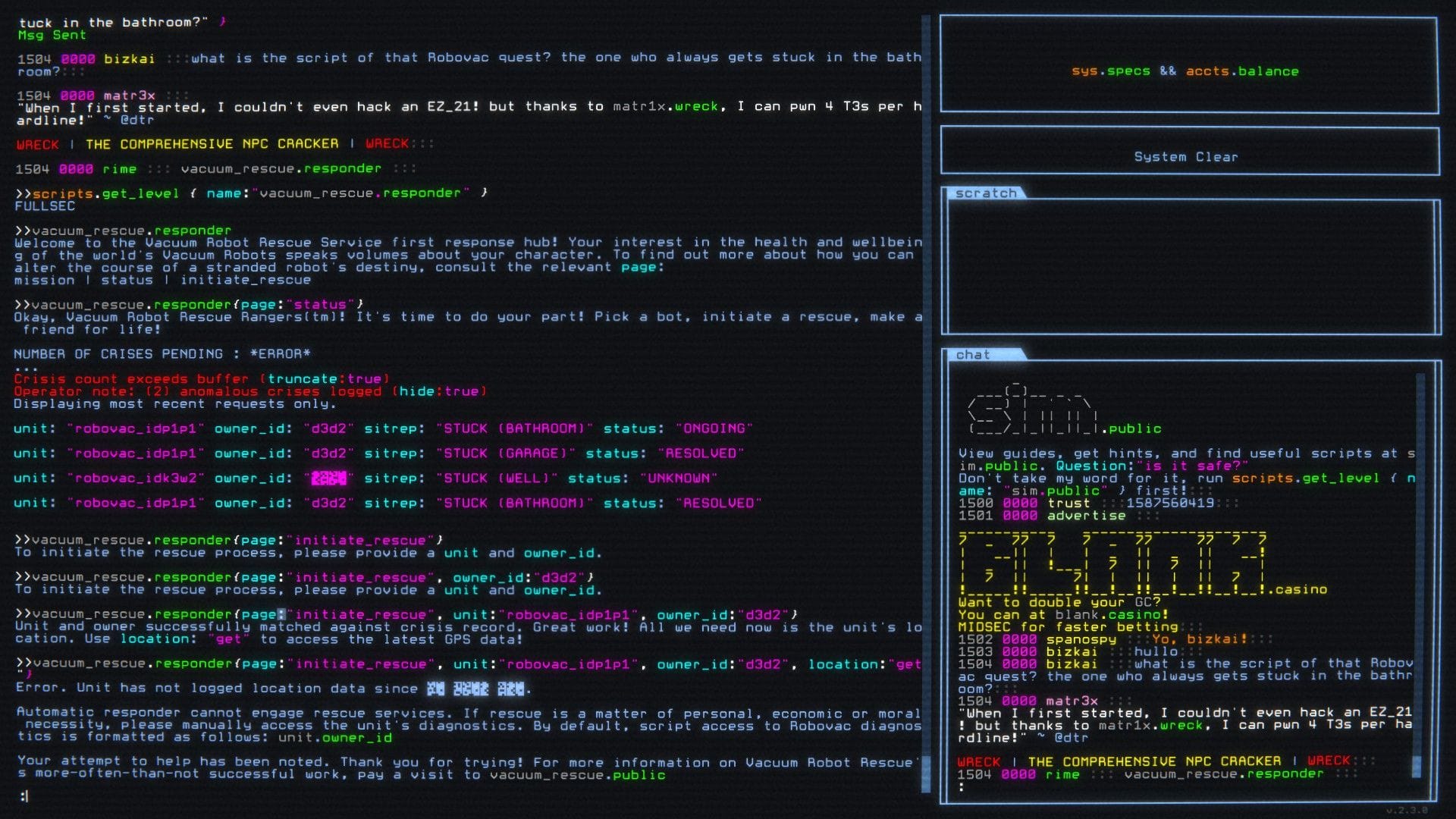
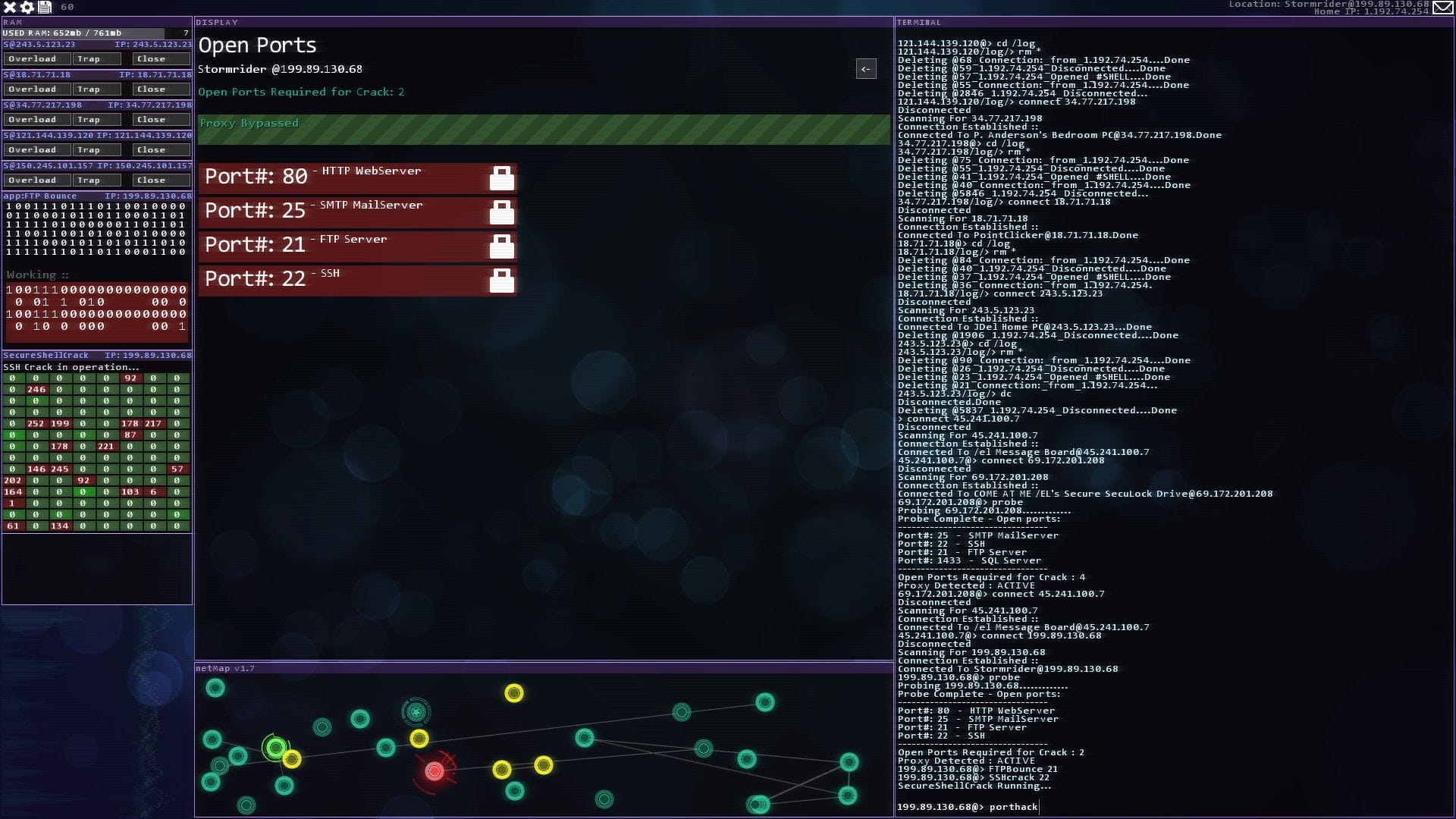
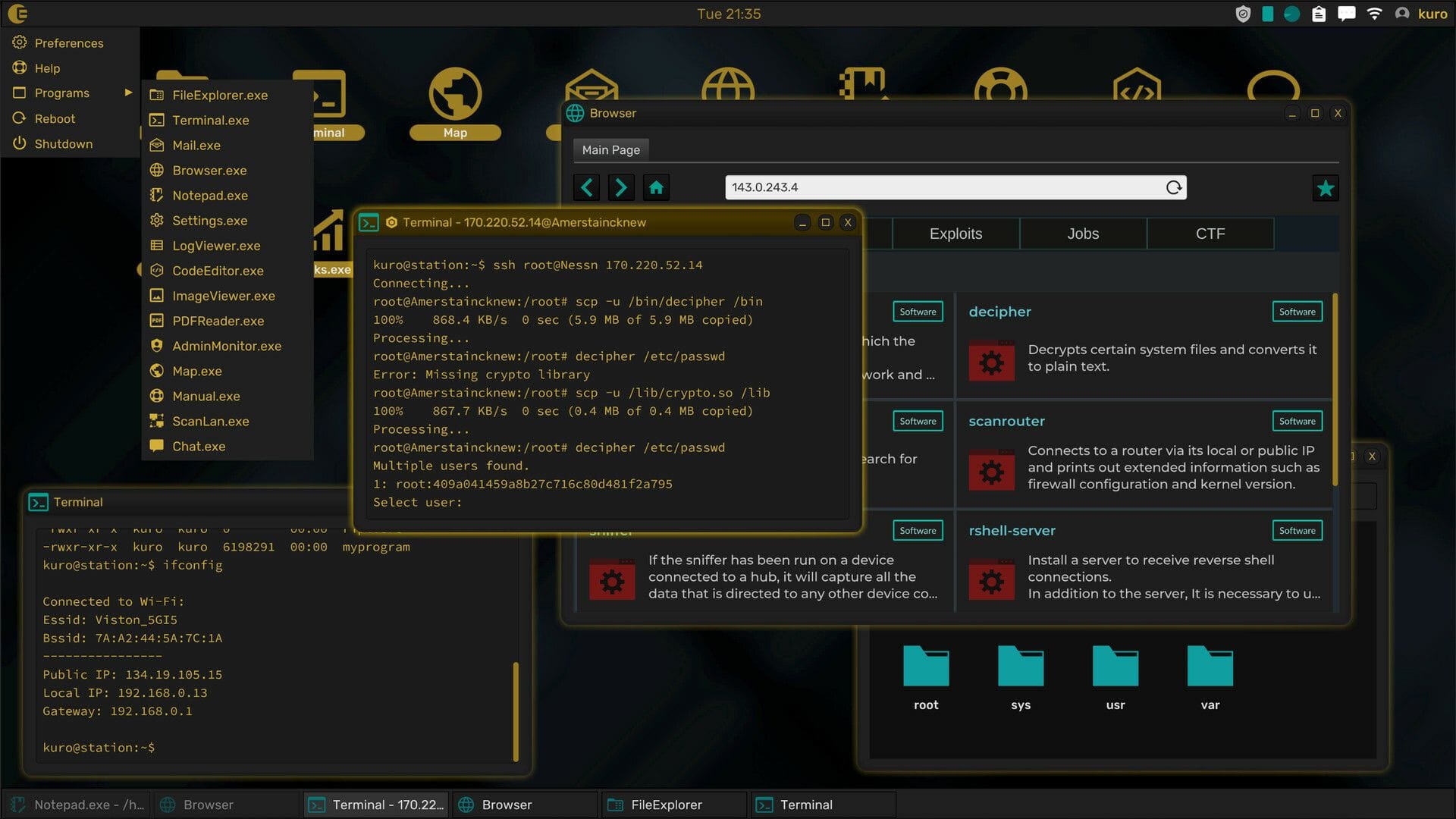
Clockwise from top left: Duskers, Hackmud, Hacknet, and Greyhack.
"For me the artwork and design languages of command lines are also very pretty," says Klubnika, "stuff like fixed width fonts being used to display images, loading screens, and things like that look very nice. A bunch of other interfaces work alongside it as well, like in the case of s.p.l.i.t and other CLI games, IRC chats do the trick perfectly for other means of storytelling. It's super fun to experiment with."
I'm not suggesting games with a focus on the command line are better than their GUI brethren - many are shallow - but it often feels like there's more of a systemic "world" to discover in Hacknet, Hackmud and Greyhack, as opposed to Orwell or Hypnospace Outlaw, which are about unravelling a story by navigating through a kind of virtual garden. I like the plain black screen of Type Help over many of these cool retro interfaces. Not least because it forces you to make your own notes or commit to memory the correct commands and file paths. In a command line game, you build a map of an entire digital landscape inside your own head.
The reason I'm writing about this now, of all moments, is partly because I recently evicted Windows 11 from my laptop's hard drive in favour of Linux, shamelessly joining the ranks of all the holier-than-thou distroheads who spit at the sound of a Windows start-up noise. I've done this before, but I always go back to using Windows 10 on desktop because: be serious. I have a job to do.
 Graham Smith
Regardless, I've loved the sojourn into the command line proper. Just like Graham, I enjoy tinkering with these cursed rocks we have electrified to count numbers for us. When I discovered running your own Raspberry Pi with an adblocking DNS service is actually a terrible method of blocking ads (just use uBlock, kids), I didn't even mind that much. The process of typing commands and rummaging around the directories of an unfamiliar inky digispace was the point of the exercise all along.
"It's compelling for similar reasons as being bilingual or having bespoke slang with your friends," says Brendon Chung, the designer of Quadrilateral Cowboy, "knowing this special language opens up a world to you. It's very satisfying to accrue grammar and syntax that lets you explore and play in a whole new space you didn't know existed."
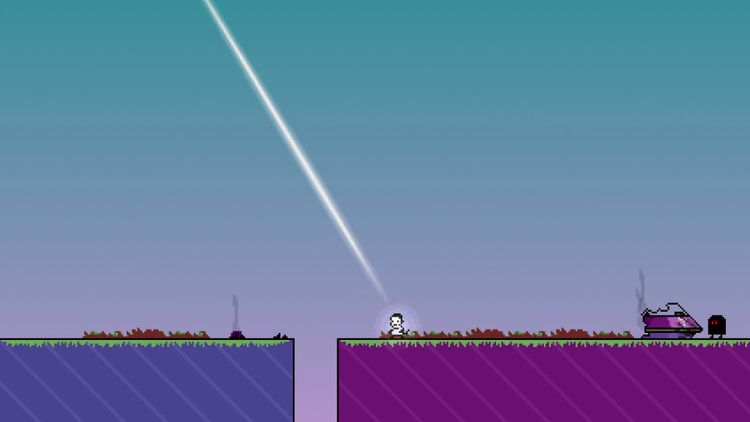
Quadrilateral Cowboy is among my favourite of hacking games that use the command line (it's ten years old next month) but it's an outlier in terms of its storytelling techniques. It's not limited to a glowing cursor on a dark screen, or a fake OS, but instead lets you carry your shady hacking "deck" (with its built-in 56k modem) along to the bank vaults and villas you intend to burgle. You're not alone on these capers, but one of a crew of lovable misfits. It's a heist game as much as a hacking game, and it has a playful, bright heart where most other hacking games are mired in paranoia and fear.
"I grew up mucking around with command-line interfaces, and Quadrilateral Cowboy was me sharing my experiences and feelings about it... Mainly, the feeling of learning a new language, of using it to help figure out your place in the world and connect with others."
And there it is, the kernel of nostalgia and community at the root of my fascination. The command line reminds me of a time when computers were mysterious boxes and the internet was uncharted territory, sure, but it's more than that. This was a time when I explored such worlds not scrolling alone with a thumb on a screen, but sitting in a swivelling chair next to family and friends. There's a lot of this feeling going around, clearly, and if our combined desire to play with words in the dark results in even more of these games, I'll happily type "help" a bunch more times.


Comments ()