Big concrete is taking over. There are now enough megastructures in games to justify a whole bundle on Steam. You may not be familiar with the term "megastructure" if you've not yet been cornered by your architecture-obsessed pal in the pub, or by your manga mate who keeps telling you to read Blame. It is basically an artificial space so huge you can't easily conceptualise it. One enormous planet-covering city encased in a shell. An orbital world many thousands of kilometers in circumference. Thatawful shopping mall in Edmonton, Alberta.
Big weird places that make you feel like an insignificant pipsqueak, essentially. Megastructures are not new to videogames. The subterranean complex of Portal 2 stretched further than fans of the first game would have guessed, and the cavernous corridors of Halo suggest a galaxy of long-lost giants. But now indie developers are increasingly exploring these colossal spaces. And small developers, it turns out, go pretty big.
"I spent quite a lot of time in my childhood staring out at vast roads from nearby hills full of little travelling dots," says Aleksandra Herout, developer of Metal Garden, a first-person shooter set in a drab land with a titanic concrete ceiling for a sky. "As the place I grew up in is a transport hub for the greater region, there was much of this architecture to be found in local landscapes.
"It wasn't just the size that made them stick with me, but also the sense of anticipation. The promise that this open road would lead me somewhere else. I kept returning to this feeling again and again throughout my life, and it very much impacted the visual language of Metal Garden."
'It is large enough if it makes your head spin and heart pound'
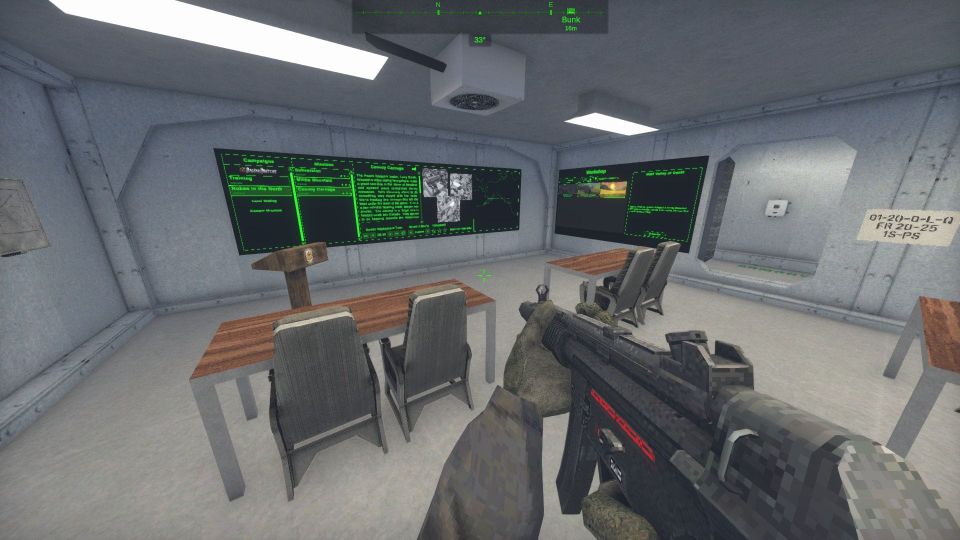
In Herout's 2-3 hour singleplayer shooter, you wander lonely hilltops and lurk through deep blocky catacombs, routinely blasting dark gunfolk and beefy catlads who - it is suggested - have caught wind of a priceless discovery: a way out of the structure. The shotguns and sniper rifles are straightforward, and the jetboot doublejump is as satisfying as equivalent leaps in Destiny 2. But it's the landscape that makes Metal Garden easy to recommend (plus it costs peanuts).
How ambition turned an open-world pioneer into a janky cult classic
Sometimes, when a dad squints at a monitor to assess their child's latest PC gaming obsession, they say exactly the right thing. Ilya Gulyaev's dad suggested that, if he liked modding Operation Flashpoint so much, he should seek out an apprenticeship.
"He literally told me to pick up a copy of a local PC gaming magazine, find an article about Ukrainian videogames in development, write down the company names, look them up in the phone book, and call them," Gulyaev says. "Back in those days, such a direct approach actually worked."
The year was 2003. Stalker: Shadow of Chernobyl was little more than a crackle on a Geiger counter, and Ukraine's development scene was in its nascency. "It was in an absolutely embryonic state," says Oleksandr Khrutskyi, who worked at Boiling Point developer Deep Shadows. "I think there were probably no more than one or two thousand people working in the games industry across the entire country."
The team grappled with open-world problems which hadn't been solved by the wider industry
Ukrainians had only a decade earlier detached themselves from the Soviet Union, but the resulting governmental flux was to the benefit of budding developers. "Weak tax policy and imperfect intellectual property laws opened great opportunities to anyone who understood how to operate a computer," says Oleksandr Honcharuk, who worked on Boiling Point as a 3D artist. "We received untaxed payment in the envelopes. If we wanted to try any software, we rode to the book market and bought any cracked software we wanted. Official versions we bought only for final compiling and exporting. These factors lowered the cost of the development dramatically."
Many entrants to this new field were self-taught enthusiasts, but even they were surprised to see Gulyaev walk into the rented three-room apartment that Deep Shadows called an office with his dad in tow. "Imagine our wonder," says Honcharuk. "Because he was only 15 years old." Nonetheless, Gulyaev proved himself as a 3D modeller, recreating an M167 Vulcan Air Defense System as a test assignment. "It ended up being used in the game because I did it well, receiving only two rounds of feedback for my first-ever real in-game asset," Gulyaev says. "After that, they felt confident giving me more work."
It's the second heatwave of the year in the UK right now. My PC quivers like angry blancmanche at the suggestion it perform even the laziest task, and Snickers ice creams melt down my palm and form crunchy bangles around my wrist before I can ferry them home to my face. Sol Cesto, you say? The sun has ceased? Sign me up!
But seriously, folks: the sun dying will actually wreak a terrible toll on the once-verdant earth and force you to eke out a dangerous living in monster-infested catacombs far beneath the soil. I love the concept of a dungeon that's marginally better lit than the surface, but it sucks down here. I keep being forced to shove gargoyle teeth into my gums, and there are massive magic bees everywhere.
The red and blue monsters switch affinity each time you move. I call them 'butt imps'.
Each screen of the dungeon consists of four rows of four squares each, and each turn you choose one row to move to, landing on a random square. Some contain traps or monsters, others treasure or healing strawberries. You always kill monsters, eat fruit, or collect treasure you land on, but traps stay. Monsters are aligned to either strength or magic, and your chosen hero has a numeric score in each. Land on a two strength monster with a one strength hero, lose one HP. Land on a three strengther, and lose two HP, and so on.
"That's so much HP!", you wail, cravenly, producing a non-zero amount of spittle. "Why would I ever click on a row with a monster I can't handle on it? Am I stupid?!". It's fine. All adventurers are stupid, it's part of the job description. The reason you'd do that is because it might be the only sensible choice. Click the all-monster top row, and you're guaranteed to take damage. Go for the bottom, and you've got a 75% chance of getting some treasure, but you might land on your third toxic mushroom and die instantly. The very basic idea is to make the least worst choice each turn until you've knocked out enough squares to move on.
Except you might not actually want to play it safe - you might want to snaffle up treasure so you can buy handy, single use items from the merchant to counter the spiraling difficulty: healing potions, monster-killing arrows, a die that rolls a new room. Or, you might want to save your coins to pop in the bucket that takes them to the surface. Surface gold is safe gold, spendable between runs to diversify the dungeon's offerings, and also on a few new characters and upgrades. So: village coffers, or personal glory?
It's a much zestier approach to roguelike upgrades than plain buffs, since you're often just buying the chance to benefit - expanding a pool of possibilities with few guarantees that, say, the merchant will have the toothpaste you just spent a fortune to unlock. And I love how bloody dungeony this all is. Everything is either elusive, expensive, a bit shit in ways you can imagine a fickle god getting a mild chuckle out of, or is some variety of monkey's paw, bottle imp, or that time Beat Saber added 3D stages but only for Imagine Dragons.
Good morning, videogames. What's the point of a lie-in when your bed is on the ground? I am, as this post is published, waking up - if indeed I slept at all - at a campsite, where I have been experiencing all the discomforts of the outdoors with a large contingent of children and animals. For that reason, I'm going to keep things brief this week, and hope that you enjoy your links from a comfier bed than my own.
Videogame studios aren't monoliths, writes Hayes Madsen, responding to an article that tried to draft fantasy developers for Microsoft IP from the burning remnants of last week's layoffs and divestments.
Xbox's franchise-first approach is bad for a number of reasons, but this kind of coverage is endemic of a major problem that has plagued games media for years, even decades - the idea that studios are monoliths. Studios make games, not the hundreds of people that make up a studio. I'm certainly not going to claim I haven't been guilty of the same thing in the past, but we need to do better.
I hadn't even heard of this game, but Lewis Gordon
Hello, enjoyers of Jank. I am informed there are a lot of new readers among you, swamping through the gates thanks to a brutal takedown of Dungeon Crawler Carl. Come in, come in, warm yourself by the burning effigy of Ernest Cline. I think you're going to like it here.
This newsletter is normally scribbled by Jonty. But this week he's missing, presumed on holiday. I'll do my best to fill your eyes with games industry newsbits in his absence. This will be difficult. I've been distracted because I have only this week learned of Jimothy, a creature which is either a raccoon in Seattle with shortened spine syndrome, or the latest cryptid stalking America, depending on who you ask. Anyway, I'll try. Onto the videogames.
We began the week with a brawl. The season finale of Character Select (in which we pit game characters against one another) saw Max Payne, Octodad, Dog from Half-Life 2, the Flood from Halo, and SkiFree's Yeti having a free-
Asha Sharma wants to call the recent layoffs at Xbox-owned game studios a "reset". This is because of the connotations the word brings - a reset is a mildly disruptive way to solve a problem. When your PC is being glitchy, a reset is kind of annoying, but it fixes things. When you have over-complicated a spreadsheet, a reset will take everything back to the start. A reset has the feel of icy water splashed on your face during a difficult day, a dive into a cold pool when your week is going bad. A clean slate. A fresh do-over. A reset is a brief but ultimately freeing moment of discomfort or inconvenience, followed by excitement at a new start.
This is not that. The wrecking ball currently crashing through Xbox is anything but cleansing. If we are to use a word or phrase to describe the ongoing layoffs, why not reach for words which truly reflect the human cost, impact and intent of the action. How about "bloodletting" or "demolition job"? What about "slash and burn"? This is an act of cutting, violent in its method, drastic in scope and ultimately a form of self-inflicted
Nothing makes me feel quite so motivated as a camping trip, and not in a good way. It's like when you get to the end of a long holiday and right before you're due to return to work, you feel this sudden burst of inspiration to do all the things you soon won't be able to. I could have started a running habit or become the sort of person who gets up at 6am and meditates, but alas, I'm going camping this weekend. I could have played all these new videogames, but alas, I'm going camping this weekend.
Here's what you could be playing. Tell us what you are playing in the comments below.
The latest game in the Detective Grimoire series, and another standalone mystery to solve. This one is a locked room murder, and unlike its predecessor, every clue is a 3D object you can rotate and explore in search of secrets. It's also fully voiced and wonderfully animated, if the trailers are any indication. I need to make time to play this.
Yet more selfless ideation for the industry's benefit
Total Playtime is now the official Jank podcast, formerly funded by Patreon. Every two weeks we publish a backer-only episode hosted by Alice Bell, Nate Crowley, Jonty and Brendan. You can listen to this and all previous Patreon-exclusive episodes by subscribing to Jank.
This week is a rare two-header, as Nate and I convened to workshop some future games in the Alien Isolation franchise, as a service to Creative Assembly once they’ve finished the second one. The results are… surprisingly plausible pitch ideas, although I foresee some real hassle getting the rights squared away.